Spectral entropy as an objective measure of sedation state in midazolam-premedicated patients
- PMID: 22754438
- PMCID: PMC3385254
- DOI: 10.4103/1658-354X.97025
Spectral entropy as an objective measure of sedation state in midazolam-premedicated patients
Abstract
Context: Objective assessment of sedation depth is a valuable target. Spectral entropy is an anesthetic depth monitor based on the analysis of the electroencephalogram signal.
Aims: To evaluate the performance of spectral entropy as an objective measure of sedation state in midazolam-premedicated patients and to correlate it with a clinically assessed sedation score.
Settings and design: This prospective double-blind placebo-controlled study was performed in King Fahd Hospital of the university.
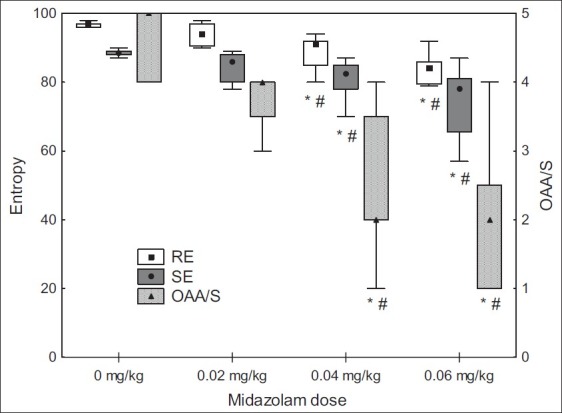
Methods: Eighty adult ASA I-II patients were randomly assigned into 4 groups. Patients were premedicated using 0.02, 0.04, or 0.06 mg/kg midazolam or saline intramuscularly. The effect of these doses on the Observer's Assessment of Alertness and Sedation (OAA/S) scale, hemodynamic variables, response entropy (RE), and state entropy (SE), was evaluated at 10, 20, and 30 min after premedication.
Statistical analysis: Spearman Rank-order correlation analysis to examine the relation between OAA/S and entropy. The ability of spectral entropy to predict the depth of sedation was evaluated using Smith prediction probability.
Results: Midazolam doses ≥0.04 mg/kg produced significant decreases in RE, SE, and OAA/S scores. There was a strong correlation between midazolam dose and OAA/S scale, RE, and SE since Spearman Rank R values were 0.792, 0.822, and 0.745, respectively (P<0.001). In addition, RE and SE were strong predictors of OAA/S level during midazolam sedation with no significant difference in prediction between the 2 entropy components.
Conclusions: Spectral entropy is a reliable measure for the sedative premedication. It may be used to objectively assess the adequacy of midazolam premedication and to determine the dose requirement.
Keywords: Monitoring; depth of anaesthesia; midazolam; observer's assessment of alertness and sedation; premedication; sedation.
Conflict of interest statement
Figures
References
-
- McCormick AS, Thomas VL, Berry D, Thomas PW. Plasma concentrations and sedation scores after nebulized and intranasal midazolam in healthy volunteers. Br J Anaesth. 2008;100:631–6. - PubMed
-
- Chernik DA, Gillings D, Laine H, Hendler J, Silver JM, Davidson AB, et al. Validity and reliability of the observer's assessment of alertness/sedation scale: Study with intravenous midazolam. J Clin Psychopharmacol. 1990;10:244–51. - PubMed
-
- Hirota K, Matsunami K, Kudo T, Ishihara H, Matsuki A. Relation between bispectral index and plasma catecholamines after oral diazepam premedication. Eur J Anaesthesiol. 1999;16:516–8. - PubMed
-
- Hogarth DK, Hall J. Management of sedation in mechanically ventilated patients. Curr Opin Crit Care. 2004;10:40–6. - PubMed
-
- Voss L, Sleigh J. Monitoring consciousness: The current status of EEG-based depth of anaesthesia monitors. Best Pract Res Clin Anaesthesiol. 2007;21:313–25. - PubMed