Two series of familial cases with unclassified interstitial pneumonia with fibrosis
- PMID: 22754718
- PMCID: PMC3378931
- DOI: 10.4168/aair.2012.4.4.240
Two series of familial cases with unclassified interstitial pneumonia with fibrosis
Abstract
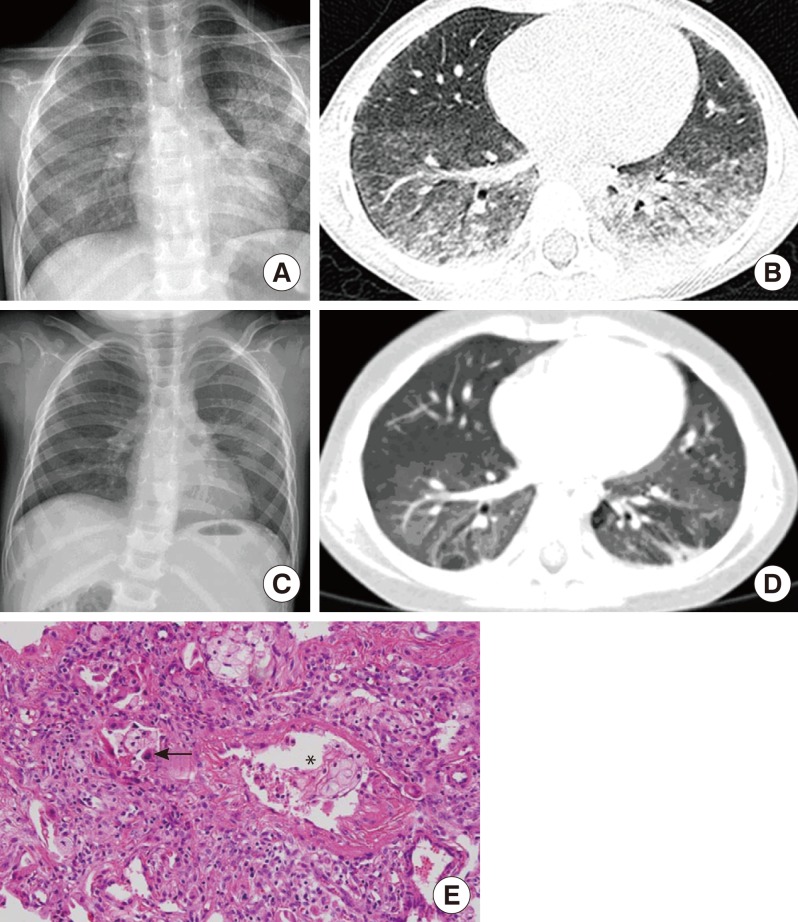
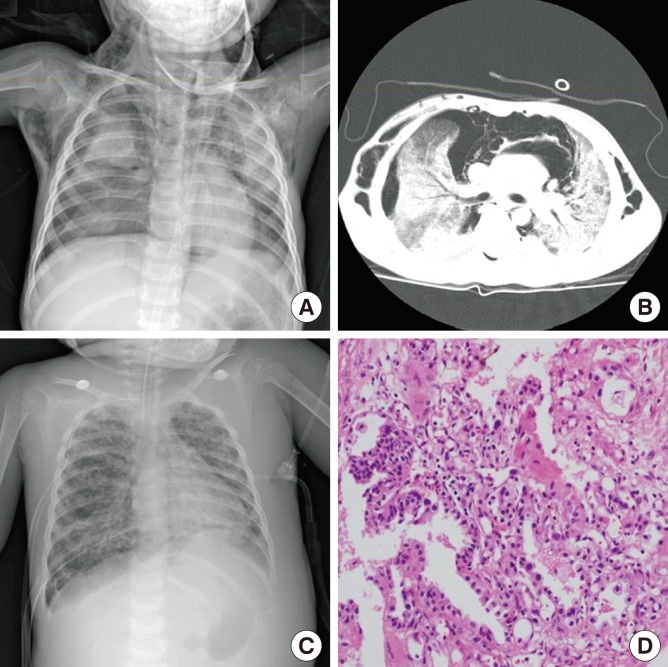
Several children presenting with mild symptoms of respiratory tract infection were diagnosed with unclassified interstitial pneumonia with fibrosis. Their clinical and radiological findings were similar to those of acute interstitial pneumonia, but there were some differences in the pathological findings. Unclassified interstitial pneumonia with fibrosis is characterized by histological findings of centrilobular distribution of alveolar damage and bronchiolar destruction with bronchiolar obliteration. This report describes two different series of familial cases of unclassified interstitial pneumonia with fibrosis, which developed almost simultaneously in the spring. Some of the individual cases showed rapidly progressive respiratory failure of unknown cause, with comparable clinical courses and similar radiological and pathological features, including lung fibrosis. Each family member was affected almost simultaneously in the spring, different kinds of viruses were detected in two patients, and all members were negative for bacterial infection, environmental and occupational agents, drugs, and radiation. These findings implicate a viral infection and/or processes related to a viral infection, such as an exaggerated or altered immune response, or an unknown inhaled environmental agent in the pathogenesis of unclassified interstitial pneumonia with fibrosis.
Keywords: Interstitial pneumonia; environment; family; fibrosis; respiratory tract infections.
Conflict of interest statement
There are no financial or other issues that might lead to conflict of interest.
Figures
References
-
- American Thoracic Society; European Respiratory Society. American Thoracic Society/European Respiratory Society International Multidisciplinary Consensus Classification of the Idiopathic Interstitial Pneumonias. This joint statement of the American Thoracic Society (ATS), and the European Respiratory Society (ERS) was adopted by the ATS board of directors, June 2001 and by the ERS Executive Committee, June 2001. Am J Respir Crit Care Med. 2002;165:277–304. - PubMed
-
- Cheon CK, Jin HS, Kang EK, Kim HB, Kim BJ, Yu J, Park SJ, Hong SJ, Park JD. Epidemic acute interstitial pneumonia in children occurred during the early 2006s. Korean J Pediatr. 2008;51:383–390.
-
- Kim BJ, Kim HA, Song YH, Yu J, Kim S, Park SJ, Kim KW, Kim KE, Kim DS, Park JD, Ahn KM, Kim HB, Jung HM, Kang C, Hong SJ. Nationwide surveillance of acute interstitial pneumonia in Korea. Korean J Pediatr. 2009;52:324–329.
-
- Katzenstein AL, Myers JL, Mazur MT. Acute interstitial pneumonia. A clinicopathologic, ultrastructural, and cell kinetic study. Am J Surg Pathol. 1986;10:256–267. - PubMed
-
- Bouros D, Nicholson AC, Polychronopoulos V, du Bois RM. Acute interstitial pneumonia. Eur Respir J. 2000;15:412–418. - PubMed