Histamine H3 receptor antagonists in relation to epilepsy and neurodegeneration: a systemic consideration of recent progress and perspectives
- PMID: 22758607
- PMCID: PMC3514756
- DOI: 10.1111/j.1476-5381.2012.02093.x
Histamine H3 receptor antagonists in relation to epilepsy and neurodegeneration: a systemic consideration of recent progress and perspectives
Abstract
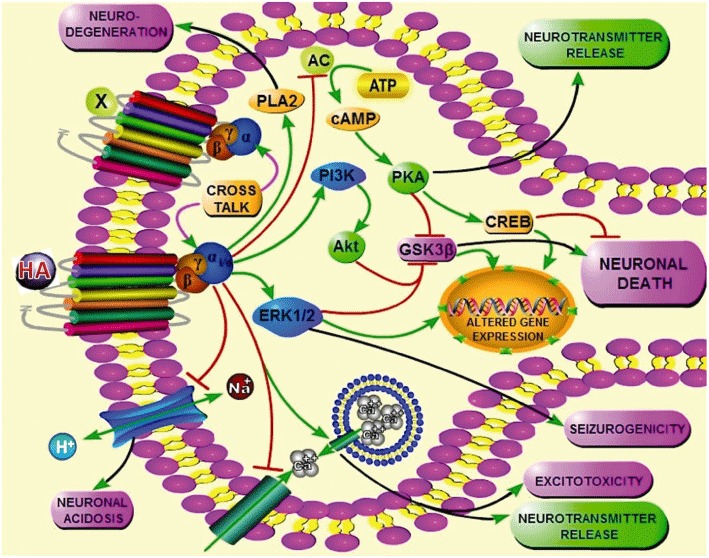
The central histaminergic actions are mediated by H(1) , H(2) , H(3) and H(4) receptors. The histamine H(3) receptor regulates the release of histamine and a number of other neurotransmitters and thereby plays a role in cognitive and homeostatic processes. Elevated histamine levels suppress seizure activities and appear to confer neuroprotection. The H(3) receptors have a number of enigmatic features like constitutive activity, interspecies variation, distinct ligand binding affinities and differential distribution of prototypic splice variants in the CNS. Furthermore, this Gi/Go-protein-coupled receptor modulates several intracellular signalling pathways whose involvement in epilepsy and neurotoxicity are yet to be ascertained and hence represent an attractive target in the search for new anti-epileptogenic drugs. So far, H(3) receptor antagonists/inverse agonists have garnered a great deal of interest in view of their promising therapeutic properties in various CNS disorders including epilepsy and related neurotoxicity. However, a number of experiments have yielded opposing effects. This article reviews recent works that have provided evidence for diverse mechanisms of antiepileptic and neuroprotective effects that were observed in various experimental models both in vitro and in vivo. The likely reasons for the apparent disparities arising from the literature are also discussed with the aim of establishing a more reliable basis for the future use of H(3) receptor antagonists, thus improving their utility in epilepsy and associated neurotoxicity.
© 2012 The Authors. British Journal of Pharmacology © 2012 The British Pharmacological Society.
Figures
References
-
- Acharya JN. Recent advances in epileptogenesis. Curr Sci. 2002;82:679–688.
-
- Adachi N. Cerebral ischemia and brain histamine. Brain Res Rev. 2005;50:275–286. - PubMed
-
- Adachi N, Itoh Y, Oishi R, Saeki K. Direct evidence for increased continuous histamine release in the striatum of conscious freely moving rats produced by middle cerebral artery occlusion. J Cereb Blood Flow Metab. 1992;12:477–483. - PubMed
-
- Adachi N, Oishi R, Itano Y, Yamada T, Hirakawa M, Saeki K. Aggravation of ischemic neuronal damage in the rat hippocampus by impairment of histaminergic neurotransmission. Brain Res. 1993;602:165–168. - PubMed
Publication types
MeSH terms
Substances
LinkOut - more resources
Full Text Sources
Other Literature Sources
Medical