Review
doi: 10.2174/157340311799960645.
Anthracycline cardiotoxicity: prevalence, pathogenesis and treatment
Affiliations
- PMID: 22758622
- PMCID: PMC3322439
- DOI: 10.2174/157340311799960645
Item in Clipboard
Review
Anthracycline cardiotoxicity: prevalence, pathogenesis and treatment
Curr Cardiol Rev.
2011 Nov.
Abstract
Anthracyclines, such as doxorubicin and idarubicin, remain an important class of chemotherapeutic agents. Unfortunately, their efficacy in treating cancer is limited by a cumulative dose-dependent cardiotoxicity, which can cause irreversible heart failure. In this review, we discuss the pathogenesis and incidence of anthracycline-induced cardiotoxicity as well as methods to detect, prevent and treat the condition.
Figures
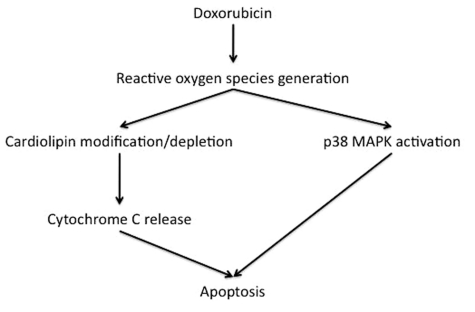
Cellular mechanisms responsible for increased apoptosis in cardiac myocytes by doxorubicin.
References
-
- Di Marco A, Cassinelli G, Arcamone F. The discovery of daunorubicin. Cancer. Treat Rep. 1981;4 (65 Suppl ):3–8. - PubMed
-
- Tan C, Tasaka H, Yu KP, Murphy ML, et al. Daunomycin an antitumor antibiotic, in the treatment of neoplastic disease Clinical evaluation with special reference to childhood leukemia. Cancer. 1967;20(3 ):333–53. - PubMed
-
- Arcamone F, Cassinelli G, Fantini G, et al. Adriamycin 14-hydroxydaunomycin, a new antitumor antibiotic from S peucetius var caesius. Biotechnol Bioeng. 1969;11(6 ):1101–10. - PubMed
-
- Di Marco A, Gaetani M, Scarpinato B. Adriamycin (NSC-123 127) a new antibiotic with antitumor activity. Cancer Chemother Rep. 1969;53(1 ):33–7. - PubMed
-
- Lefrak EA, Pitha J, Rosenheim S, Gottlieb JA. A clinicopathologic analysis of adriamycin cardiotoxicity. Cancer. 1973;32(2 ):302–14. - PubMed
Publication types
MeSH terms
Substances
LinkOut - more resources
Full Text Sources
Other Literature Sources
Medical