


Depressive symptomatology, psychological stress, and ovarian reserve: a role for psychological factors in ovarian aging?
- PMID: 22760086
- PMCID: PMC3465629
- DOI: 10.1097/gme.0b013e31825540d8
Depressive symptomatology, psychological stress, and ovarian reserve: a role for psychological factors in ovarian aging?
Abstract
Objective: The aim of this study was to examine psychological factors in relation to antral follicle count (AFC), a marker of ovarian reserve, in a multiethnic sample of 683 premenopausal women in the Ovarian Aging (OVA) Study.
Methods: In cross-sectional analyses, linear regression was performed to determine whether AFC decline across women varied over levels of depression as well as depression in combination with psychological stress. The total and subscale scores of the Center for Epidemiological Studies Depression Scale were used to measure depression, and the Perceived Stress Scale was used to measure psychological stress.
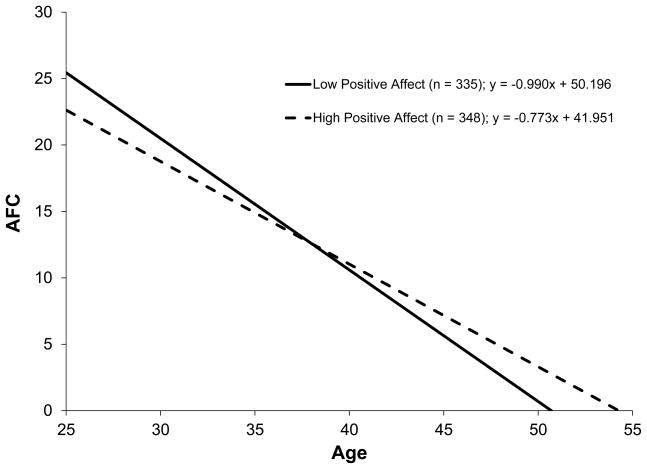
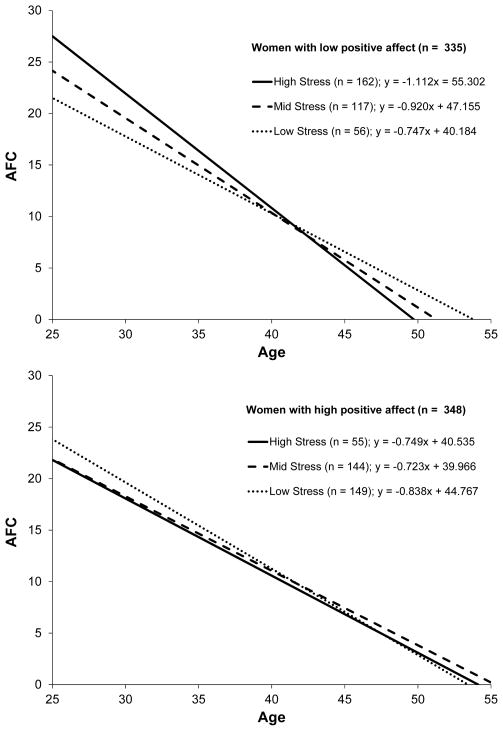
Results: After covariate adjustment, the two-way interaction of age × positive affect and the three-way interaction of age × positive affect × stress were related to AFC (b = 0.047, P = 0.036; b = 0.012, P = 0.099, respectively). In stratified analyses, stress was related to AFC in women with low positive affect (b = -0.070, P = 0.021) but not in women with high positive affect (b = 0.018, P = 0.54). AFC decline across women was progressively higher in women with low positive affect who reported low (-0.747 follicles/year), mid (-0.920 follicles/year), and high (-1.112 follicles/year) levels of stress. Results examining the Center for Epidemiological Studies Depression Scale total and remaining subscale scores were all nonsignificant (P values > 0.05).
Conclusions: Cross-sectional evidence suggests that (1) women with low positive affect may experience accelerated AFC decline and (2) low positive affect may be a vulnerability factor, or, alternatively, high positive affect may be a protective factor, in moderating the negative effects of psychological stress on AFC decline.
Conflict of interest statement
No author has a conflict of interest to declare.
Figures
Comment in
-
Mood and the aging ovary.Menopause. 2012 Nov;19(11):1167-8. doi: 10.1097/gme.0b013e31826e3cc2. Menopause. 2012. PMID: 23103751 No abstract available.
References
-
- Wolkowitz OM, Epel ES, Reus VI, Mellon SH. Depression gets old fast: Do stress and depression accelerate cell aging? Depress Anxiety. 2010;27(4):327–338. - PubMed
-
- Wolkowitz OM, Epel ES, Mellon S. When blue turns to grey: Do stress and depression accelerate cell aging? World J Biol Psychiatry. 2008;9(1):2–5. - PubMed
-
- Simon NM, Smoller JW, McNamara KL, et al. Telomere shortening and mood disorders: Preliminary support for a chronic stress model of accelerated aging. Biol Psychiatry. 2006;60(5):432–435. - PubMed
