. 2012 Jun;245(5-6):333-44.
doi: 10.1007/s00232-012-9454-2. Epub 2012 Jul 4.

Connexin composition in apposed gap junction hemiplaques revealed by matched double-replica freeze-fracture replica immunogold labeling

Affiliations

Connexin composition in apposed gap junction hemiplaques revealed by matched double-replica freeze-fracture replica immunogold labeling

John E Rash et al. J Membr Biol. 2012 Jun.

Abstract

Despite the combination of light-microscopic immunocytochemistry, histochemical mRNA detection techniques and protein reporter systems, progress in identifying the protein composition of neuronal versus glial gap junctions, determination of the differential localization of their constituent connexin proteins in two apposing membranes and understanding human neurological diseases caused by connexin mutations has been problematic due to ambiguities introduced in the cellular and subcellular assignment of connexins. Misassignments occurred primarily because membranes and their constituent proteins are below the limit of resolution of light microscopic imaging techniques. Currently, only serial thin-section transmission electron microscopy and freeze-fracture replica immunogold labeling have sufficient resolution to assign connexin proteins to either or both sides of gap junction plaques. However, freeze-fracture replica immunogold labeling has been limited because conventional freeze fracturing allows retrieval of only one of the two membrane fracture faces within a gap junction, making it difficult to identify connexin coupling partners in hemiplaques removed by fracturing. We now summarize progress in ascertaining the connexin composition of two coupled hemiplaques using matched double-replicas that are labeled simultaneously for multiple connexins. This approach allows unambiguous identification of connexins and determination of the membrane "sidedness" and the identities of connexin coupling partners in homotypic and heterotypic gap junctions of vertebrate neurons.


Figures
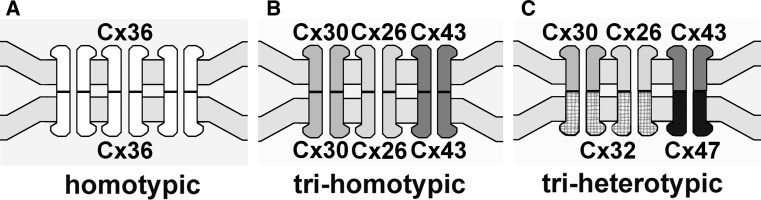
Fig. 1
Fig. 1
Generalized models of different connexin coupling patterns in the most common type of gap junctions in the CNS. a “Homotypic” neuronal gap junction, with intercellular channels composed of Cx36 coupling with Cx36. b “Trihomotypic” astrocyte-to-astrocyte gap junction, with intercellular channels composed of Cx43 coupling with Cx43, Cx30 coupling with Cx30 and Cx26 coupling with Cx26. c “Triheterotypic” astrocyte-to-oligodendrocyte gap junction, with astrocyte Cx43 coupling with oligodendrocyte Cx47, astrocyte Cx30 coupling with oligodendrocyte Cx32 and astrocyte Cx26 coupling with oligodendrocyte Cx32. Additional permissive coupling pairs are discussed in the text
Fig. 2
Fig. 2
Comparison of limits of resolution of light microscopy (a) with ultrastructural resolution (b, c). a Neurons double-stained for Cx43 (green fluorescence) and the neuronal marker MAP-2 (red fluorescence) but without visualization of intervening glial cells. Without companion bright-field or differential interference optics to reveal other cell types, it is not possible to assign Cx43 unambiguously to the visualized cells, regardless of apparent close proximity. This deficiency is implicit in representative thin-section TEM images. b Modified from Peters et al. (1991). The limits of resolution in the blue and red wavelengths are indicated by superimposed red and blue discs, each of which overlaps cell margins of all three cell types, as well as multiple cytoplasmic membranes. c Two neuronal dendritic processes (red overlays), with a gap junction linking two thin intervening astrocyte processes (blue overlays). The astrocyte gap junction (shown at higher magnification in the inset) is double-labeled for Cx26 (12 nm gold) and Cx30 (20 nm gold). The limits of resolution in the x, y and z axes are indicated by the inscribed three-dimensional box, which corresponds to a single voxel (volume pixel) at the limit of resolution of confocal LM. If this region had been visualized by LM, with neurons stained red, astrocytes and oligodendrocytes not stained and connexins visualized using green fluorescence (as in a), Cx26 and Cx30 would have appeared to be localized to the decussating, small-diameter neuronal processes. Crossing red arrows indicate the limit of LM resolution in the red wavelength, suggesting that these two neuronal processes would have been in direct contact, with no room for intervening astrocyte processes. Barred Circle = gold bead on top of replica, as "noise" (Rash and Yasumura 1999). d, e “Serial sections in which gold–silver labeling for Cx32 (straight open arrows) was identified on the cytoplasmic surface of a peroxidase-labeled TH dendrite and in an apposed glial process (asterisks) that separates two TH-positive dendrites from one another” (Alvarez-Maubecin et al. 2000). However, we note that Cx32 is an oligodendrocyte connexin and is not found in astrocytes, nor has it been detected in ultrastructurally defined neuronal gap junctions, so we consider these images to represent background “noise” on two nonserial sections, each showing an astrocyte process between two different sets of TH neurons. Calibration bars 0.2 μm. f Comparison FRIL image of two neuronal gap junctions (red overlays) in adult rat retina that were immunogold-labeled for Cx36 (13- and three 20-nm gold beads). Unlabeled glutamate receptor postsynaptic density (yellow overlay). Modified from Rash et al. (2001). Calibration bars 0.1 μm, unless otherwise indicated
Fig. 3
Fig. 3
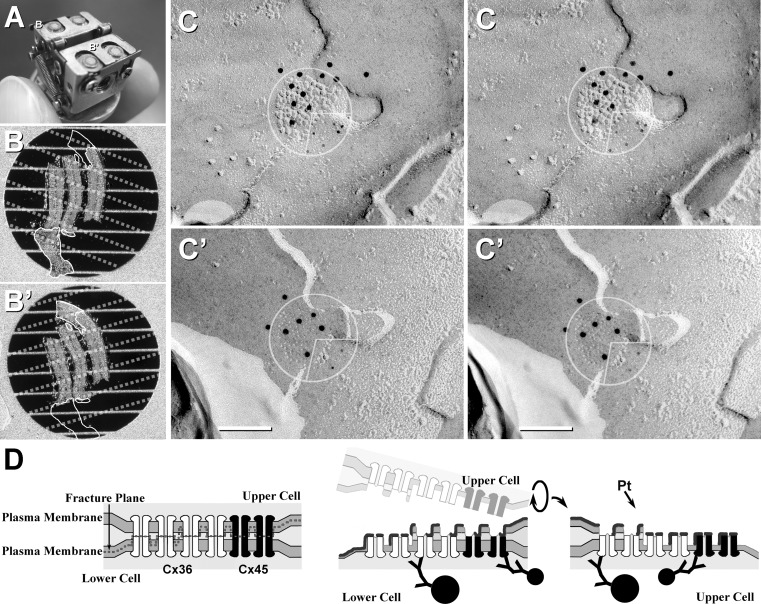
Explanation of the DR-FRIL technique. a Photograph of the DR stage after fracturing of two specimens. Matched DR samples (indicated by B and B′ in a) are shown at higher magnification in b, b′), after floating off into buffer. b, b′ Replicated but undigested samples were mounted on thin-bar grids, with matching outlines indicated. Small tissue fragments were lost during washing (open outlines opposite corresponding outlined tissues). Bars occluding matching areas are indicated by dotted lines. c, c′ One of 11 pairs of matched gap junction hemiplaques (circles with inscribed quadrants) from the samples indicated in b, b′. Cx45 is labeled with 5-nm gold beads (lower right quadrants), whereas Cx36 is labeled with 10-nm gold beads (upper left three quadrants c, c′). Labeling for Cx45 is aligned with (i.e., opposite) labeling for Cx45 in the matching areas of the two hemiplaques. Likewise, labeling for Cx36 is aligned with labeling for Cx36. These matching hemiplaques demonstrate bihomotypic gap junctions. b, c Modified from Li et al. (2008a). d Diagram showing production of matched DRs and the subsequent immunogold labeling of bihomotypic plaques containing mostly Cx36 (white connexons labeled with large gold beads) and fewer Cx45 (black connexons, labeled with small gold beads)
Fig. 4
Fig. 4
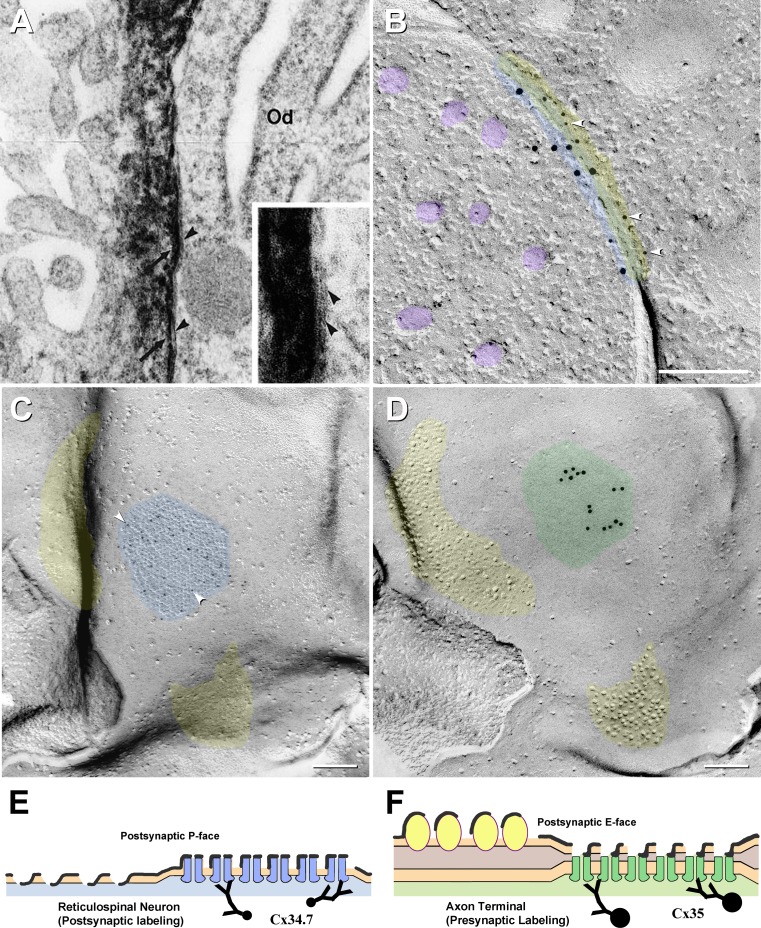
Comparison of heterotypic labeling in TEM thin sections (a), cross-fractured FRIL images (b) and by the DR-FRIL technique (c, d), with explanatory drawing (e, f). a Thin-section immunocytochemical demonstration of Cx43 in the astrocyte side of an O:A gap junction, labeled by the peroxidase–antiperoxidase method, leaving DAB deposition on the astrocyte side (arrows) and the oligodendrocyte side (Od) unlabeled (arrowheads). [This image was obtained 10 years before Cx47 was identified as the coupling partner for Cx43; modified from Ochalski et al. (1997)]. b Cross-fractured “mixed” (electrical plus chemical synapse), presumably from an auditory afferent onto an unidentified reticulospinal neuron in goldfish hindbrain. In this companion image to (c), 5-nm gold beads labeled postsynaptic connexin Cx34.7 (arrowheads), whereas 10-nm gold beads for Cx35 labeled presynaptic connexins. (Synaptic vesicles are indicated by purple overlays.) The yellow overlay indicates the radius of uncertainty of immunogold labeling for small gold beads, the blue overlay indicates the radius of uncertainty for large gold beads and the green overlay indicates the region of potential overlap. This asymmetric distribution of gold labels reveals that this gap junction between a sensory afferent and the reticulospinal neuron is heterotypic. c, d Matching complementary replicas at club ending synapse on reticulospinal neuron. The postsynaptic hemiplaque (c, designated by blue overlay) is labeled for Cx34.7 by approximately three 5-nm gold beads (arrowheads), whereas the complementary E-face (green overlay) is labeled for Cx35 by 15 10-nm gold beads. Areas corresponding to glutamate receptor–containing postsynaptic densities are indicated by yellow overlays, with the P-face pits in c matching the E-face particles in (b), as previously shown by labeling for glutamate receptors (Pereda et al. 2003). e, f Diagram of matching replica complements, showing Cx34.7 without Cx35 in the reticulospinal neuron (e) and Cx35 labeling without labeling for Cx34.7 in the E-face of the matching hemiplaque of the apposed club ending. Labeling in (d) and (f) is for connexins in the cytoplasm of the underlying axon terminal ending, even though only the E-face pits of the reticulospinal neuron are visualized in the replica

References

    1. Altevogt BM, Paul DL. Four classes of intercellular channels between glial cells in the CNS. J Neurosci. 2004;24:4313–4323. doi: 10.1523/JNEUROSCI.3303-03.2004. - DOI - PMC - PubMed
    1. Altevogt BM, Kleopas KA, Postma FR, Scherer SS, Paul D. Connexin29 is uniquely distributed within myelinating glial cells of the central and peripheral nervous systems. J Neurosci. 2002;22:6458–6470. - PMC - PubMed
    1. Alvarez-Maubecin V, Garcia-Hernandez F, Williams JT, Van Bockstaele EJ. Functional coupling between neurons and glia. J Neurosci. 2000;20:4091–4098. - PMC - PubMed
    1. Barrio LC, Suchyna T, Bargiello T, Xu LX, Roginski RS, Bennett MVL, Nicholson BJ. Gap junctions formed by connexins26 and 32 alone and in combination are differently affected by applied voltage. Proc Natl Acad Sci USA. 1991;88:8410–8414. doi: 10.1073/pnas.88.19.8410. - DOI - PMC - PubMed
    1. Bartel DP. MicroRNAs: genomics, biogenesis, mechanism, and function. Cell. 2004;116:281–297. doi: 10.1016/S0092-8674(04)00045-5. - DOI - PubMed

Publication types

LinkOut - more resources