Review
. 2012 Sep;86(18):9558-65.
doi: 10.1128/JVI.00357-12. Epub 2012 Jul 3.

Pangaea and the Out-of-Africa Model of Varicella-Zoster Virus Evolution and Phylogeography

Affiliations
Review

Pangaea and the Out-of-Africa Model of Varicella-Zoster Virus Evolution and Phylogeography

Charles Grose. J Virol. 2012 Sep.

Abstract

The goal of this minireview is to provide an overview of varicella-zoster virus (VZV) phylogenetics and phylogeography when placed in the broad context of geologic time. Planet Earth was formed over 4 billion years ago, and the supercontinent Pangaea coalesced around 400 million years ago (mya). Based on detailed tree-building models, the base of the phylogenetic tree of the Herpesviridae family has been estimated at 400 mya. Subsequently, Pangaea split into Laurasia and Gondwanaland; in turn, Africa rifted from Gondwanaland. Based on available data, the hypothesis of this minireview is that the ancestral alphaherpesvirus VZV coevolved in simians, apes, and hominins in Africa. When anatomically modern humans first crossed over the Red Sea 60,000 years ago, VZV was carried along in their dorsal root ganglia. Currently, there are five VZV clades, distinguishable by single nucleotide polymorphisms. These clades likely represent continued VZV coevolution, as humans with latent VZV infection left Arabia and dispersed into Asia (clades 2 and 5) and Europe (clades 1, 3, and 4). The prototype VZV sequence contains nearly 125,000 bp, divided into 70 open reading frames. Generally, isolates within a clade display >99.9% identity to one another, while members of one clade compared to a second clade show 99.8% identity to one another. Recently, four different VZV genotypes that do not segregate into the previously defined five clades have been identified, a result indicating a wider than anticipated diversity among newly collected VZV strains around the world.


Figures
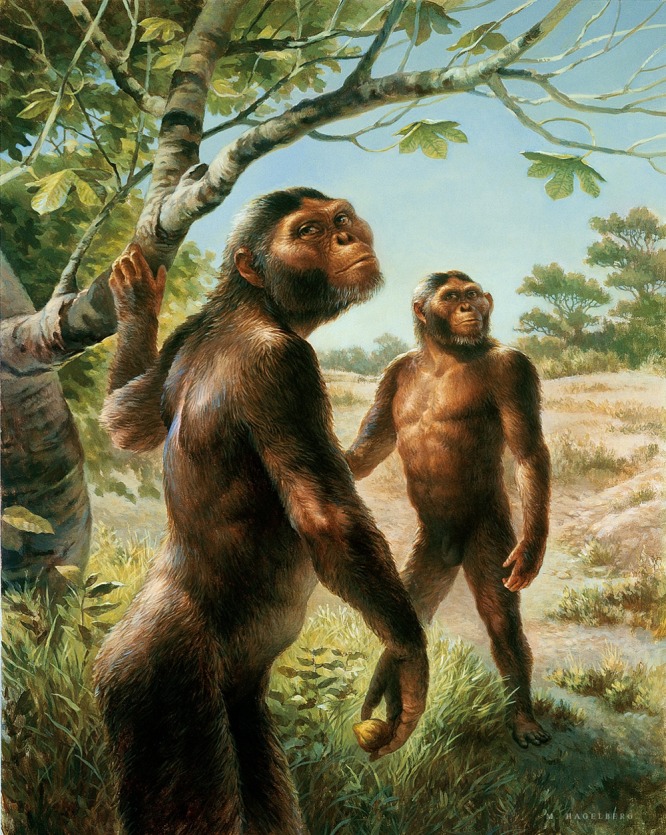
Fig 1
Fig 1
Illustration of Lucy and Tembo Australopithecus based on the hominin fossils recovered in East Africa. These hominins lived over 3 mya in the current country of Ethiopia in East Africa (22, 23). Based on phylogenetic data presented in this minireview, Australopithecans were infected with ancestral VZV. Illustration prepared by and reproduced with permission of Michael Hagelberg, Institute of Human Origins, Arizona State University, Tempe, AZ.
Fig 2
Fig 2
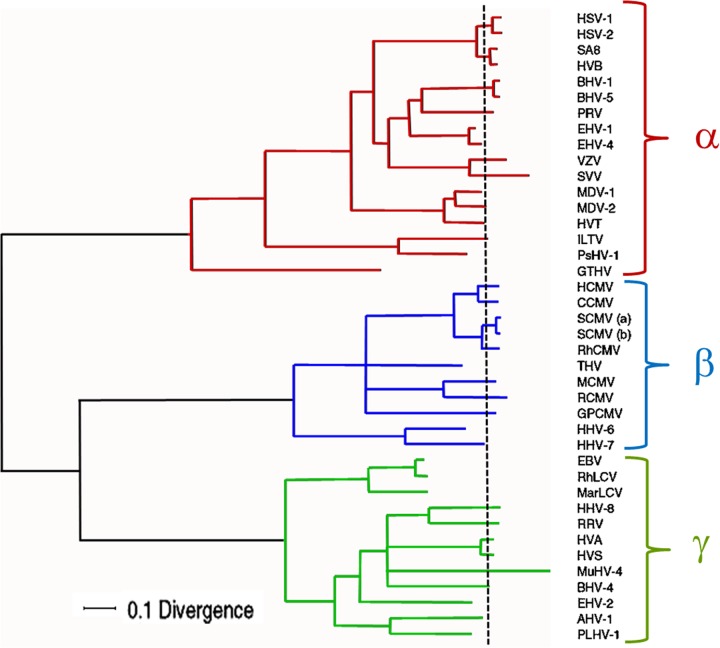
Phylogenetic tree for the family Herpesviridae. A phylogenetic tree was constructed based on an alignment of amino acid sequences for six shared genes from 40 different herpesviral species within all three subfamilies. The genes included the orthologs of VZV ORF28, ORF29, ORF30, ORF31, ORF40, and ORF42. Initial tree evaluation utilized a Bayesian Monte Carlo Markov chain process. The root of the tree was estimated as the midpoint between the mean tip positions of terminal branches in the alphaherpesviruses (α) and those in the betaherpesviruses (β) plus gammaherpesviruses (γ). The mean tip position is marked with a vertical dashed line. A divergence scale is shown at the bottom of the figure. Abbreviations for the 40 viruses are as follows: HSV-1, herpes simplex virus 1; HSV-2, herpes simplex virus 2; SA-8, simian agent 8; HVB, herpesvirus B; BHV-1, bovine herpesvirus 1; BHV-5, bovine herpesvirus 5; PRV, pseudorabies virus; EHV-1, equid herpesvirus 1; EHV-4, equid herpesvirus 4; VZV, varicella-zoster virus; SVV, simian varicella virus; MDV-1, Marek's disease virus type 1; MDV-2, Marek's disease virus type 2; HVT, herpesvirus of turkeys; ILTV, infectious laryngotracheitis virus; PsHV-1, psittacid herpesvirus 1; GTHV, green turtle herpesvirus; HCMV, human cytomegalovirus; CCMV, chimpanzee cytomegalovirus; SCMV (a) and SCMV (b), simian cytomegalovirus; RhCMV, rhesus cytomegalovirus; THV, tupaiid herpesvirus; MCMV, murine cytomegalovirus; RCMV, rat cytomegalovirus; HHV-6, human herpesvirus 6; HHV-7, human herpesvirus 7; EBV, Epstein-Barr virus; RLV, rhesus lymphocryptovirus; MarLCV, marmoset herpesvirus; HHV-8, human herpesvirus 8; RRV, rhesus rhadinovirus; HVA, herpesvirus ateles; HVS, herpesvirus saimiri; MuHV-4, murid herpesvirus 4; BHV-4, bovine herpesvirus 4; EHV-2, equid herpesvirus 2; AHV-1, alcelaphine herpesvirus 1; PLHV-1, porcine herpesvirus 1. Reprinted from Virus Research (31) with permission of the publisher.
Fig 3
Fig 3
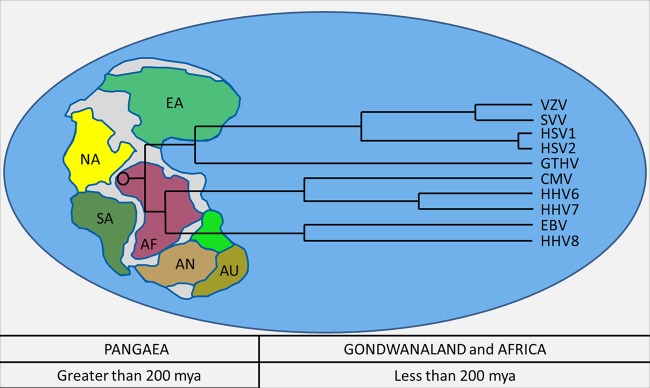
The age of Pangaea and the emergence of herpesviruses. Based on data provided in several reports cited in this minireview, the herpesviruses arose 400 mya in ancestral synapsids and sauropsids, during or even before formation of the supercontinent of Pangaea. Among the most ancient viral species are the GTHV strains, which infect green sea turtles (Chelonia mydas) (16, 42). This reptilian alphaherpesvirus continues to be found in green turtles in the Atlantic and Pacific Oceans (26). By analogy, it is likely that similarly ancient beta- and gammaherpesviruses existed within sauropsids at the time of Pangaea, as illustrated in the tree. Current human herpesviruses arose after Pangaea had separated into Gondwanaland and subsequently into Africa (<200 mya). Abbreviations within Pangaea: EA, Europe/Asia; NA, North America; SA, South America; AF, Africa; AN, Antarctica; and AU, Australia.
Fig 4
Fig 4
Phylogeography of VZV clades around the world. Based on the data in this minireview, the most likely explanation for VZV dispersal around the world is by VZV coevolution with modern humans as humans with latent varicella infection migrated out of Africa around 60 to 100 kya into Arabia and then onward to Asia and Europe. In 2008, five clades were recognized after a VZV consensus nomenclature meeting (5). Further information about the clades is found in the text. The most recent ancestor to the five VZV clades remains to be defined.

References

    1. Anthony DA. 2007. The horse, the wheel, and language: how Bronze Age riders from the Eurasian steppes shaped the modern world. Princeton University Press, Princeton, NJ
    1. Atkinson QD, Gray RD, Drummond AJ. 2008. mtDNA variation predicts population size in humans and reveals a major Southern Asian chapter in human prehistory. Mol. Biol. Evol. 25:468–474 - PubMed
    1. Barrett-Muir W, et al. 2003. Genetic variation of varicella-zoster virus: evidence for geographical separation of strains. J. Med. Virol. 70(Suppl. 1):S42–S47 - PubMed
    1. Benton MJ, Donoghue PC. 2007. Paleontological evidence to date the tree of life. Mol. Biol. Evol. 24:26–53 - PubMed
    1. Breuer J, Grose C, Norberg P, Tipples G, Schmid DS. 2010. A proposal for a common nomenclature for viral clades that form the species varicella-zoster virus: summary of VZV Nomenclature Meeting 2008, Barts and the London School of Medicine and Dentistry, 24–25 July 2008. J. Gen. Virol. 91:821–828 - PMC - PubMed

MeSH terms

LinkOut - more resources