. 2012 Sep;86(18):9866-74.
doi: 10.1128/JVI.01190-12. Epub 2012 Jul 3.

Binding of cellular export factor REF/Aly by Kaposi's sarcoma-associated herpesvirus (KSHV) ORF57 protein is not required for efficient KSHV lytic replication

Affiliations

Binding of cellular export factor REF/Aly by Kaposi's sarcoma-associated herpesvirus (KSHV) ORF57 protein is not required for efficient KSHV lytic replication

Da-Jiang Li et al. J Virol. 2012 Sep.

Abstract

Kaposi's sarcoma-associated herpesvirus (KSHV) ORF57 protein is expressed early during lytic KSHV replication, enhances expression of many KSHV genes, and is essential for virus production. ORF57 is a member of a family of proteins conserved among all human and many animal herpesviruses that are multifunctional regulators of gene expression and act posttranscriptionally to increase accumulation of their target mRNAs. The mechanism of ORF57 action is complex and may involve effects on mRNA transcription, stability, and export. ORF57 directly binds to REF/Aly, a cellular RNA-binding protein component of the TREX complex that mediates RNA transcription and export. We analyzed the effects of an ORF57 mutation known to abrogate REF/Aly binding and demonstrate that the REF-binding mutant is impaired in activation of viral mRNAs and noncoding RNAs confined to the nucleus. Although the inability to bind REF leads to decreased ORF57 activity in enhancing gene expression, there is no demonstrable effect on nuclear export of viral mRNA or the ability of ORF57 to support KSHV replication and virus production. These data indicate that REF/Aly-ORF57 interaction is not essential for KSHV lytic replication but may contribute to target RNA stability independent of effects on RNA export, suggesting a novel role for REF/Aly in viral RNA metabolism.


Figures
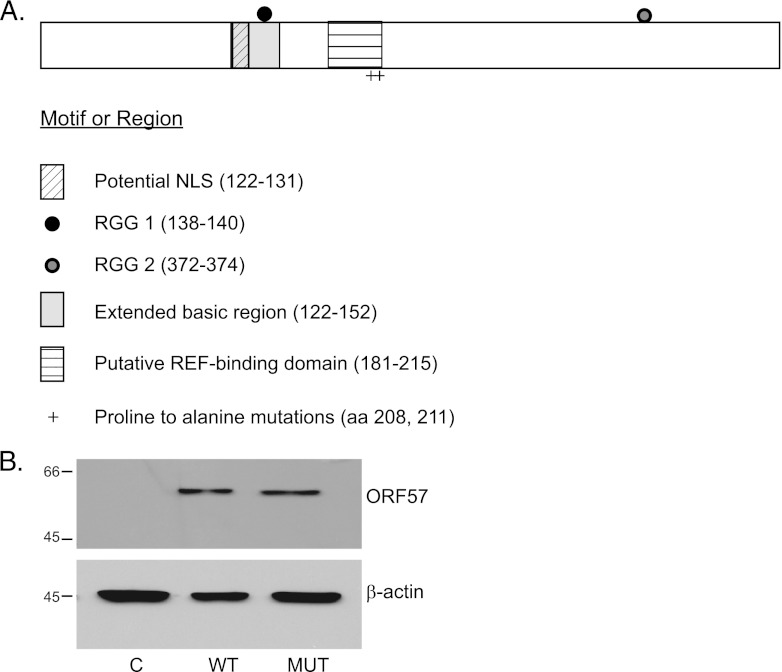
Fig 1
Fig 1
Construction and expression of mutant ORF57 defective for REF/Aly binding. (A) Diagram of ORF57 protein motifs and sites of REF/Aly-binding mutation. The nuclear localization signal (NLS), two RGG motifs, and other potential functional domains are shown. Amino acids 208 and 211 in the REF/Aly-binding domain that were mutated from proline to alanine are shown. (B) Expression of wild-type ORF57 and mutant ORF57 proteins. Lysates of cells transfected with wtORF57 or ORF57Pmut were analyzed by SDS-PAGE and immunoblotting with anti-ORF57 antibody. The blot was stripped and reprobed with anti-actin antibody (lower panel). The molecular mass in kilodaltons is indicated at the left.
Fig 2
Fig 2
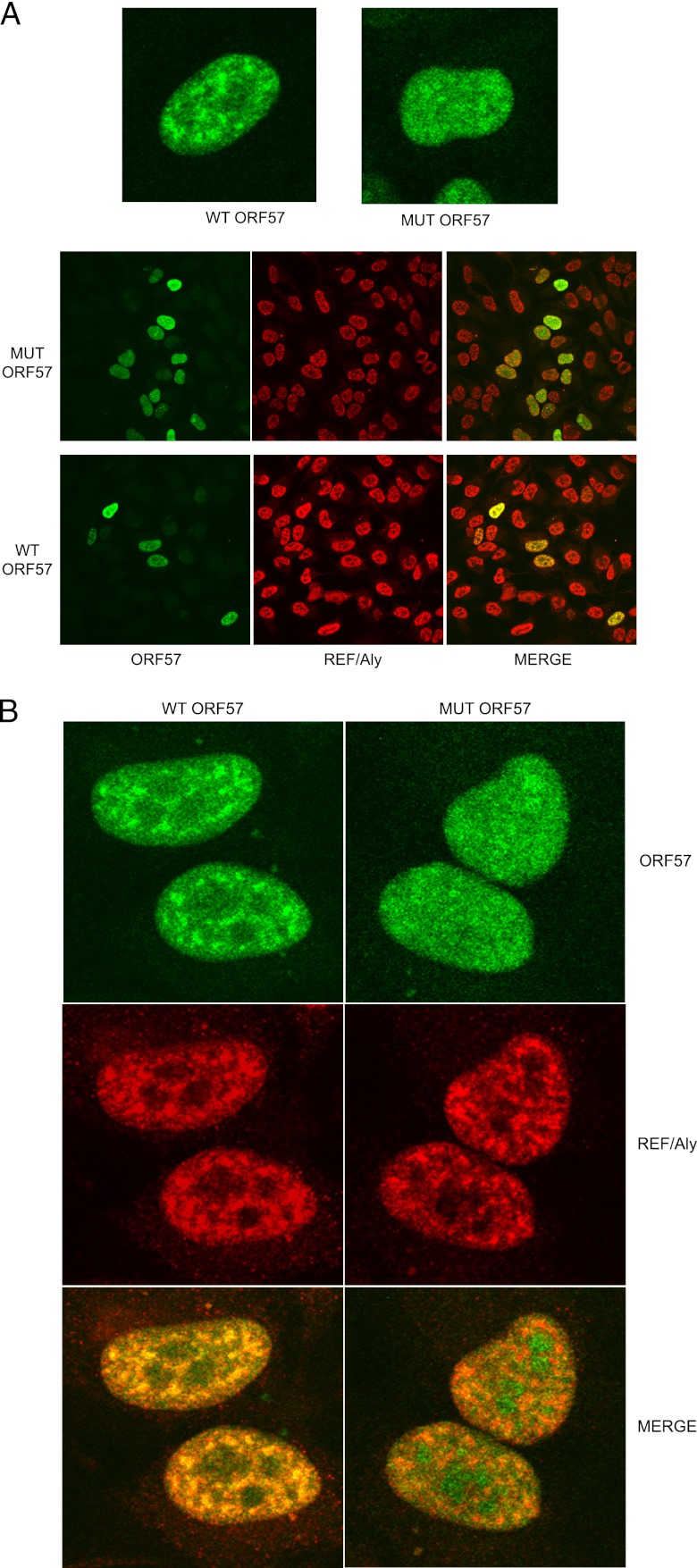
Nuclear localization patterns of wtORF57, ORF57Pmut, and REF/Aly. (A) HeLa cells transfected with either HA-wtORF57 or HA-ORF57Pmut were fixed and stained with monoclonal anti-HA and polyclonal anti-REF antibodies and examined by confocal immunofluorescence microscopy. Individual cells stained with anti-HA to detect ORF57 (upper panel) and lower power view of cells stained with each antibody and merged (lower panel). (B) Higher magnification of cells transfected and stained in panel A above. Cells were transfected with either HA-wtORF57 or HA-ORF57Pmut and stained with anti-HA and anti-REF/Aly antibodies and visualized as described above.
Fig 3
Fig 3
Coimmunoprecipitation of ORF57 and REF/Aly. 293T cells were transfected with either HA-wtORF57 (WT) or HA-ORF57Pmut (MUT) or empty vector (C). Lysates of transfected cells were immunoprecipitated with anti-REF/Aly antibody (lanes Ref), anti-ORF57 (lanes 57), or normal rabbit serum (lanes C) and immunoblotted with anti-HA antibody to detect ORF57. A total of 1% of each input lysate (lanes I) was loaded onto each gel.
Fig 4
Fig 4
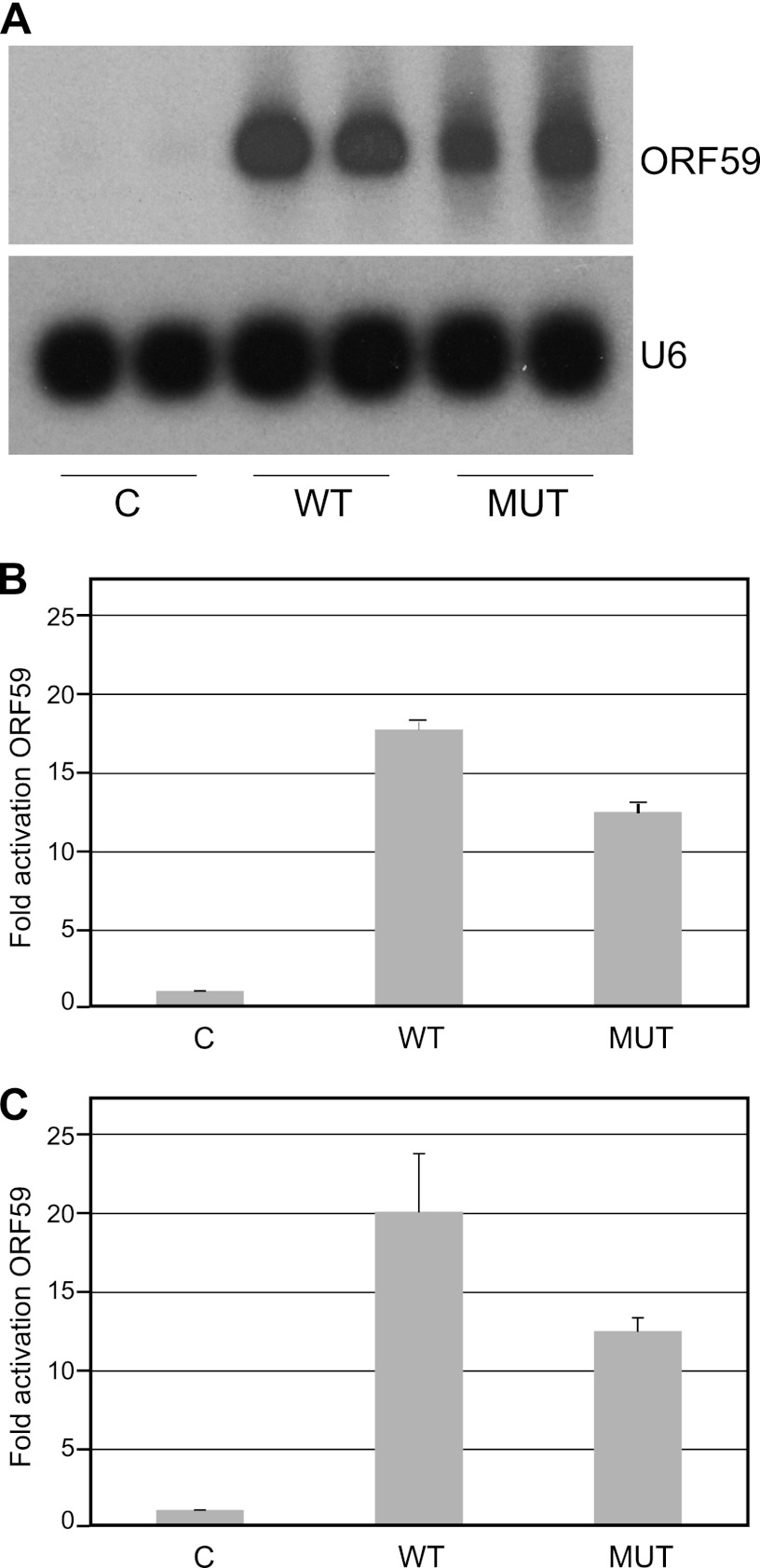
Effect of mutant or wtORF57 on ORF59 expression. (A) RNA was isolated from HeLa cells transfected in duplicate with ORF59 and either wtORF57 (WT), ORF57Pmut (MUT), or empty vector (C), and Northern blotting was performed with ORF59 probe. The blot was stripped and reprobed with U6 probe as an internal loading control. (B) Quantitation of samples in panel A was performed by phosphorimager. (C) RNA from cells transfected with ORF59 and either empty vector (C), wtORF57 (WT), or ORF57Pmut (MUT) as in panel A was analyzed by qPCR to quantitate ORF59 mRNA.
Fig 5
Fig 5
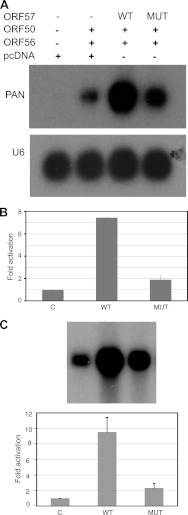
Effect of wtORF57 or ORF57Pmut on nuclear PAN RNA expression. (A) Northern blotting was performed to measure the levels of PAN RNA in Vero cells infected with ORF57-knockout KSHV. HeLa cells were transfected with ORF50 and either wtORF57 (WT), ORF57Pmut (MUT), or empty vector (C). (B) qPCR was performed on the RNAs from panel A. (C) RNA from HeLa cells transfected with PAN and either ORF57 or ORF57Pmut plasmids was analyzed by Northern blotting (upper panel) and qPCR (lower panel). qPCR was performed on RNA from three transfections.
Fig 6
Fig 6
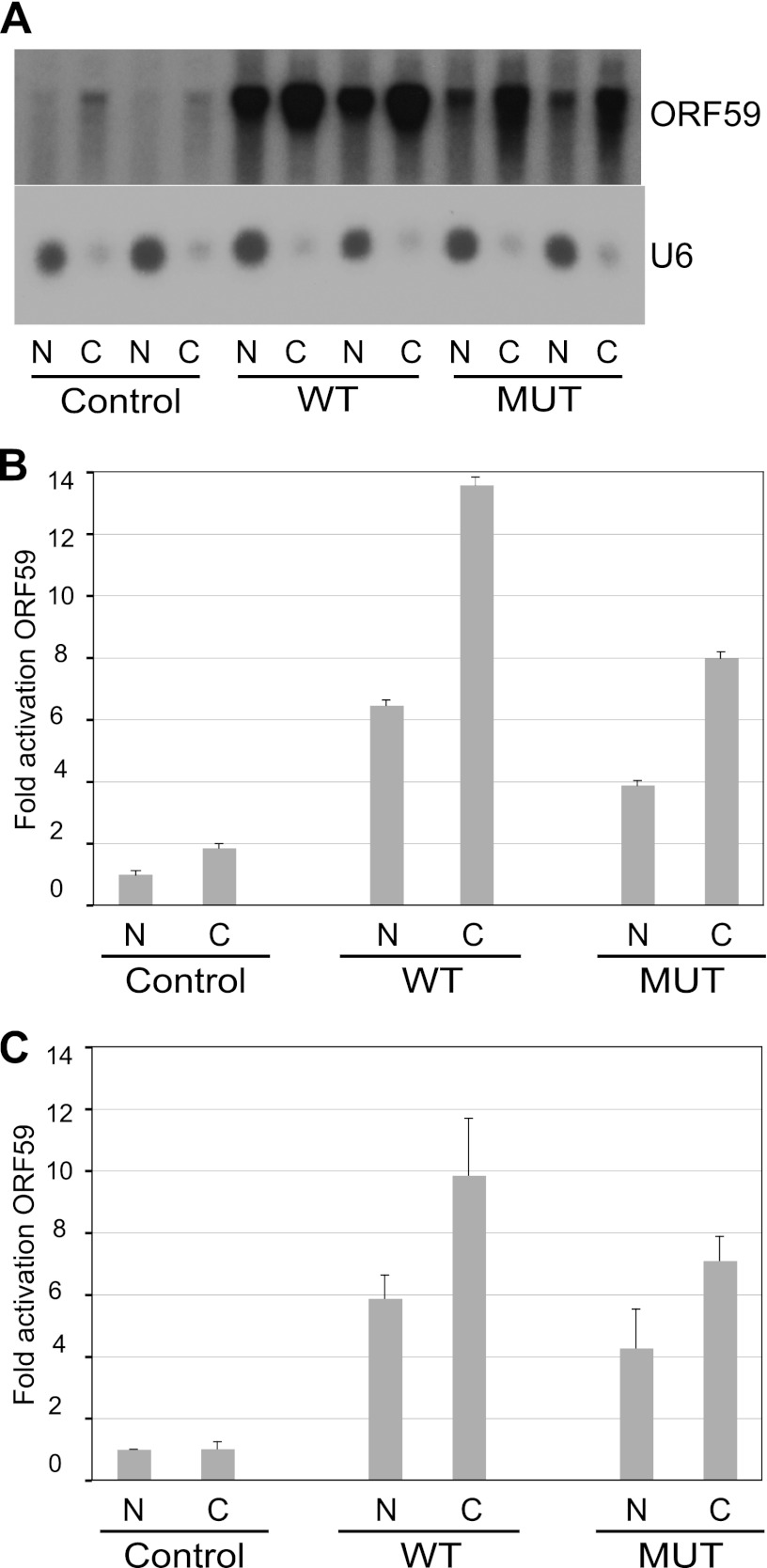
Effect of wild-type or mutant ORF57 on nuclear and cytoplasmic accumulation of ORF59 mRNA. (A) Northern blotting was performed with ORF59 probe on RNA isolated from cytoplasmic and nuclear fractions of lysates from HeLa cells transfected with ORF59 and either empty vector (Control), wtORF57 (WT), or ORF57Pmut (MUT). Blot was stripped and reprobed with U6 as a control (lower panel). (B) Quantitation of samples in panel A was performed by phosphorimaging. (C) qPCR of nuclear and cytoplasmic RNAs isolated as in panel A above.
Fig 7
Fig 7
Effect of ORF57 on nuclear and cytoplasmic accumulation of ORF47 mRNA. (A) Northern blotting was performed with ORF47 probe on RNA isolated from cytoplasmic and nuclear fractions of lysates from HeLa cells transfected with ORF47 and either empty vector (Control), wtORF57 (WT), or ORF57Pmut (MUT). (B) Quantitation of samples in panel A was performed by phosphorimaging. (C) qPCR of nuclear and cytoplasmic RNAs isolated as in panel A above.
Fig 8
Fig 8
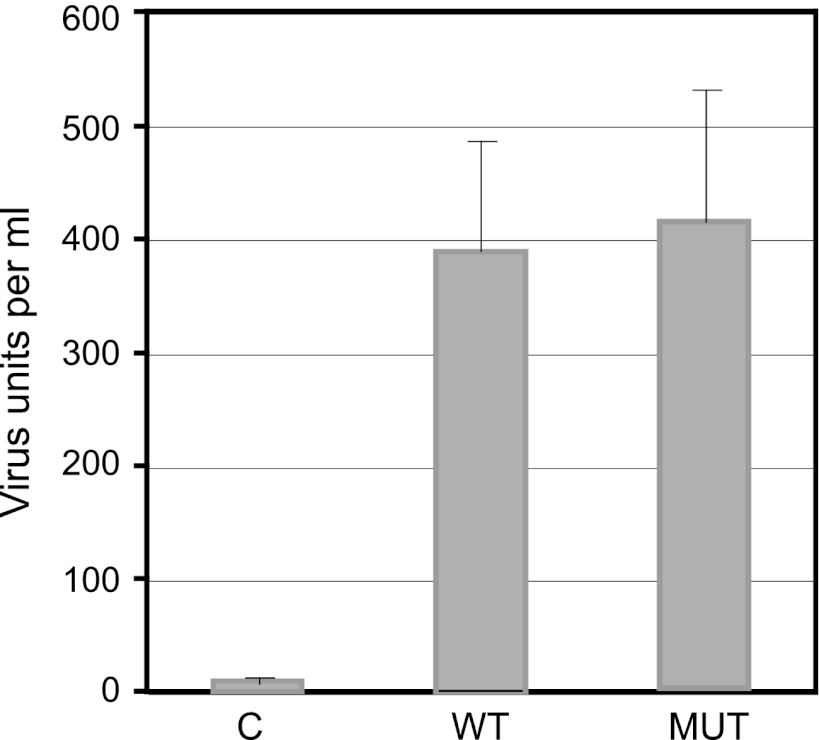
Rescue of Δ57-KSHV replication by transfection of ORF57. 293 cells stably carrying Δ57 KSHV bacmid were transfected with either empty vector (C), wtORF57 (WT), or ORF57Pmut (MUT). At 24 h posttransfection, cells were infected with Ad50 and treated with TPA to induce KSHV replication. After an additional 96 h, supernatants were collected, filtered and used to infect 293T cells. Cells were examined 24 to 48 h after infection by fluorescence microscopy, and GFP-positive cells were counted. In all experiments, when cells transfected with empty vector (C), fewer than 10 GFP units (infected cells)/ml of supernatant were obtained. The results are representative of four independent transfection and passage experiments.

Similar articles

Cited by

References

    1. Bechtel JT, Liang Y, Hvidding J, Ganem D. 2003. Host range of Kaposi's sarcoma-associated herpesvirus in cultured cells. J. Virol. 77:6474–6481 - PMC - PubMed
    1. Bello LJ, et al. 1999. The human herpesvirus-8 ORF 57 gene and its properties. J. Gen. Virol. 80:3207–3215 - PubMed
    1. Boyer JL, Swaminathan S, Silverstein SJ. 2002. The Epstein-Barr virus SM protein is functionally similar to ICP27 from herpes simplex virus in viral infections. J. Virol. 76:9420–9433 - PMC - PubMed
    1. Boyne JR, Colgan KJ, Whitehouse A. 2008. Recruitment of the complete hTREX complex is required for Kaposi's sarcoma-associated herpesvirus intronless mRNA nuclear export and virus replication. PLoS Pathog. 4:e1000194 doi:10.1371/journal.ppat.1000194 - DOI - PMC - PubMed
    1. Boyne JR, Jackson BR, Taylor A, Macnab SA, Whitehouse A. 2010. Kaposi's sarcoma-associated herpesvirus ORF57 protein interacts with PYM to enhance translation of viral intronless mRNAs. EMBO J. 29:1851–1864 - PMC - PubMed

Publication types

MeSH terms

LinkOut - more resources