


Brain activity in fairness consideration during asset distribution: does the initial ownership play a role?
- PMID: 22761850
- PMCID: PMC3383671
- DOI: 10.1371/journal.pone.0039627
Brain activity in fairness consideration during asset distribution: does the initial ownership play a role?
Abstract
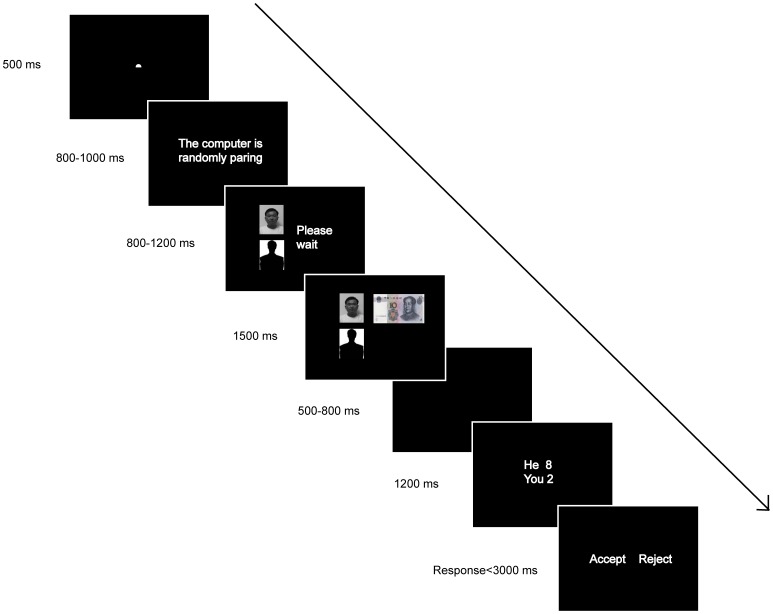
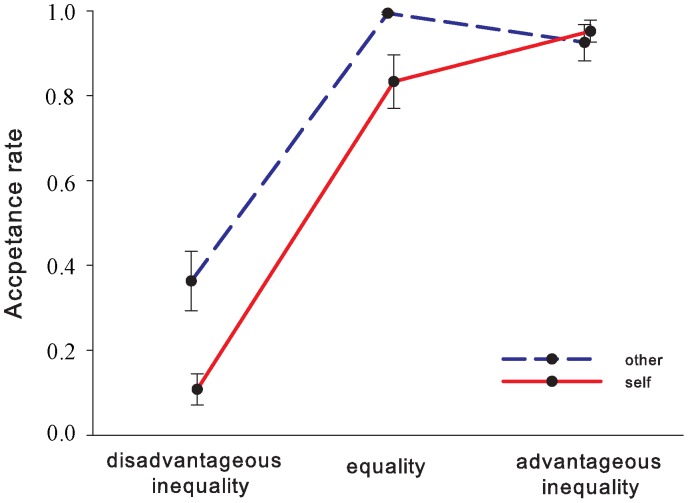
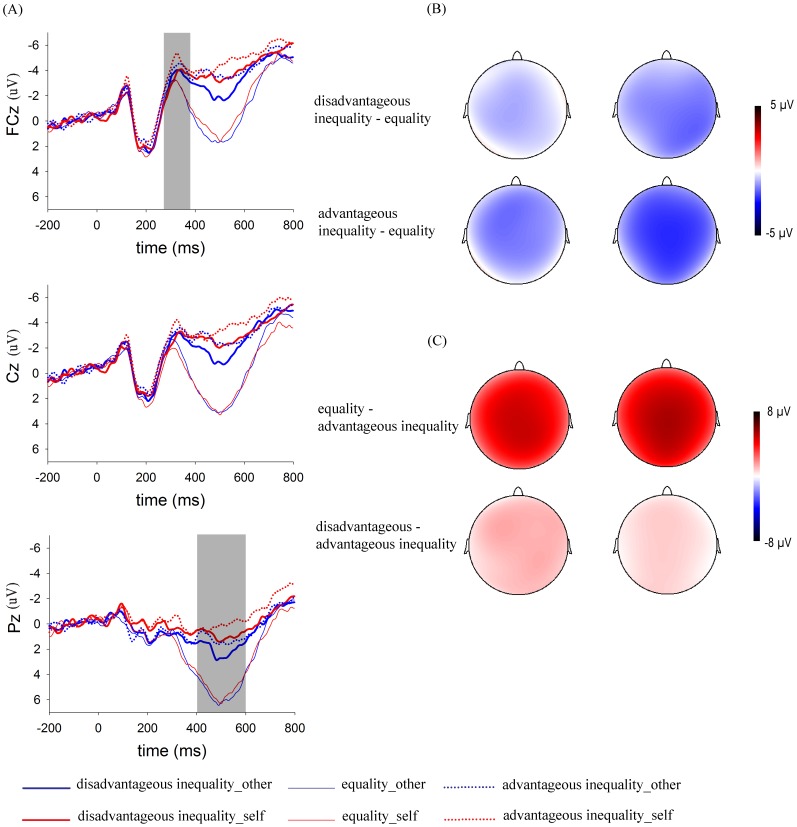
Previous behavioral studies have shown that initial ownership influences individuals' fairness consideration and other-regarding behavior. However, it is not entirely clear whether initial ownership influences the brain activity when a recipient evaluates the fairness of asset distribution. In this study, we randomly assigned the bargaining property (monetary reward) to either the allocator or the recipient in the ultimatum game and let participants of the study, acting as recipients, receive either disadvantageous unequal, equal, or advantageous unequal offers from allocators while the event-related potentials (ERPs) were recorded. Behavioral results showed that participants were more likely to reject disadvantageous unequal and equal offers when they initially owned the property as compared to when they did not. The two types of unequal offers evoked more negative going ERPs (the MFN) than the equal offers in an early time window and the differences were not modulated by the initial ownership. In a late time window, however, the P300 responses to division schemes were affected not only by the type of unequal offers but also by whom the property was initially assigned to. These findings suggest that while the MFN may function as a general mechanism that evaluates whether the offer is consistent or inconsistent with the equity rule, the P300 is sensitive to top-down controlled processes, into which factors related to the allocation of attentional resources, including initial ownership and personal interests, come to play.
Conflict of interest statement
Figures
References
-
- Beggan JK. On the social nature of nonsocial perception: The mere ownership effect. J Pers Soc Psychol. 1992;62:229–237.
-
- Nesselroade KP, Jr, Beggan JK, Allison ST. Possession enhancement in an interpersonal context: An extension of the mere ownership effect. Psychol Market. 1999;16:21–34.
-
- Sen S, Johnson EJ. Mere-possession effects without possession in consumer choice. J Cons Res. 1997;24:105–117.
-
- Leliveld MC, van Dijk E, van Beest I. Initial ownership in bargaining: Introducing the giving, splitting, and taking ultimatum bargaining game. Pers Soc Psychol Bull. 2008;34:1214–1225. - PubMed
-
- Nelissen R, Leliveld MC, van Dijk E, Zeelenberg M. Fear and guilt in proposers: Using emotions to explain offers in ultimatum bargaining. Eur J Soc Psychol. 2011;41:78–85.
Publication types
MeSH terms
LinkOut - more resources
Full Text Sources
Miscellaneous
