


Calpain-cleaved type 1 inositol 1,4,5-trisphosphate receptor impairs ER Ca(2+) buffering and causes neurodegeneration in primary cortical neurons
- PMID: 22762283
- PMCID: PMC6718092
- DOI: 10.1111/j.1471-4159.2012.07859.x
Calpain-cleaved type 1 inositol 1,4,5-trisphosphate receptor impairs ER Ca(2+) buffering and causes neurodegeneration in primary cortical neurons
Abstract
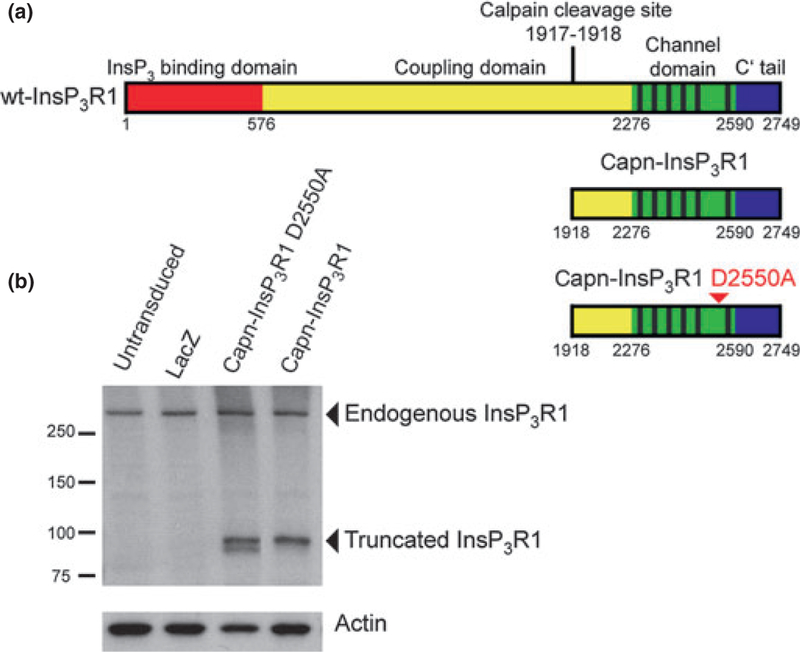
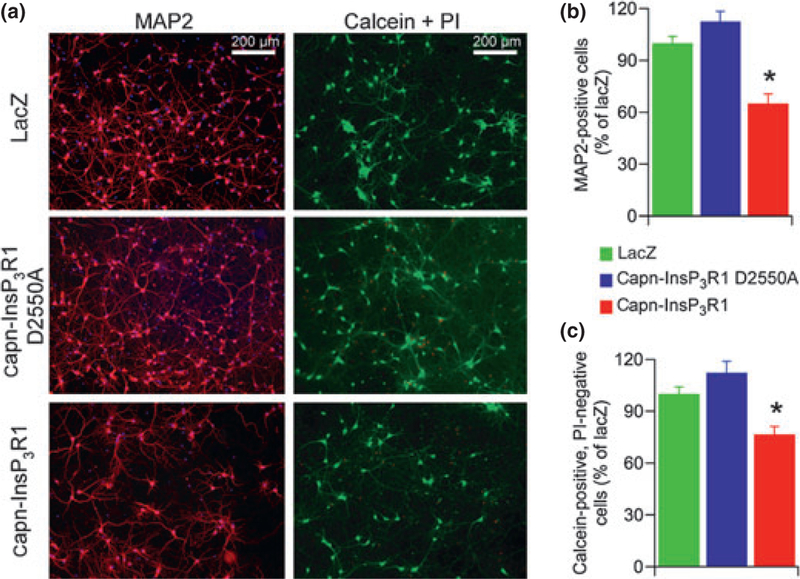
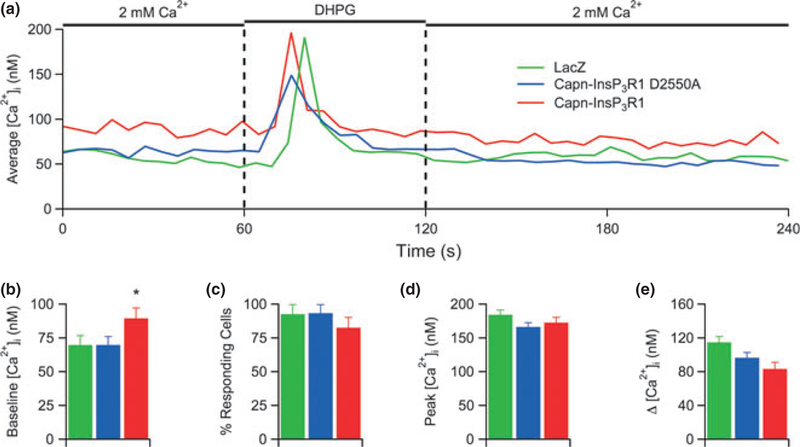
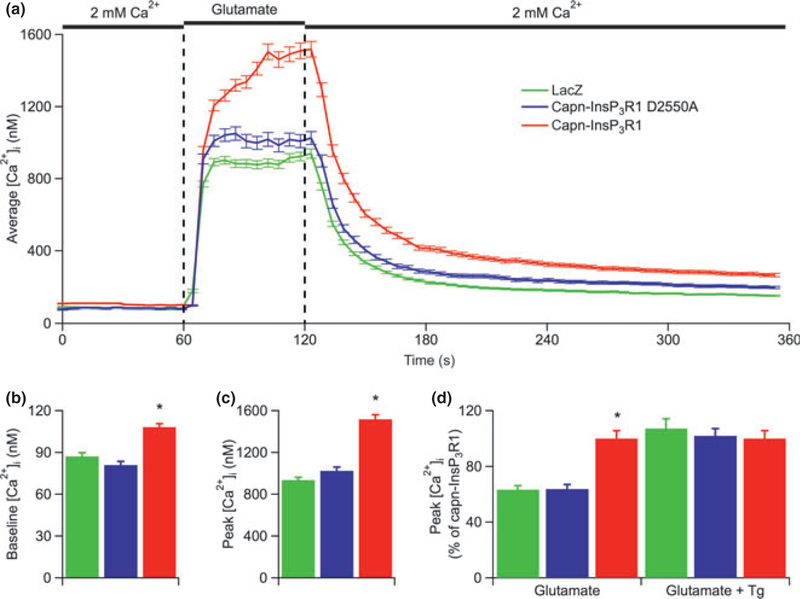
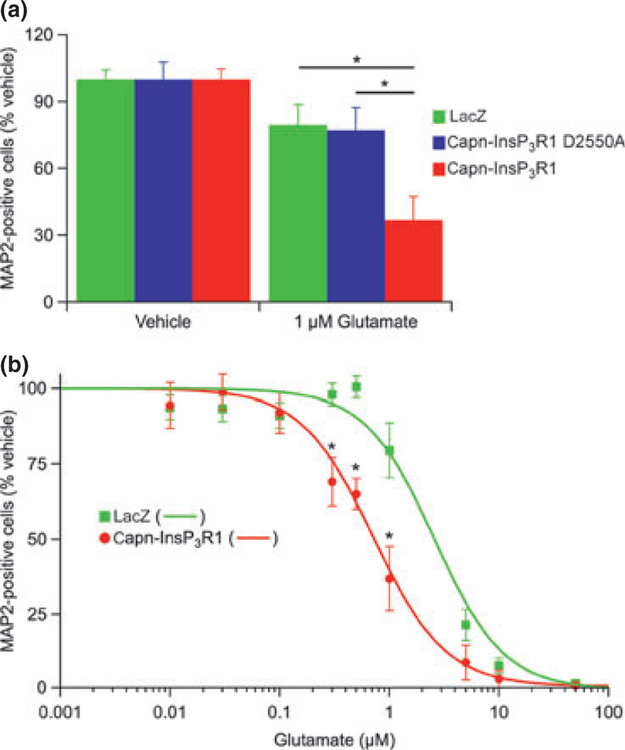
Disruption of neuronal Ca(2+) homeostasis plays a well-established role in cell death in a number of neurodegenerative disorders. Recent evidence suggests that proteolysis of the type 1 inositol 1,4,5-trisphosphate receptor (InsP(3)R1), a Ca(2+) release channel on the endoplasmic reticulum, generates a dysregulated channel, which may contribute to aberrant Ca(2+) signaling and neurodegeneration in disease states. However, the specific effects of InsP(3)R1 proteolysis on neuronal Ca(2+) homeostasis are unknown, as are the functional contributions of this pathway to neuronal death. This study evaluates the consequences of calpain-mediated InsP(3)R1 proteolysis on neuronal Ca(2+) signaling and survival using adeno-associated viruses to express a recombinant cleaved form of the channel (capn-InsP(3)R1) in rat primary cortical neurons. Here, we demonstrate that expression of capn-InsP(3)R1 in cortical cultures reduced cellular viability. This effect was associated with increased resting cytoplasmic Ca(2+) concentration ([Ca(2+)](i)), increased [Ca(2+)](i) response to glutamate, and enhanced sensitivity to excitotoxic stimuli. Together, our results demonstrate that InsP(3)R1 proteolysis disrupts neuronal Ca(2+) homeostasis, and potentially acts as a feed-forward pathway to initiate or execute neuronal death.
© 2012 The Authors. Journal of Neurochemistry © 2012 International Society for Neurochemistry.
Conflict of interest statement
Conflict of interest
The authors declare no conflict of interest.
Figures
References
-
- Assefa Z, Bultynck G, Szlufcik K, Nadif Kasri N, Vermassen E, Goris J, Missiaen L, Callewaert G, Parys JB and De Smedt H (2004) Caspase-3-induced truncation of type 1 inositol trisphosphate receptor accelerates apoptotic cell death and induces inositol trisphosphate-independent calcium release during apoptosis.J. Biol. Chem 279, 43227–43236. - PubMed
-
- Bardo S, Cavazzini MG and Emptage N (2006) The role of the endoplasmic reticulum Ca2+ store in the plasticity of central neurons. Trends Pharmacol. Sci 27, 78–84. - PubMed
-
- Berridge MJ, Lipp P and Bootman MD (2000) The versatility and universality of calcium signalling. Nat. Rev. Mol. Cell Biol 1, 11–21. - PubMed
-
- Berridge MJ, Bootman MD and Roderick HL (2003) Calcium signalling: dynamics, homeostasis and remodelling. Nat. Rev. Mol. Cell Biol 4, 517–529. - PubMed
Publication types
MeSH terms
Substances
Grants and funding
LinkOut - more resources
Full Text Sources
Miscellaneous
