


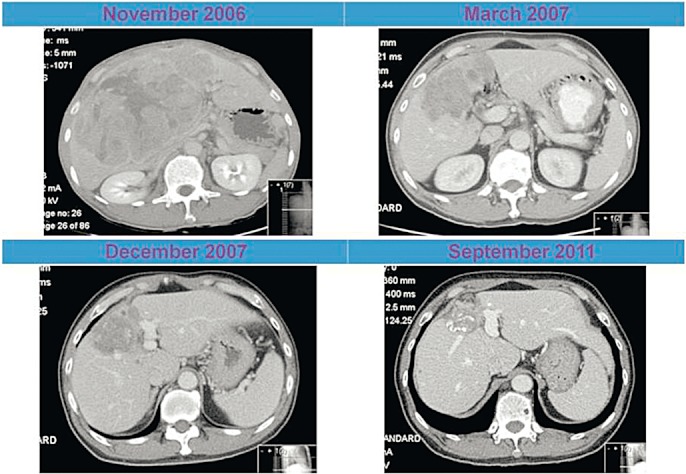
Spontaneous regression of hepatocellular carcinoma is most often associated with tumour hypoxia or a systemic inflammatory response
- PMID: 22762397
- PMCID: PMC3406346
- DOI: 10.1111/j.1477-2574.2012.00478.x
Spontaneous regression of hepatocellular carcinoma is most often associated with tumour hypoxia or a systemic inflammatory response
Abstract
Background: Spontaneous regression of hepatocellular carcinoma (HCC) is well documented, although the aetiology of this phenomenon remains unknown.
Methods: A review of the English literature was performed for reports of spontaneous regression of HCC. Reports were classified by mechanism based on the available information.
Results: Spontaneous regression of HCC has been identified in 75 patients. The most common mechanisms of regression identified were tumour hypoxia (n= 21, 28.0%), a systemic inflammatory response (n= 25, 33.3%) and unknown (n= 29, 38.7%). In patients where tumour hypoxia was described as the aetiology, mechanisms included spontaneous hepatic artery thrombosis and sustained systemic hypotension. In patients where a systemic inflammatory response was the aetiology, mechanisms included cholangitis, trauma and elevated cytokine levels.
Discussion: Spontaneous regression of HCC is most commonly associated with tumour hypoxia or a systemic inflammatory response. Determining the aetiology of spontaneous regression may identify potential therapeutic pathways. Tumour hypoxia is already the basis of treatment modalities such as hepatic artery embolization and the anti-angiogenic agent sorafenib. However, treatment modalities for HCC do not currently include immune-directed therapies; this may prove to be a worthy target for future research.
© 2012 International Hepato-Pancreato-Biliary Association.
Figures
References
-
- Parkin DM, Bray F, Ferlay J, Pisani P. Global cancer statistics, 2002. CA Cancer J Clin. 2005;55:74–108. - PubMed
-
- The Cancer of the Liver Italian Program (Clip) Investigators. A new prognostic system for hepatocellular carcinoma: a retrospective study of 435 patients. Hepatology. 1999;28:751–755. - PubMed
-
- Cole WH. Spontaneous regression of cancer and the importance of finding its cause. Natl Cancer Inst Monogr. 1976;44:5–9. - PubMed
-
- Johnson FL, Lerner KG, Siegel M, Feagler JR, Majerus PW, Hartmann JR, et al. Association of androgenic-anabolic steroid therapy with development of hepatocellular carcinoma. Lancet. 1972;2:1273–1276. - PubMed
Publication types
MeSH terms
LinkOut - more resources
Full Text Sources
Medical
