


Relevance of residual disease after liver resection for incidental gallbladder cancer
- PMID: 22762403
- PMCID: PMC3406352
- DOI: 10.1111/j.1477-2574.2012.00498.x
Relevance of residual disease after liver resection for incidental gallbladder cancer
Abstract
Objectives: In patients diagnosed with incidental gallbladder cancer (GC), the benefit and optimal extent of further surgery remain unclear. The aims of this study were to analyse outcomes in patients who underwent liver resection following a diagnosis of incidental GC and to determine factors associated with longterm survival.
Methods: A retrospective analysis of patients diagnosed with incidental GC between June 1999 and June 2010 was performed. Data covering demographics, clinical and surgical characteristics and local pathological stage were analysed.
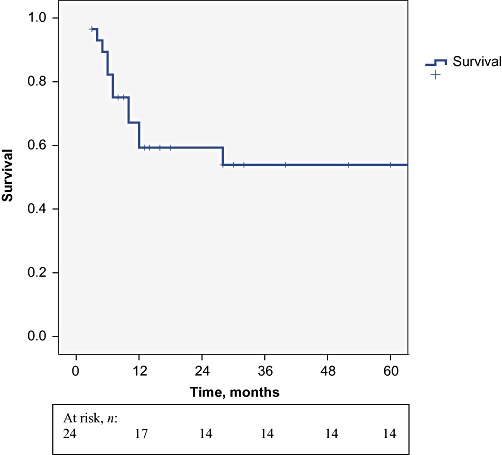
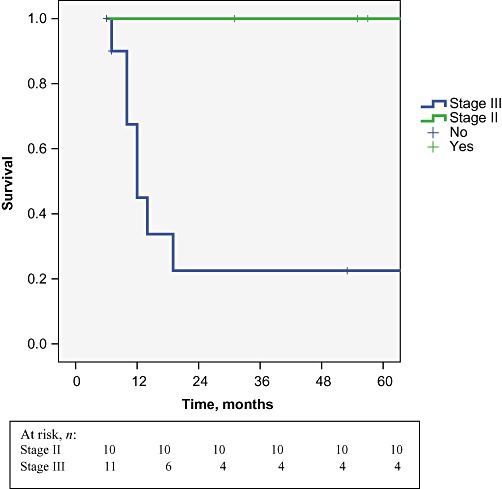
Results: A total of 24 patients were identified. All patients underwent a resection of segments IVb and V and lymphadenectomy. Histological examination revealed residual disease in 10 patients, all of whom presented with recurrent disease at 3-12 months. Overall 5-year survival was 53%. Increasing T-stage (P < 0.001), tumour-node-metastasis (TNM) stage (P= 0.003), and the presence of residual tumour in the resected liver (P < 0.001) were all associated with worse survival.
Conclusions: Aggressive re-resection of incidental GC offers the only chance for cure, but its efficacy depends on the extent of disease found at the time of repeat surgery. The presence of residual disease correlated strongly with T-stage and was the most relevant prognostic factor for survival in patients treated with curative resection.
© 2012 International Hepato-Pancreato-Biliary Association.
Figures
References
-
- Arroyo GF. Cáncer de vesícula biliar. Oncol Clin. 2002;8:831–836.
-
- Jensen EH, Abraham A, Habermann EB, Al-Refaie WB, Vickers SM, Virnig BA, et al. A critical analysis of the surgical management of early-stage gallbladder cancer in the United States. J Gastrointest Surg. 2009;13:722–727. - PubMed
-
- Dong XD, DeMatos P, Prieto VG, Seigler HF. Melanoma of the gallbladder: a review of cases seen at Duke University Medical Center. Cancer. 1999;85:32–39. - PubMed
-
- Batra Y, Pal S, Dutta U, Gark PK, Makharia G. Gallbladder cancer in India: a dismal picture. J Gastrointest Hepatol. 2005;20:309–314. - PubMed
MeSH terms
LinkOut - more resources
Full Text Sources
Medical
Miscellaneous
