The paradox of higher light tolerance during desiccation in rare old forest cyanolichens than in more widespread co-occurring chloro- and cephalolichens
- PMID: 22762452
- PMCID: PMC3593164
- DOI: 10.1111/j.1469-8137.2012.04221.x
The paradox of higher light tolerance during desiccation in rare old forest cyanolichens than in more widespread co-occurring chloro- and cephalolichens
Abstract
Desiccation tolerance was quantified in four cyanolichens (Lobaria hallii, Lobaria retigera, Lobaria scrobiculata, Pseudocyphellaria anomala), one cephalolichen (Lobaria pulmonaria) and one chlorolichen (Platismatia glauca) from xeric and mesic, open and closed North American boreal forests. These sympatric epiphytes were exposed to 0%, 33%, 55% and 75% relative humidity with or without medium light (200 μmol m⁻² s⁻¹) for 7 d. Permanent and temporary photoinhibitory damage was recorded as viability measures. All species tolerated well the drying in darkness, but L. hallii and L. retigera, associated with a very humid climate, showed minor damage at the hardest drying (silica gel). Simultaneous exposure to medium light severely aggravated the drying damage at all relative humidity levels. Combined drying-light exposure was particularly devastating for the widespread chloro- and cephalolichens, whereas cyanolichens, including rare old forest species, were fairly resistant. The ability to recover after combined drying-light stress (this study) correlated positively with increasing species-specific water holding capacities (from the literature). Cyanolichens, depending on liquid water and large internal water storage, probably require strong drying-light resistance to handle long periods between hydration events, whereas chlorolichens can regularly maintain their photosynthetic apparatus during frequent and rapid activation by humid air on clear mornings.
© 2012 The Authors. New Phytologist © 2012 New Phytologist Trust.
Figures
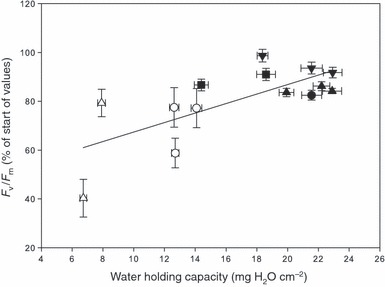
 = 0.469; P = 0.005). Open symbols, the chlorolichens Platismatia glauca (triangles apex up) and Lobaria pulmonaria (circles). Closed symbols, Pseudocyphellaria anomala (squares), Lobaria scrobiculata (triangles apex down), L. hallii (triangles apex up) and L. retigera (circles). Each error bar (vertical as well as horizontal) represents ± 1SE (n = 39–40 for WHC and n = 19–20 for Fv/Fm) from each type of habitat (see Table 3).
References
-
- Adams WW, Demmig-Adams B, Rosenstiel TN, Brightwell AK, Ebbert V. Photosynthesis and photoprotection in overwintering plants. Plant Biology. 2002;4:545–557.
-
- Barták M, Solhaug KA, Vrábliková H, Gauslaa Y. Curling during desiccation protects the foliose lichen Lobaria pulmonaria against photoinhibition. Oecologia. 2006;149:553–560. - PubMed
-
- Beckett RP, Minibayeva FV, Vylegzhanina NN, Tolpysheva T. High rates of extracellular superoxide production by lichens in the suborder Peltigerineae correlate with indices of high metabolic activity. Plant, Cell & Environment. 2003;26:1827–1837.
-
- Belnap J, Lange OL. Lichens and microfungi in biological soil crusts: community structure, physiology, and ecological functions. In: Dighton J, White JF, Oudemans P, editors. The fungal community. Its organization and role in the ecosystem. Boca Raton, FL, USA: CRC Press; 2005. pp. 117–138.
-
- Bilger W, Rimke S, Schreiber U, Lange OL. Inhibition of energy-transfer to photosystem II in lichens by dehydration: different properties of reversibility with green and blue–green phycobionts. Journal of Plant Physiology. 1989;134:261–268.
MeSH terms
Substances
LinkOut - more resources
Full Text Sources