


A mathematical reason for FEV1/FVC dependence on age
- PMID: 22762777
- PMCID: PMC3461438
- DOI: 10.1186/1465-9921-13-57
A mathematical reason for FEV1/FVC dependence on age
Abstract
Background: Recent studies have showed that FEV1/FVC describing correspondence between the forced expiratory volume in one second (FEV1) and forced vital capacity (FVC) depends significantly on age. However, the nature of this dependence is uncertain. The study aim is to analyze mathematically the relationship between FEV1 and FVC to find a cause of the FEV1/FVC dependence on age in healthy subjects.
Methods: The relationship was examined for 1,120 males and 1,625 females--Polish (Caucasian) population, healthy, never-smoking, aged 18 - 85 years, who performed a technically adequate spirometry maneuver. Lung functions were measured using the LungTest1000 (MES, Poland) with maximal effort according to the ATS/ERS guidelines.
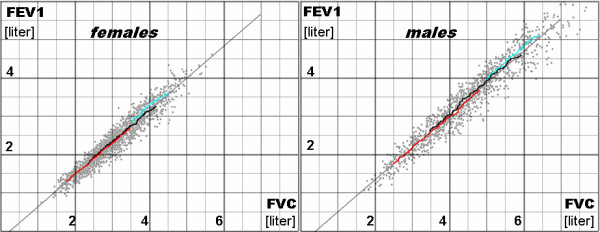
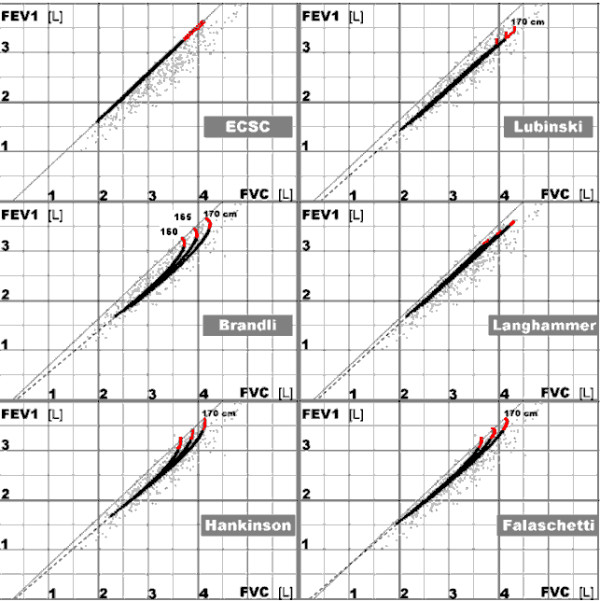
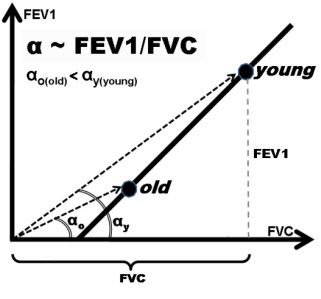
Results: A very strong, age-independent linear relationship between FEV1 and FVC was found in healthy individuals (the correlation coefficient r = 0.96). It can be described with the equation FEV1 = A x FVC + C, where A = 0.84 and C = -0.23 (-0.36) for females (males). As C is different from zero, FEV1/FVC depends on FVC because FEV1/FVC = A + C/FVC, in average. And thus, since FVC is significantly age-dependent, FEV1/FVC has to be also age-dependent because of the term C/FVC. In particular, the smaller the FVC value because of advanced age, the more significant the fall of FEV1/FVC.
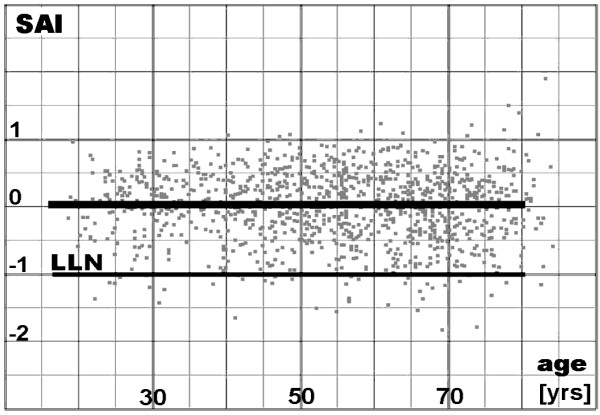
Conclusions: FEV1/FVC dependence on age in healthy individuals is of mathematical rather than biological nature. Due to the strong correlation between FEV1 and FVC in healthy subjects, the difference between patient's FEV1 and the FEV1 value expected for patient's FVC seems to be a more natural, age-independent description of the correspondence between patient's FEV1 and FVC.
Figures
References
-
- Mead J, Turner JM, Macklem PT, Little JB. Significance of the relationship between lung recoil and maximum expiratory flow. J Appl Physiol. 1967;22:95–108. - PubMed
-
- Pride NB, Permutt S, Riley RL, Bromberger-Barnea B. Determinants of maximal expiratory flow from the lungs. J Appl Physiol. 1967;23:646–662. - PubMed
-
- Golczewski T, Darowski M. Virtual respiratory system for education and research: simulation of expiratory flow limitation for spirometry. Int J Artif Organs. 2006;29:961–972. - PubMed
-
- Tiffeneau R, Pinelli A. Air circulant et air captif dans l’exploration de la fonction ventilatoire pulmonaire. Paris Med. 1947;133:624–631. - PubMed
-
- Pauwels RA, Buist AS, Calverley PM, Jenkins CR, Hurd SS. Global strategy for the diagnosis, management, and prevention of chronic obstructive pulmonary disease: NHLBI/WHO Global Initiative for Chronic Obstructive Lung Disease (GOLD) Workshop summary. Am J Respir Crit Care Med. 2001;163:1256–1276. - PubMed
Publication types
MeSH terms
LinkOut - more resources
Full Text Sources
Medical
Research Materials
Miscellaneous
