. 2012 Jul 4;4(1):32.
doi: 10.1186/1758-5996-4-32.

Diet high in fat and sucrose induces rapid onset of obesity-related metabolic syndrome partly through rapid response of genes involved in lipogenesis, insulin signalling and inflammation in mice

Affiliations

Diet high in fat and sucrose induces rapid onset of obesity-related metabolic syndrome partly through rapid response of genes involved in lipogenesis, insulin signalling and inflammation in mice

Zhi-Hong Yang et al. Diabetol Metab Syndr. .

Abstract

Background: Frequent consumption of a diet high in fat and sucrose contributes to lifestyle-related diseases. However, limited information is available regarding the short-term effects of such a diet on the onset of obesity-associated metabolic abnormalities.

Methods: Male C57BL/6 J mice were divided into two groups and fed a standard chow diet (control group) or a high fat-high sucrose diet containing 21% fat and 34% sucrose (HF-HS diet group) for 2 or 4 weeks.

Results: The HF-HS diet significantly induced body weight gain beginning at week 1 and similarly increased mesenteric white adipose tissue weight and plasma insulin levels at weeks 2 and 4. Plasma resistin levels were notably elevated after feeding with the HF-HS diet for 4 weeks. Measurement of hepatic triglycerides and Oil Red O staining clearly indicated increased hepatic lipid accumulation in response to the HF-HS diet as early as 2 weeks. Quantitative PCR analysis of liver and white adipose tissue indicated that, starting at week 2, the HF-HS diet upregulated mRNA expression from genes involved in lipid metabolism and inflammation and downregulated genes involved in insulin signalling. Although plasma cholesterol levels were also rapidly increased by the HF-HS diet, no differences were found between the control and HF-HS diet-fed animals in the expression of key genes involved in cholesterol biosynthesis.

Conclusions: Our study demonstrates that the rapid onset of hepatosteatosis, adipose tissue hypertrophy and hyperinsulinemia by ingestion of a diet high in fat and sucrose may possibly be due to the rapid response of lipogenic, insulin signalling and inflammatory genes.


Figures
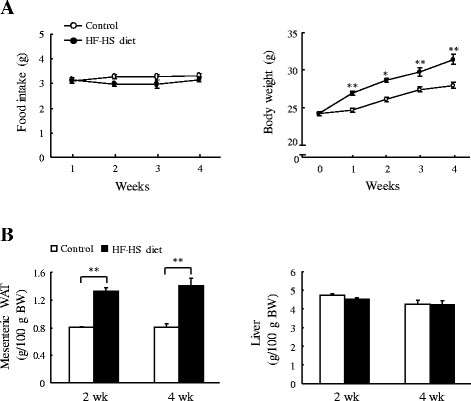
Figure 1
Figure 1
Changes in body, white adipose tissue (WAT), and liver weights. Food intake and body weight (A) and mesenteric WAT and liver weights (B) are shown. HF–HS diet: high fat–high sucrose diet. C57BL/6 J mice were fed standard chow diet or the HF–HS diet (milk fat 21% and sucrose 34%) for 2 or 4 weeks. Values are the mean ± SE, n = 6. *P < 0.05; **P < 0.01.
Figure 2
Figure 2
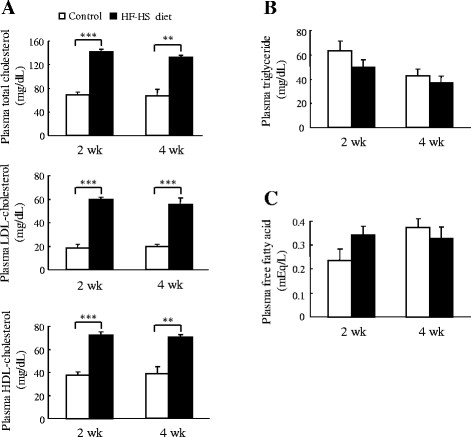
Effect of the HF–HS diet on the plasma lipid profile. Plasma levels of cholesterol (total cholesterol, LDL–cholesterol, and HDL–cholesterol) (A), triglycerides (B), and free fatty acids (C) are shown. HF–HS diet: high fat–high sucrose diet. C57BL/6 J mice were fed standard chow diet or the HF–HS diet (milk fat 21% and sucrose 34%) for 2 or 4 weeks. Values are the mean ± SE, n = 6. ** P < 0.01; *** P < 0.001.
Figure 3
Figure 3
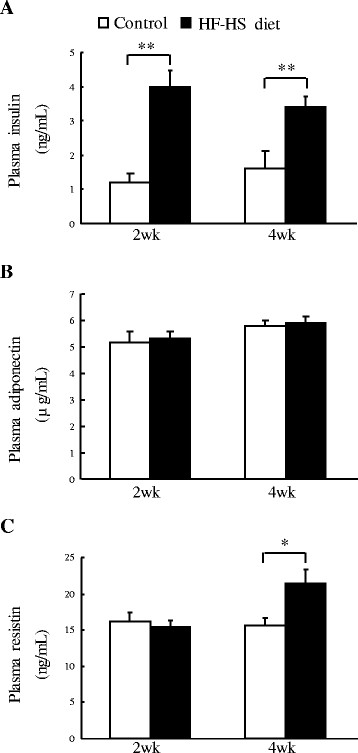
Effect of the HF–HS diet on plasma levels of insulin and adipokines. Plasma levels of insulin (A), adiponectin (B), and resistin (C) are shown. HF–HS diet: high fat–high sucrose diet. C57BL/6 J mice were fed standard chow diet or the HF–HS diet (milk fat 21% and sucrose 34%) for 2 or 4 weeks. * P < 0.05. ** P < 0.01.
Figure 4
Figure 4
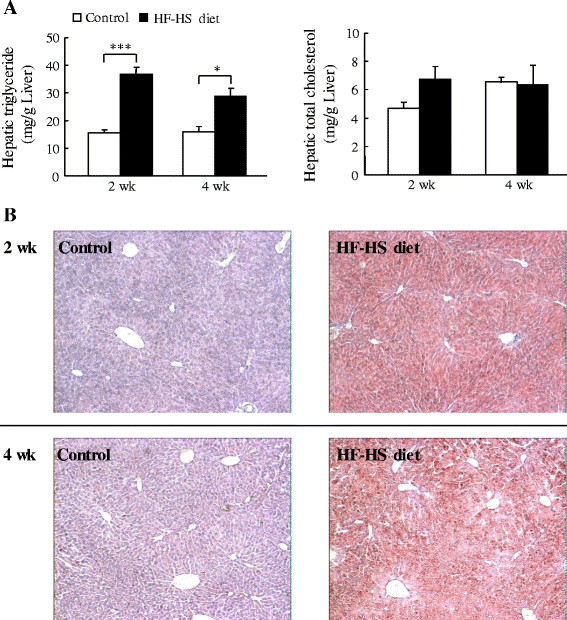
Effect of the HF–HS diet on hepatic lipid accumulation. (A) Hepatic triglyceride and total cholesterol levels. (B) Photomicrographs of liver sections stained with hematoxylin-eosin and Oil Red O at week 2 (upper panel) and week 4 (lower panel). HF–HS diet: high fat–high sucrose diet. C57BL/6 J mice were fed standard chow diet or the HF–HS diet (milk fat 21% and sucrose 34%) for 2 or 4 weeks. Values are the mean ± SE, n = 6. ** P < 0.01, *** P < 0.001.
Figure 5
Figure 5
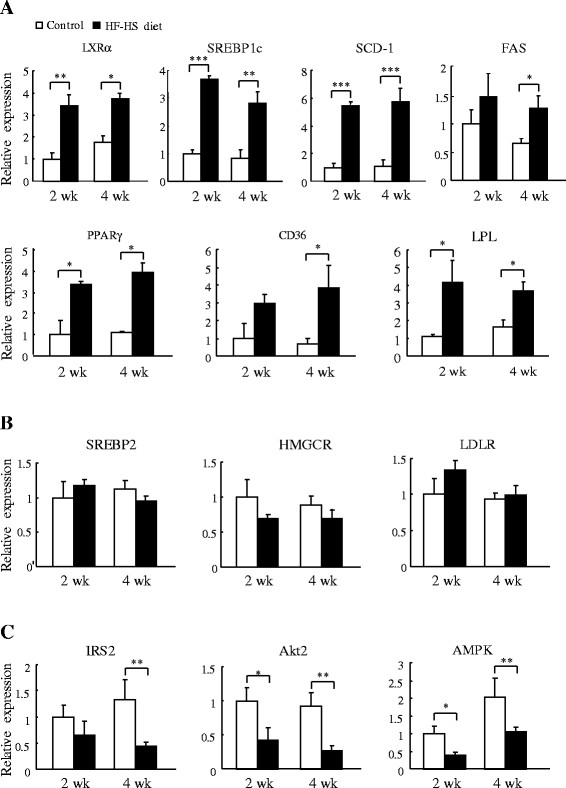
Effect of the HF–HS diet on hepatic genes for lipid/cholesterol metabolism and insulin signalling. (A) mRNA expression of genes related to lipid metabolism: LXRa, SREBP1c, SCD-1, FAS, PPARγ, CD36, and LPL. (B) mRNA expression of genes related to cholesterol metabolism: SREBP2, HMGCR, and LDLR. (C) mRNA expression of genes related to insulin signalling: IRS2, Akt2, and AMPK. HF–HS diet: high fat–high sucrose diet. C57BL/6 J mice were fed standard chow diet or the HF–HS diet (milk fat 21% and sucrose 34%) for 2 or 4 weeks. Values are the mean ± SE and are relative to control values, which were set at 1.0. n = 6. * P < 0.05, ** P < 0.01, *** P < 0.001.
Figure 6
Figure 6
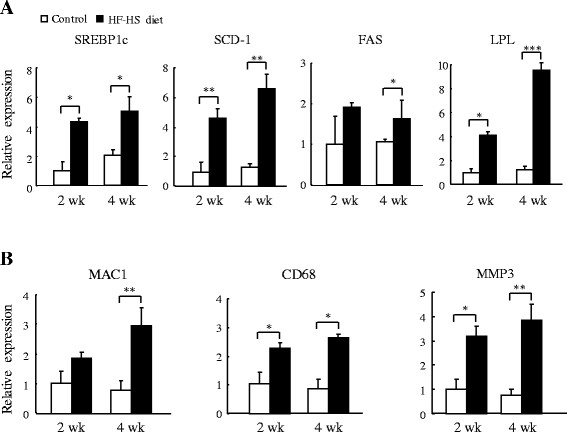
Effect of the HF–HS diet on WAT genes involved in lipogenesis and inflammation. (A) mRNA expression of genes related to lipogenesis: SREBP1c, SCD-1, and FAS, and of the lipolysis-related gene, LPL. (B) mRNA expression of genes related to inflammation: MAC1, CD68, and MMP3. HF–HS diet: high fat–high sucrose diet. C57BL/6 J mice were fed standard chow diet or the HF–HS diet (milk fat 21% and sucrose 34%) for 2 or 4 weeks. Values are the mean ± SE and are relative to control values, which were set at 1.0. n = 6. * P < 0.05, ** P < 0.01, *** P < 0.001.

References

    1. Ogden CL, Yanovski SZ, Carroll MD, Flegal KM. The epidemiology of obesity. Gastroenterology. 2007;132:2087–2102. doi: 10.1053/j.gastro.2007.03.052. - DOI - PubMed
    1. Hurt RT, Kulisek C, Buchanan LA, McClave SA. The obesity epidemic: challenges, health initiatives, and implications for gastroenterologists. Gastroenterol Hepatol NY. 2010;6:780–792. - PMC - PubMed
    1. Aucott LS. Influences of weight loss on long-term diabetes outcomes. Proc Nutr Soc. 2008;67:54–59. doi: 10.1017/S0029665108006022. - DOI - PubMed
    1. Cameron AJ, Shaw JE, Zimmet PZ. The metabolic syndrome: prevalence in worldwide populations. Endocrinol Metab Clin North Am. 2004;33:351–375. doi: 10.1016/j.ecl.2004.03.005. - DOI - PubMed
    1. Gami AS, Witt BJ, Howard DE, Erwin PJ, Gami LA, Somers VK, Montori VM. Metabolic syndrome and risk of incident cardiovascular events and death: a systematic review and meta-analysis of longitudinal studies. J Am Coll Cardiol. 2007;49:403–414. doi: 10.1016/j.jacc.2006.09.032. - DOI - PubMed