


The absence of longitudinal data limits the accuracy of high-throughput clinical phenotyping for identifying type 2 diabetes mellitus subjects
- PMID: 22762862
- PMCID: PMC3478423
- DOI: 10.1016/j.ijmedinf.2012.05.015
The absence of longitudinal data limits the accuracy of high-throughput clinical phenotyping for identifying type 2 diabetes mellitus subjects
Abstract
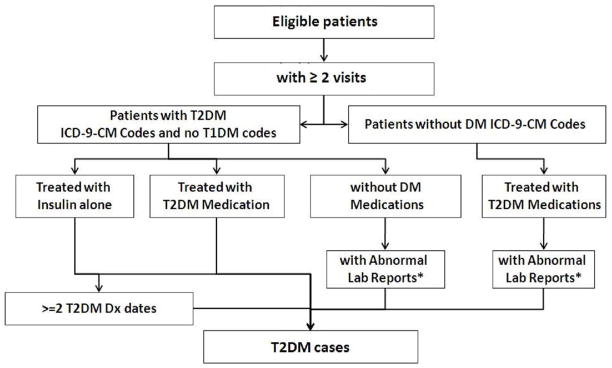
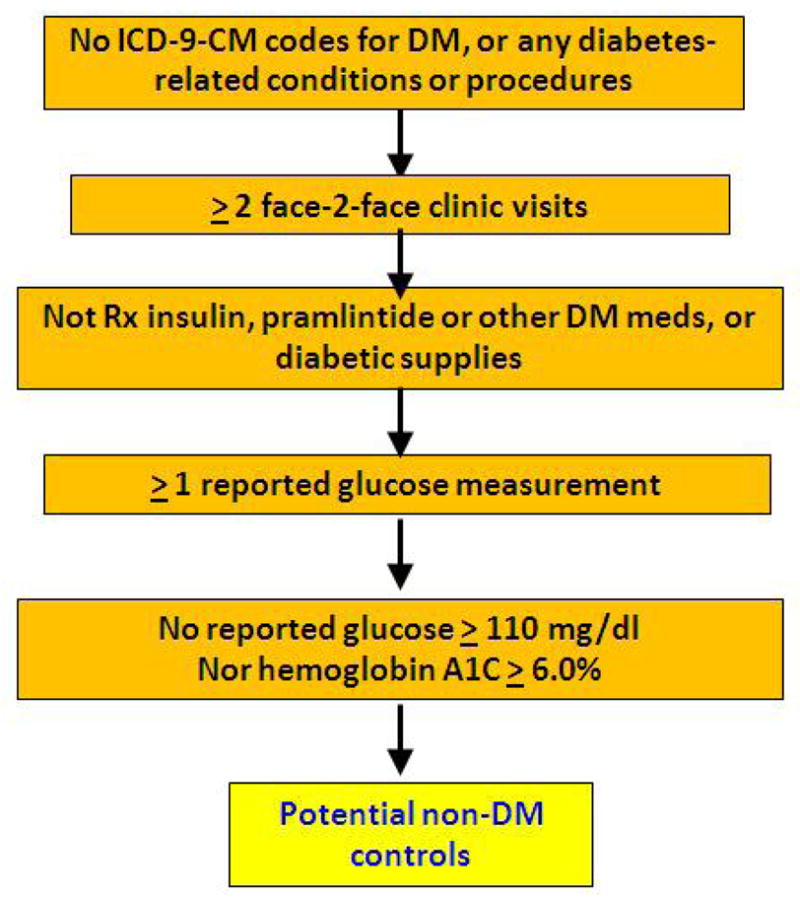
Purpose: To evaluate the impact of insufficient longitudinal data on the accuracy of a high-throughput clinical phenotyping (HTCP) algorithm for identifying (1) patients with type 2 diabetes mellitus (T2DM) and (2) patients with no diabetes.
Methods: Retrospective study conducted at Mayo Clinic in Rochester, Minnesota. Eligible subjects were Olmsted County residents with ≥1 Mayo Clinic encounter in each of three time periods: (1) 2007, (2) from 1997 through 2006, and (3) before 1997 (N = 54,283). Diabetes relevant electronic medical record (EMR) data about diagnoses, laboratories, and medications were used. We employed the HTCP algorithm to categorize individuals as T2DM cases and non-diabetes controls. Considering the full 11 years (1997-2007) as the gold standard, we compared gold-standard categorizations with those using data for 10 subsequent intervals, ranging from 1998-2007 (10-year data) to 2007 (1-year data). Positive predictive values (PPVs) and false-negative rates (FNRs) were calculated. McNemar tests were used to determine whether categorizations using shorter time periods differed from the gold standard. Statistical significance was defined as P < 0.05.
Results: We identified 2770 T2DM cases and 21,005 controls when the algorithm was applied using 11-year data. Using 2007 data alone, PPVs and FNRs, respectively, were 70% and 25% for case identification and 59% and 67% for control identification. All time frames differed significantly from the gold standard, except for the 10-year period.
Conclusions: The accuracy of the algorithm reduced remarkably as data were limited to shorter observation periods. This impact should be considered carefully when designing/executing HTCP algorithms.
Copyright © 2012 Elsevier Ireland Ltd. All rights reserved.
Conflict of interest statement
There are no conflicts of interests.
Figures
References
-
- Kohane IS. Using electronic health records to drive discovery in disease genomics. Nat Rev Genet. 2011;12(6):417–28. - PubMed
-
- Wilke RA, et al. Characterization of low-density lipoprotein cholesterol-lowering efficacy for atorvastatin in a population-based DNA biorepository. Basic Clin Pharmacol Toxicol. 2008;103(4):354–9. - PubMed
Publication types
MeSH terms
Grants and funding
LinkOut - more resources
Full Text Sources
Other Literature Sources
Medical
Molecular Biology Databases
