


Independent evolution of striated muscles in cnidarians and bilaterians
- PMID: 22763458
- PMCID: PMC3398149
- DOI: 10.1038/nature11180
Independent evolution of striated muscles in cnidarians and bilaterians
Abstract
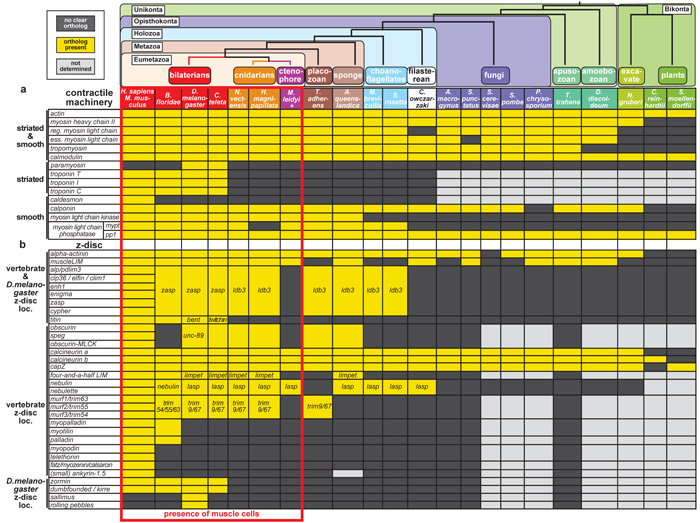
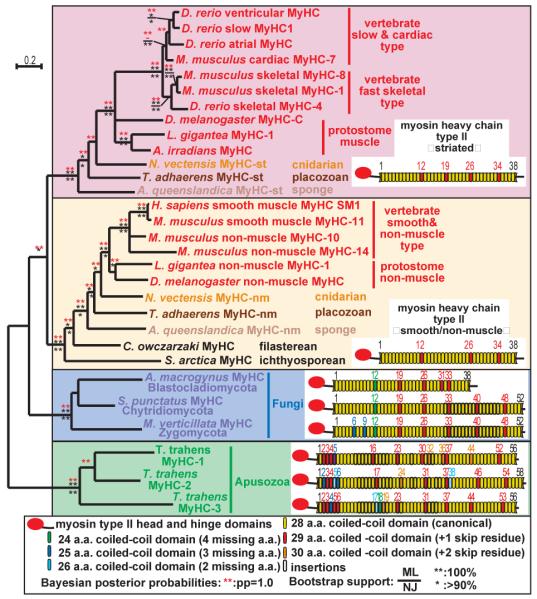
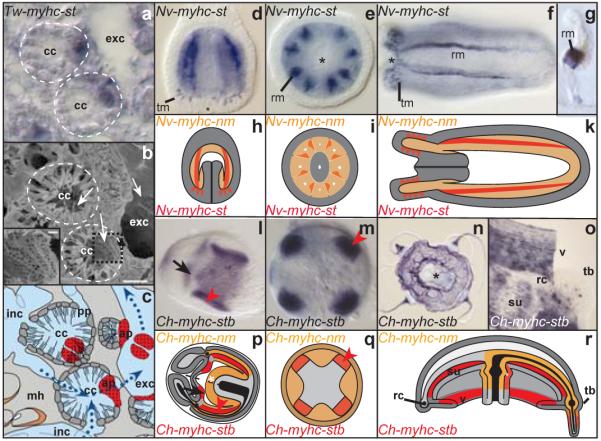
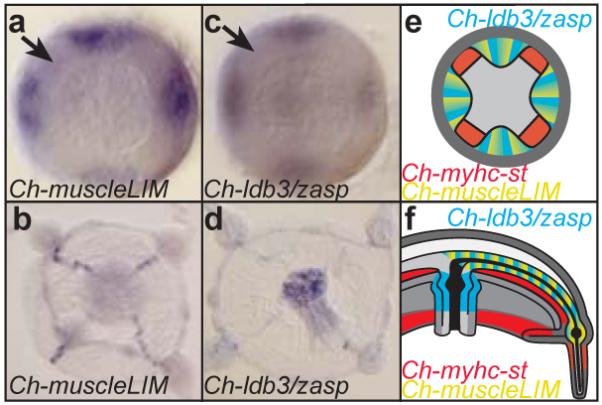
Striated muscles are present in bilaterian animals (for example, vertebrates, insects and annelids) and some non-bilaterian eumetazoans (that is, cnidarians and ctenophores). The considerable ultrastructural similarity of striated muscles between these animal groups is thought to reflect a common evolutionary origin. Here we show that a muscle protein core set, including a type II myosin heavy chain (MyHC) motor protein characteristic of striated muscles in vertebrates, was already present in unicellular organisms before the origin of multicellular animals. Furthermore, 'striated muscle' and 'non-muscle' myhc orthologues are expressed differentially in two sponges, compatible with a functional diversification before the origin of true muscles and the subsequent use of striated muscle MyHC in fast-contracting smooth and striated muscle. Cnidarians and ctenophores possess striated muscle myhc orthologues but lack crucial components of bilaterian striated muscles, such as genes that code for titin and the troponin complex, suggesting the convergent evolution of striated muscles. Consistently, jellyfish orthologues of a shared set of bilaterian Z-disc proteins are not associated with striated muscles, but are instead expressed elsewhere or ubiquitously. The independent evolution of eumetazoan striated muscles through the addition of new proteins to a pre-existing, ancestral contractile apparatus may serve as a model for the evolution of complex animal cell types.
Figures
Comment in
-
Evolutionary biology: Muscle's dual origins.Nature. 2012 Jul 11;487(7406):181-2. doi: 10.1038/487181a. Nature. 2012. PMID: 22785312 No abstract available.
References
-
- Seipel K, Schmid V. Evolution of striated muscle: Jellyfish and the origin of triploblasty. Dev Biol. 2005;282:14–26. - PubMed
-
- Schuchert P, Reber-Müller S, Schmid V. Life stage specific expression of a myosin heavy chain in the hydrozoan Podocoryne carnea. Differentiation. 1993;54:11–18. - PubMed
-
- Chapman DM, Muscatine L. In: Coelenterate Biology. Lenhoff HM, editor. Academic Press; New York, San Francisco, London: 1974.
-
- Burton PM. Inisghts from diploblasts; the evolution of mesoderm and muscle. J Exp Zool (Mol Dev Evol) 2007;308B:1–10. - PubMed
-
- Schmidt-Rhaesa A. The evolution of organ systems. Edn. 1 Oxford University Press; 2007.
Supplementary References
-
- Farah CS, Reinach FC. The troponin complex and regulation of muscle contraction. Faseb J. 1995;9:755–767. - PubMed
-
- Somlyo AP, Somlyo AV. Ca2+ sensitivity of smooth muscle and nonmuscle myosin II: modulated by G proteins, kinases, and myosin phosphatase. Physiol Rev. 2003;83:1325–1358. - PubMed
-
- Nickel M, Donath T, Schweikert M, Beckmann F. Functional morphology of Tethya species (Porifera): 1. Quantitative 3D-analysis of Tethya wilhelma by synchrotron radiation based X-ray microtomography. Zoomorphology. 2006;125:209–223.
-
- Leys SP, Degnan BM. Embryogenesis and metamorphosis in a haplosclerid demosponge: gastrulation and transdifferentiation of larval ciliated cells to choanocytes. Invertebrate Biology. 2002;121:171–189.
Publication types
MeSH terms
Substances
Grants and funding
LinkOut - more resources
Full Text Sources
