


A biomolecular isolation framework for eco-systems biology
- PMID: 22763648
- PMCID: PMC3526178
- DOI: 10.1038/ismej.2012.72
A biomolecular isolation framework for eco-systems biology
Abstract
Mixed microbial communities are complex, dynamic and heterogeneous. It is therefore essential that biomolecular fractions obtained for high-throughput omic analyses are representative of single samples to facilitate meaningful data integration, analysis and modeling. We have developed a new methodological framework for the reproducible isolation of high-quality genomic DNA, large and small RNA, proteins, and polar and non-polar metabolites from single unique mixed microbial community samples. The methodology is based around reproducible cryogenic sample preservation and cell lysis. Metabolites are extracted first using organic solvents, followed by the sequential isolation of nucleic acids and proteins using chromatographic spin columns. The methodology was validated by comparison to traditional dedicated and simultaneous biomolecular isolation methods. To prove the broad applicability of the methodology, we applied it to microbial consortia of biotechnological, environmental and biomedical research interest. The developed methodological framework lays the foundation for standardized molecular eco-systematic studies on a range of different microbial communities in the future.
Figures
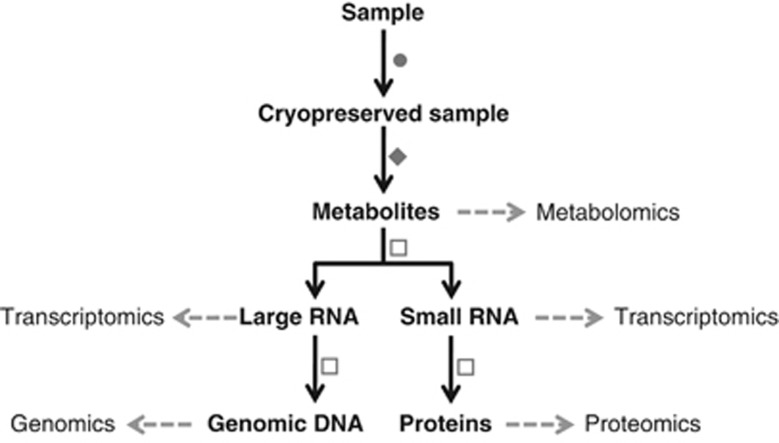
 ) Sample processing and preservation: immediate snap-freezing by immersion in liquid nitrogen for LAO-enriched mixed microbial communities; concentration by tangential flow filtration followed by high-speed centrifugation, then snap-freezing of the resulting cell pellet for freshwater mixed microbial communities; homogenization with RNAlater followed by centrifugation steps before snap-freezing for fresh human fecal samples (Materials and methods). (
 ) Cryomilling and metabolite extraction: cryomilling of cell pellets and solvent extraction of the intracellular polar and non-polar metabolite fractions (extracellular fractions were only prepared for the LAO-enriched microbial communities; Materials and methods). (
 ) Physicochemical biomacromolecular isolation: use of sequential physicochemical separation based around chromatographic spin columns following bead-beating in the modified NA-lysis buffer, resulting in the isolation of high-purity biomacromolecular fractions (Materials and methods).
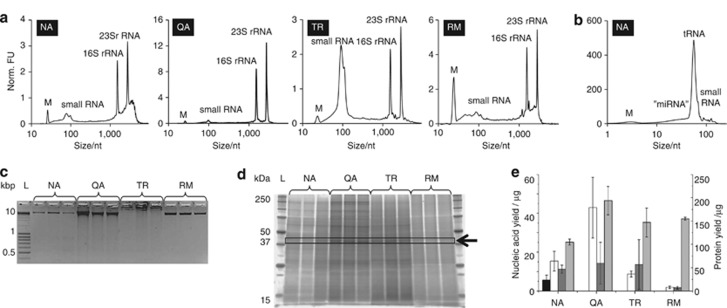
 small RNA, □ total and large RNA,
  DNA and
  protein (first elution) fractions (n=5, error bars represent s.d.). FU, fluorescent unit; L, ladder; M, marker; NA, NA-based method; Norm., normalized; nt, nucleotides; RM, reference methods; TR, TR-based method; QA, QA-based method.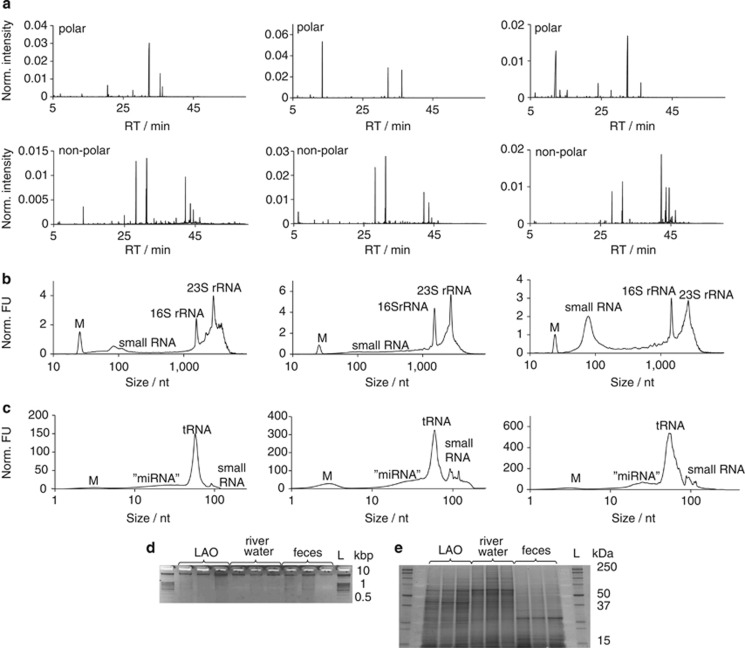
References
-
- Chey S, Claus C, Liebert UG. Improved method for simultaneous isolation of proteins and nucleic acids. Anal Biochem. 2011;411:164–166. - PubMed
-
- Chomczynski P. A reagent for the single-step simultaneous isolation of RNA, DNA and proteins from cell and tissue samples. Biotechniques. 1993;15:532–536. - PubMed
-
- Denef VJ, Mueller RS, Banfield JF. AMD biofilms: using model communities to study microbial evolution and ecological complexity in nature. ISME J. 2010;4:599–610. - PubMed
-
- Dunn WB, Broadhurst D, Begley P, Zelena E, Francis-McIntyre S, Anderson N, et al. Procedures for large-scale metabolic profiling of serum and plasma using gas chromatography and liquid chromatography coupled to mass spectrometry. Nat Protoc. 2011;6:1060–1083. - PubMed
-
- Fischer CR, Wilmes P, Bowen BP, Northen TR, Banfield JF.2011Deuterium-exchange metabolomics reveals N-methyl lyso phosphatidylethanolamines as abundant lipids in acidophilic mixed microbial communities Metabolomicsadvance online publicationdoi: 10.1007/s11306-011-0344-x - DOI
Publication types
MeSH terms
Substances
LinkOut - more resources
Full Text Sources
Other Literature Sources
Molecular Biology Databases
