


Signatures of tumor-immune interactions as biomarkers for breast cancer prognosis
- PMID: 22764768
- PMCID: PMC4634870
- DOI: 10.2217/fon.12.57
Signatures of tumor-immune interactions as biomarkers for breast cancer prognosis
Abstract
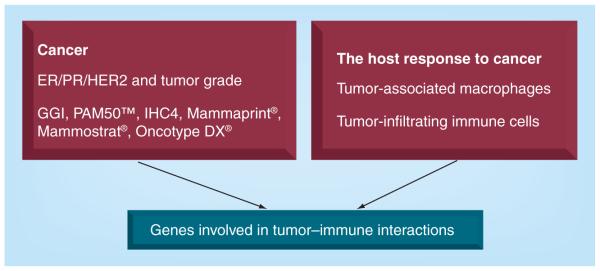
Breast cancer mortality is usually due to distant recurrence of cancer at an advanced stage of the disease rather than from primary cancer. Therefore, prediction of breast cancer recurrence at the time of diagnosis could lead to advances in personalized treatment of cancer patients in order to prevent risk of recurrence. Two prognostic biomarkers that are currently being used in clinical practice are a 70-gene MammaPrint signature and a 21-gene Oncotype DX panel. These assays generate relative risks of recurrence, but they do not provide a 'yes' or 'no' answer about recurrence in a given patient. These tests include genes that are involved in the cell cycle, invasion, metastasis and angiogenesis related to breast cancer. Emerging evidence suggests that a signature of genes involved in tumor-immune interactions may provide a more accurate prognostic tool. This paper reviews recent advances in the discovery of prognostic biomarkers for breast cancer patients.
Figures
References
-
- Carr JA, Havstad S, Zarbo RJ, Divine G, Mackowiak P, Velanovich V. The association of HER2/neu amplification with breast cancer recurrence. Arch. Surg. 2000;135(12):1469–1474. - PubMed
-
- Addressed prognostic significance of HER2 by resolving the discordance between ductal carcinoma in situ and invasive carcinoma in the frequency of HER2 overexpression.
-
- Showed that HER2 is not an independent predictor of recurrence because T-cell responses can induce HER2 loss and result in the relapse of a more aggressive HER2-negative tumor.
Publication types
MeSH terms
Substances
Grants and funding
LinkOut - more resources
Full Text Sources
Other Literature Sources
Medical
