


doi: 10.1080/13803395.2012.666230.
Epub 2012 Mar 9.
Validation of the Face Name Associative Memory Exam in cognitively normal older individuals
Affiliations
- PMID: 22765048
- PMCID: PMC3391747
- DOI: 10.1080/13803395.2012.666230
Item in Clipboard
Validation of the Face Name Associative Memory Exam in cognitively normal older individuals
J Clin Exp Neuropsychol.
2012.
Abstract
The recently developed Face Name Associative Memory Exam (FNAME), a challenging paired associative learning task, shows promise in detecting the subtle cognitive changes characteristic of preclinical Alzheimer's disease. In this study, we evaluated the validity and reliability of the FNAME in 210 cognitively normal older individuals (58-90 years of age). Construct validity of the measure was assessed by principal components analysis, which revealed two independent factors. Correlations between the FNAME subtests and another episodic memory test were significant. The results indicated strong test-retest reliability in a subsample (n = 41). Normative data stratified by age were also generated.
Figures
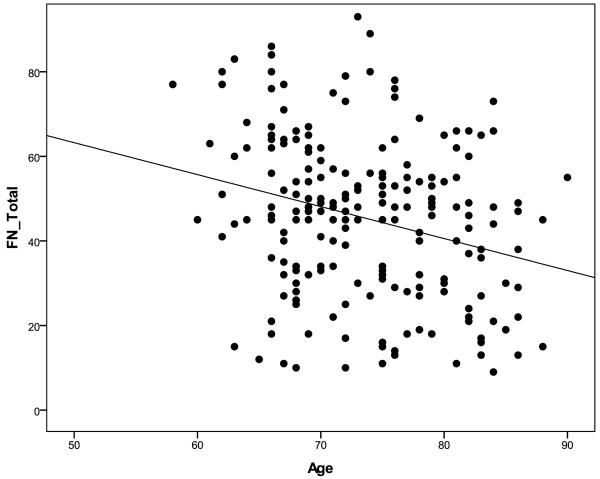
Scatter plot of age and FNAME total raw score summary scale. Performance on the FNAME declines with age.
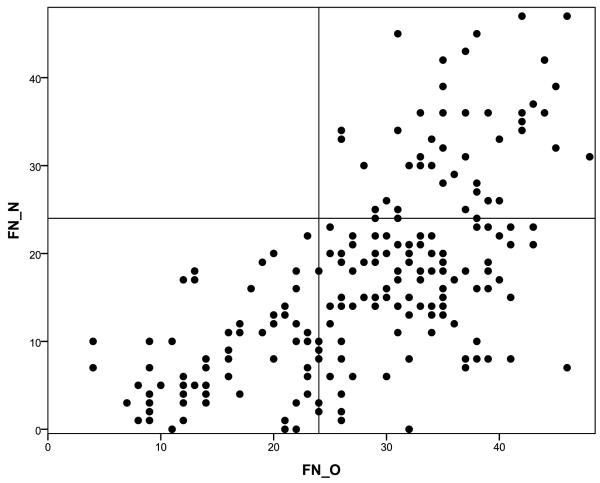
Poor performance on FN-N may result in either a high or low performance on FN-O. By contrast, strong performance on FN-N corresponds with strong performance on FN-O.
References
-
- Albert MS, Moss MB, Tanzi R, Jones K. Preclinical prediction of AD using neuropsychological tests. J Int Neuropsychol Soc. 2001;7(5):631–639. - PubMed
-
- Backman L, Jones S, Berger AK, Laukka EJ, Small BJ. Cognitive impairment in preclinical Alzheimer’s disease: a meta-analysis. Neuropsychology. 2005;19(4):520–531. doi: 2005-08223-013 [pii] 10.1037/0894-4105.19.4.520. - PubMed
-
- Blacker D, Lee H, Muzikansky A, Martin EC, Tanzi R, McArdle JJ, et al. Neuropsychological measures in normal individuals that predict subsequent cognitive decline. Arch Neurol. 2007;64(6):862–871. doi: 64/6/862 [pii] 10.1001/archneur.64.6.862. - PubMed
-
- Blackwell AD, Sahakian BJ, Vesey R, Semple JM, Robbins TW, Hodges JR. Detecting dementia: novel neuropsychological markers of preclinical Alzheimer’s disease. Dement Geriatr Cogn Disord. 2004;17(1-2):42–48. doi: 10.1159/000074081 DEM20040171_2042 [pii] - PubMed
Publication types
MeSH terms
Grants and funding
LinkOut - more resources
Full Text Sources
Medical