


Effects on promoter activity of common SNPs in 5' region of GABRB3 exon 1A
- PMID: 22765836
- PMCID: PMC3418397
- DOI: 10.1111/j.1528-1167.2012.03572.x
Effects on promoter activity of common SNPs in 5' region of GABRB3 exon 1A
Abstract
Purpose: The β3 subunit of the γ-aminobutyric acid type A receptors (GABA(A) -Rs) is an essential component of GABA(A) -Rs in fetal, perinatal, and adult mammalian brain. Various transcripts of the β3 subunit gene (GABRB3) produce various proteins with different N-termini. Rare variants in this N-terminus (exon 1A and exon 2) of GABRB3 protein segregate in affected family members of two multigeneration-multiplex families with remitting childhood absence epilepsy (rCAE), suggesting GABRB3 is a major Mendelian epilepsy gene for rare families with CAE. Therefore, the N-terminus of GABRB3 could be important for GABRB3 regulation in development, and its alteration could produce rCAE. Herein we determine if single nucleotide polymorphisms (SNPs) within the 1,148-bp region upstream from exon 1A influence the expression of GABRB3.
Methods: We studied luciferase reporter expression for promoter activity, 1,148-bp upstream from exon 1A, using human embryonic kidney 293 cells. We generated constructs of the promoter region and compared different SNP haplotypes in 48 patients with rCAE. Next, we compared frequencies of rs20317, located in the core promoter region, and rs4906902, located in the enhancer region between 48 patients with rCAE and >500 healthy controls matched for ethnicity and ancestral origin.
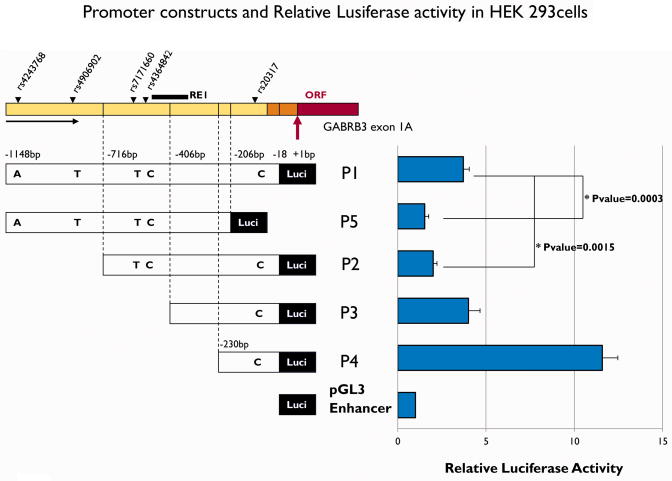
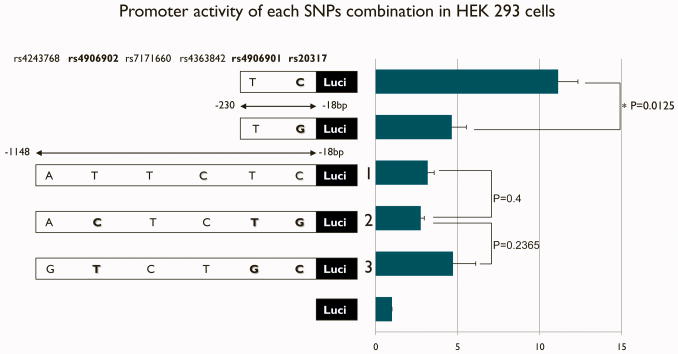
Key findings: Highest luciferase expression occurred 230-bp upstream of exon 1A. The construct that excluded this region lost luciferase activity. Therefore, this region contains the core promoter of exon 1A. Allele C but not allele G (rs20317) significantly increased luciferase expression activity. Allele C creates binding motifs for cMYB and EGR-3. Longer constructs overlapping this region have a binding motif for REST (RE1-silencing transcription factor), a critical epigenetic modulator for neuronal genes. REST represses expression of neuronal genes in nonneuronal tissues, resulting in reduced luciferase expression activity. Even in the suppressed condition, the longer construct enhanced luciferase expression activity of the shorter construct, which excluded the distal end containing rs4906902. However, allele frequencies of rs20317 and rs4906902 were not significantly associated with 48 rCAE patients in comparison to >500 controls matched for ethnicity and ancestral origin.
Significance: Common SNPs in the promoter region increase luciferase expression activity. An epigenetic modulator, REST, specifically alters expression of GABRB3 exon 1A transcripts, suggesting epigenetic regulation by REST dominantly controls the expression of GABRB3 variant 2 transcript in early life GABA(A) signaling. Abnormal epigenetic regulation could be involved in absence seizures.
Wiley Periodicals, Inc. © 2012 International League Against Epilepsy.
Conflict of interest statement
The authors declare that they have no conflicts of interest. We confirm that we have read the Journal’s position on issues involved in ethical publication and affirm that this report is consistent with those guidelines.
Figures
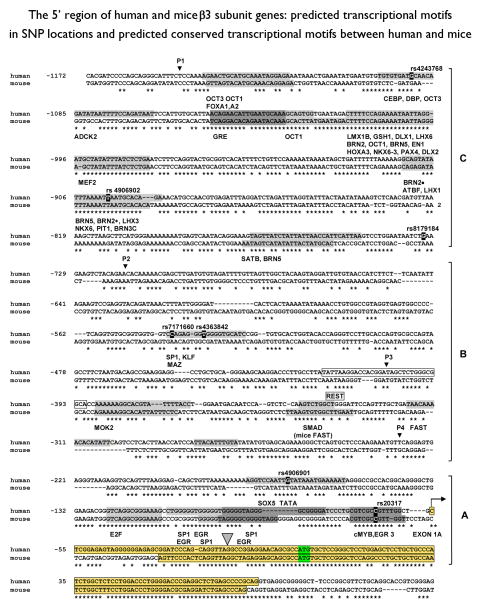
 ) and each translational start codon is shadowed by green. The arrow (
 ) shows the transcriptional start site of exon 1A. Location of SNPs are painted white against a black background (
 ) and each accession number is shown above each nucleotide. The black triangles (▼) represent the border of each segment for the deletion study. The gray larger triangle (
 ) represents the common end nucleotide for each segment of the deletion study except P5. The region which was predicted to contain transcriptional motifs associated with neuronal cells and several ubiquitous major motifs are shown by shadowed letters (

 ), and each annotation is presented under each motif. The REST binding motif (RE1) is also surrounded by a rectangle. Common predicted matrixes between human and mice have over 0.89 of matrix similarity in MatInspector version 8.01. In region A, SNP rs20317 is located in the potential core promoter region, which is over 75 % identical between mouse chromosome 7 and human chromosome 15. Three specificity protein 1 (SP1) binding sites which overlap three EGR motifs and one E2F motif are predicted in the region from −124 bp to −77 bp upstream from the translational start codon in region A. These three sorts of motifs are also predicted in the mouse genome. GpC island clustering is found in the flanking region −140 bp upstream from the start codon ATG. The matrix of the TATA box lies in the region of SNP rs4906901, but three SP1 binding sites reside downstream of this motif. The allele G of rs4906901 makes SOX 5 binding motif but the allele T does not. SOX5 has been shown the involvement in neurogenesis, neuronal differentiation and neocortical neuron diversity (Lai et al., 2008). In region B, FAST1 and SMAD protein plays a critical role in early embryonic development as well as REST (Silvestri, 2008).
References
-
- Ballas N, Mandel G. The many faces of REST oversee epigenetic programming of neuronal genes. Curr Opin Neurobiol. 2005;15:500–506. - PubMed
-
- Ben-Ari Y, Khazipov R, Leinekugel X, Caillard O, Gaiarsa JL. GABAA, NMDA and AMPA receptors: a developmentally regulated ‘ménage à trois’. Trends Neurosci. 1997;20 :523–529. - PubMed
-
- Chen ZF, Paquette AJ, Anderson DJ. NRSF/REST is required in vivo for repression of multiple neuronal target genes during embryogenesis. Nat Genet. 1998;20:136–142. - PubMed
-
- DeLorey TM, Handforth A, Homanics GE, Anagnostaras SG, Homanics GE, Minassian BA, Asatourian A, Fanselow MS, Delgado-Escueta A, Ellison GD, Olsen RW. Mice lacking the β3 subunit of the GABAA receptor have the epilepsy phenotype and many of the behavioral characteristics of Angelman syndrome. J Neurosci. 1998;18:8505–14. - PMC - PubMed
Publication types
MeSH terms
Substances
Grants and funding
LinkOut - more resources
Full Text Sources
