


A review on the importance of metals and metalloids in atmospheric dust and aerosol from mining operations
- PMID: 22766428
- PMCID: PMC3418464
- DOI: 10.1016/j.scitotenv.2012.06.013
A review on the importance of metals and metalloids in atmospheric dust and aerosol from mining operations
Abstract
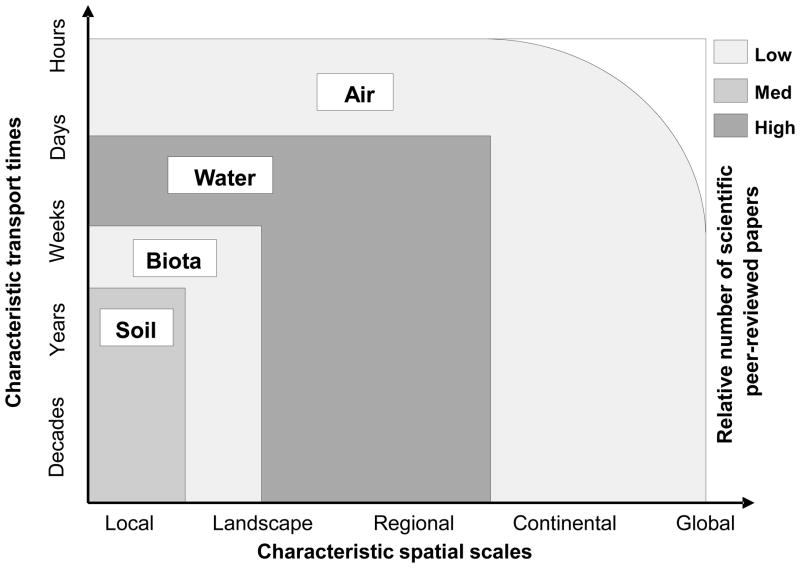
Contaminants can be transported rapidly and over relatively long distances by atmospheric dust and aerosol relative to other media such as water, soil and biota; yet few studies have explicitly evaluated the environmental implications of this pathway, making it a fundamental but understudied transport mechanism. Although there are numerous natural and anthropogenic activities that can increase dust and aerosol emissions and contaminant levels in the environment, mining operations are notable with respect to the quantity of particulates generated, the global extent of area impacted, and the toxicity of contaminants associated with the emissions. Here we review (i) the environmental fate and transport of metals and metalloids in dust and aerosol from mining operations, (ii) current methodologies used to assess contaminant concentrations and particulate emissions, and (iii) the potential health and environmental risks associated with airborne contaminants from mining operations. The review evaluates future research priorities based on the available literature and suggest that there is a particular need to measure and understand the generation, fate and transport of airborne particulates from mining operations, specifically the finer particle fraction. More generally, our findings suggest that mining operations play an important but underappreciated role in the generation of contaminated atmospheric dust and aerosol and the transport of metal and metalloid contaminants, and highlight the need for further research in this area. The role of mining activities in the fate and transport of environmental contaminants may become increasingly important in the coming decades, as climate change and land use are projected to intensify, both of which can substantially increase the potential for dust emissions and transport.
Copyright © 2012 Elsevier B.V. All rights reserved.
Figures






References
-
- Albrecht BA. Aerosols, cloud microphysics, and fractional cloudiness. Science. 1989;245:1227–30. - PubMed
-
- Allen AG, Nemitz E, Shi JP, Harrison RM, Greenwood JC. Size distributions of trace metals in atmospheric aerosols in the United Kingdom. Atmos Environ. 2001;35:4581–91.
-
- Alloway BJ, Ayres DC. Chemical principles of environmental pollution. New York: Blackie Academic & Professional; 1997.
-
- Alonso ML, Benedito JL, Miranda M, Castillo C, Hernandez J, Shore RF. Interactions between toxic and essential trace metals in cattle from a region with low levels of pollution. Arch Environ Con Tox. 2002;42:165–72. - PubMed
Publication types
MeSH terms
Substances
Grants and funding
LinkOut - more resources
Full Text Sources
