Review
. 2012 Dec;22(6):1027-38.
doi: 10.1016/j.conb.2012.06.001. Epub 2012 Jul 3.

The root of all value: a neural common currency for choice

Affiliations
Review

The root of all value: a neural common currency for choice

Dino J Levy et al. Curr Opin Neurobiol. 2012 Dec.

Abstract

How do humans make choices between different types of rewards? Economists have long argued on theoretical grounds that humans typically make these choices as if the values of the options they consider have been mapped to a single common scale for comparison. Neuroimaging studies in humans have recently begun to suggest the existence of a small group of specific brain sites that appear to encode the subjective values of different types of rewards on a neural common scale, almost exactly as predicted by theory. We have conducted a meta analysis using data from thirteen different functional magnetic resonance imaging studies published in recent years and we show that the principle brain area associated with this common representation is a subregion of the ventromedial prefrontal cortex (vmPFC)/orbitofrontal cortex (OFC). The data available today suggest that this common valuation path is a core system that participates in day-to-day decision making suggesting both a neurobiological foundation for standard economic theory and a tool for measuring preferences neurobiologically. Perhaps even more exciting is the possibility that our emerging understanding of the neural mechanisms for valuation and choice may provide fundamental insights into pathological choice behaviors like addiction, obesity and gambling.


Figures

Figure 1
Figure 1
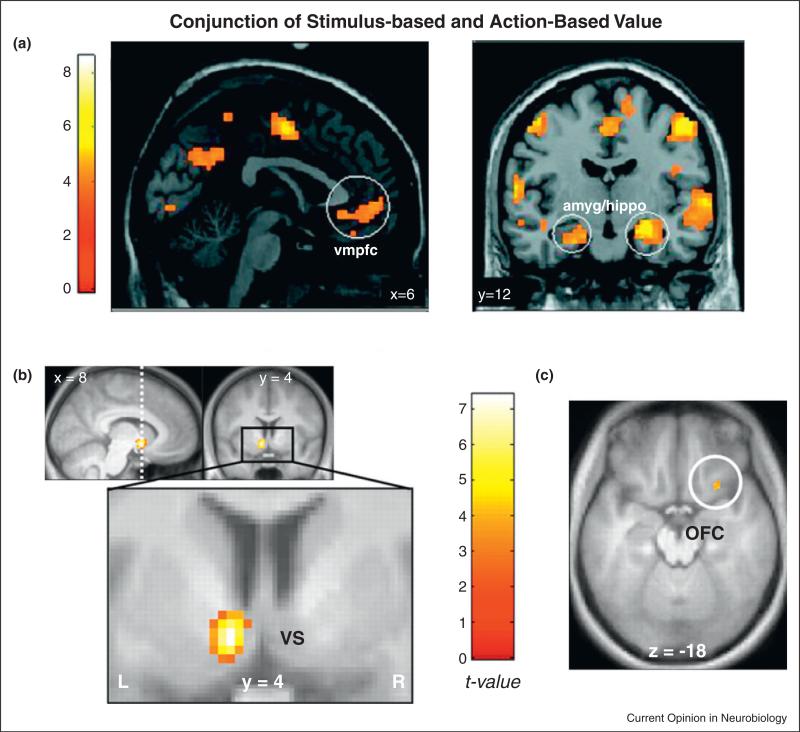
(a) Common areas that coded stimulus values and action values. Adapted with permission from [25]. (b, c) Areas that correlated with subjective values as measured in a delayed discounting task and in a risky task. Adapted with permission from [26].
Figure 2
Figure 2
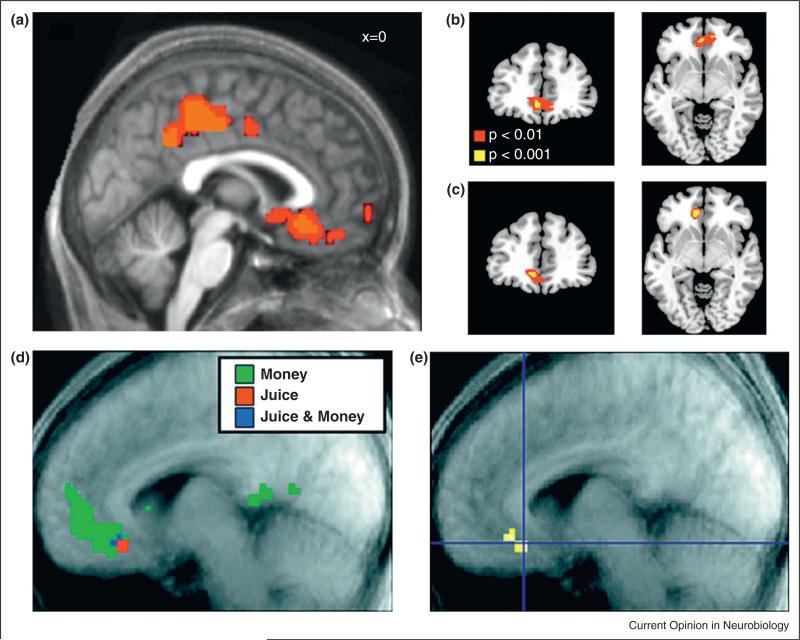
(a) Activity in a subregion of the vmPFC/OFC and PCC, which correlated with the difference between the value of money and the value of incommensurable goods. Adapted with permission from [29]. (b, c) Activity in a subregion of the vmPFC/OFC, which correlated with the decision values of money, food and non-food items. Adapted with permission from [30]. (d) Activity in the vmPFC/OFC, which correlated with the expected outcome of money and juice. (e) Activity in a subregion of the vmPFC/OFC showing the overlap response for the expected outcome of both money and juice rewards. Adapted with permission from [31].
Figure 3
Figure 3
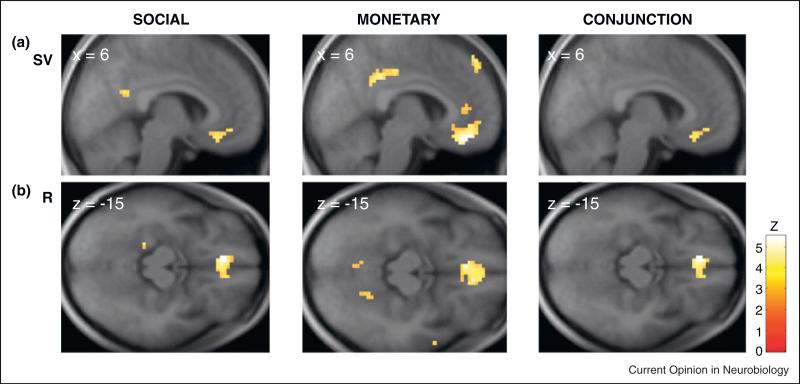
(a) Activity in a subregion of the vmPFC/OFC tracked the subjective values (SV) of both social rewards (left) and money (middle). The right column represents the conjunction activation that tracked the subjective values for both social and monetary rewards. (b) The same as in (a) but for reward values (R). Adapted with permission from [34].
Figure 4
Figure 4
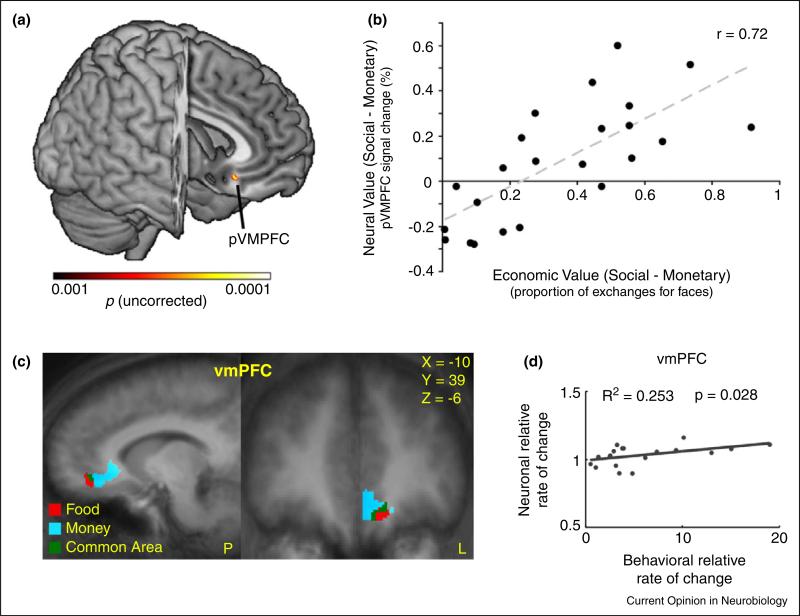
(a) The posterior vmPFC showed a significant correlation between economic value and neural value. (b) A positive correlation (across subjects) between a neural value difference (defined as neural social value – neural monetary value) and the exchange rate between money and social values determined in behavior was found in the posterior vmPFC. A higher neurometric value difference was associated with a higher propensity to make an economic exchange. Adapted with permission from [36••]. (c) A subregion of the vmPFC/OFC showed a significant correlation between behavioral and neuronal rate of change. (d) A positive correlation (across subjects) was found between the ratio of money and food neural subjective values (marginal BOLD) in a subregion of the vmPFC/OFC with the ratio of the scaled marginal utilities of money and food measured behaviorally using a fitted exchanged rate between money and food. A higher neural ‘exchange rate’ was associated with a higher behavioral exchange rate. Adapted with permission from [37]. Each dot represents the value of one subject and the line represents the least square fit across subjects.
Figure 5
Figure 5
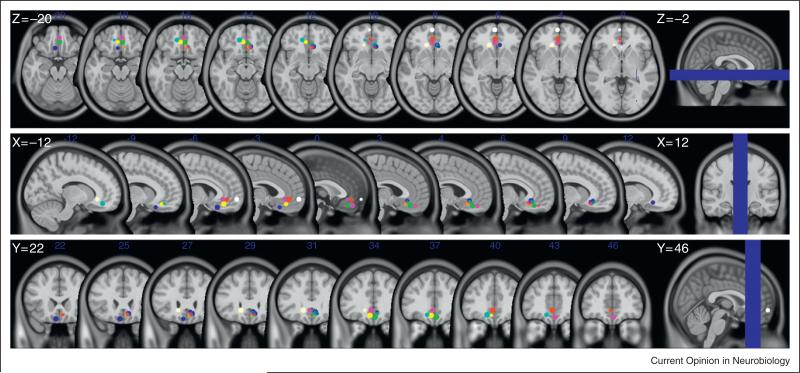
Peak voxels in the subregion of the vmPFC/OFC representing value-related signals from the studies described in the text. The coordinates of the peak voxels were taken from the original studies and are detailed in Table 1. We drew a ball of 5 mm3 radius around each of the peak voxels for presentation purposes. Brain images are the T1 MNI-152 template.
Figure 6
Figure 6
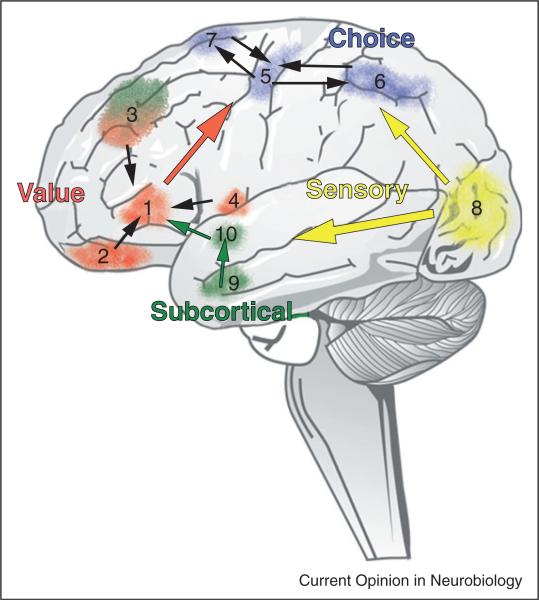
One possible schema for understanding the decision-making networks of the human brain. Current evidence suggests that information from cortical and subcortical structures converges toward a single common value representation before passing on to the choice-related motor control circuitry. Modulatory inputs play a critical role in establishing this final common representation with those inputs carrying signals related to arousal, internal state (satiety, thirst, hormonal levels, etc.) and emotional intensity. In this schema, sensory information from all modalities carries, among other things, the identity and location of the options. We use visual signals in this diagram to stand for information from all sensory modalities. (1) vmPFC, (2) OFC, (3) DLPFC, (4) Insula, (5) Primary motor cortex (M1), (6) Posterior parietal cortex, (7) frontal eye fields, (8) Visual cortex, (9) Amygdala, (10) Striatum.

References

    1. Deaner RO, Khera AV, Platt ML. Monkeys pay per view: adaptive valuation of social images by rhesus macaques. Curr Biol. 2005;15:543–548. - PubMed
    1. Klein JT, Deaner RO, Platt ML. Neural correlates of social target value in macaque parietal cortex. Curr Biol. 2008;18:419–424. [The authors demonstrate, for the first time, common currency representations of value. They showed that single unit activity in parietal area LIP reflects the aggregated subjective value of expected social rewards, threats, and fluid rewards.] - PMC - PubMed
    1. Matsumoto M, Hikosaka O. Two types of dopamine neuron distinctly convey positive and negative motivational signals. Nature. 2009;459:837–841. - PMC - PubMed
    1. Samuelson PA. Foundations of Economic Analysis. Harvard University Press; Cambridge: 1947.
    1. Von Neumann J, Morgenstern O. Theory of Games and Economic Behavior. Princeton Univ. Press; 1944.