


Review
doi: 10.1007/s00018-012-1042-1.
Epub 2012 Jul 6.
Prevention or acceleration of type 1 diabetes by viruses
Affiliations
- PMID: 22766971
- PMCID: PMC11113684
- DOI: 10.1007/s00018-012-1042-1
Item in Clipboard
Review
Prevention or acceleration of type 1 diabetes by viruses
Cell Mol Life Sci.
2013 Jan.
Erratum in
- Cell Mol Life Sci. 2013 Jan;70(2):257
Abstract
Type 1 diabetes is an autoimmune disease characterized by the destruction of insulin-producing pancreatic β-cells. Even though extensive scientific research has yielded important insights into the immune mechanisms involved in pancreatic β-cell destruction, little is known about the events that trigger the autoimmune process. Recent epidemiological and experimental data suggest that environmental factors are involved in this process. In this review, we discuss the role of viruses as an environmental factor on the development of type 1 diabetes, and the immune mechanisms by which they can trigger or protect against this pathology.
Figures
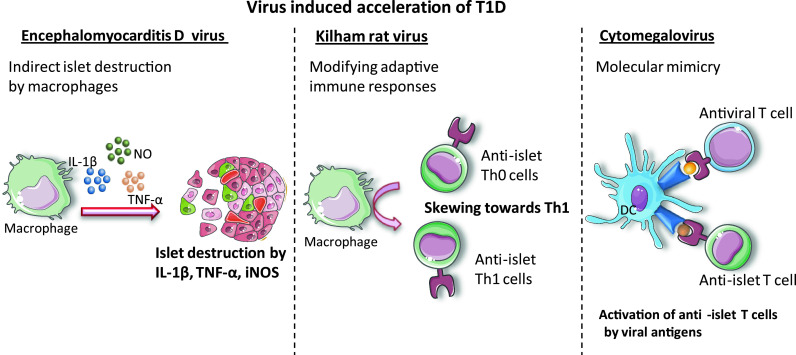
Virus-induced acceleration of T1D. Viruses can accelerate T1D by inducing immune cells such as macrophages to produce proinflammatory cytokines that can kill pancreatic β-cells or by skewing immune responses towards generation of pathogenic anti-islet Th1 cells. Molecular mimicry can be another mechanism leading to the activation of autoreactive anti-islet T cells
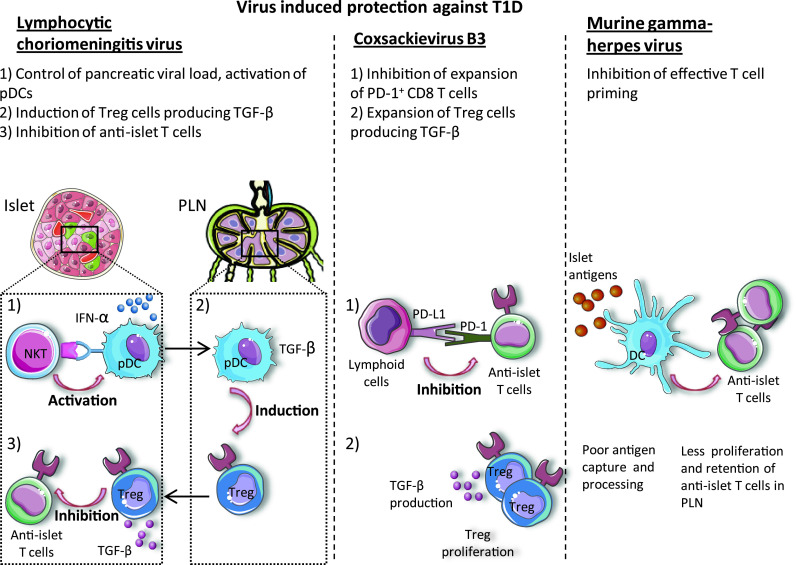
Virus-induced protection against T1D. Viruses can induce protection from T1D by eliciting immune mechanisms such as induction of Treg cells, inhibition of anti-islet T cells through suppressive receptors like PD-1 and suppressive cytokines like TGF-β or by blocking the efficient antigen capture and processing by antigen-presenting cells
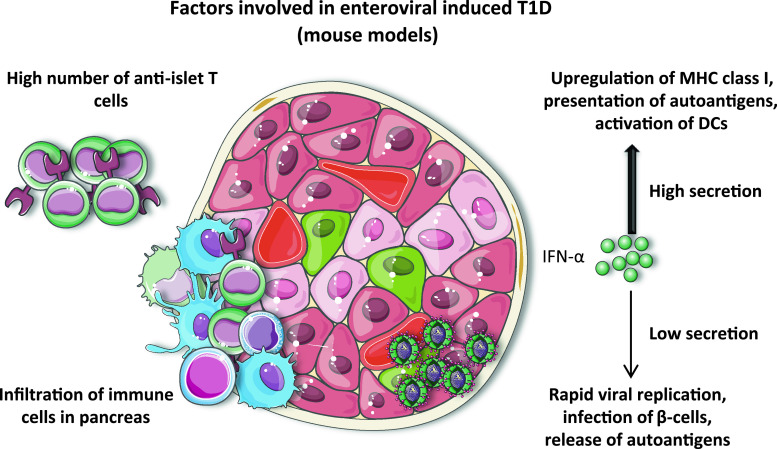
Factors involved in enteroviral-induced T1D. Studies in mouse models have revealed that in order for enteroviruses to accelerate T1D, a high number of autoreactive anti-islet T cells are necessary. In addition, pancreas must be infiltrated by cells of the immune system. As for the IFN-α, its high secretion can result in a strong activation of the immune system favoring the presentation of islet autoantigens. On the other hand, if IFN-α secretion is too low, viruses will replicate freely, infect islet β-cells, and provoke the release of autoantigens leading to the activation of anti-islet T cells and provoking diabetes
References
Publication types
MeSH terms
LinkOut - more resources
Full Text Sources
Medical
