


Patterns of antiretroviral therapy adherence and impact on HIV RNA among patients in North America
- PMID: 22767342
- PMCID: PMC3655551
- DOI: 10.1097/QAD.0b013e328354bed6
Patterns of antiretroviral therapy adherence and impact on HIV RNA among patients in North America
Abstract
Objective: Adherence to antiretroviral therapies (ART) is the strongest predictor of viral suppression among individuals infected with HIV, however, limited data exists to understand the patterns of adherence that confer the greatest benefit across different ART regimens.
Design: Longitudinal data pooled from 16 studies conducted between 1997 and 2009 across the United States.
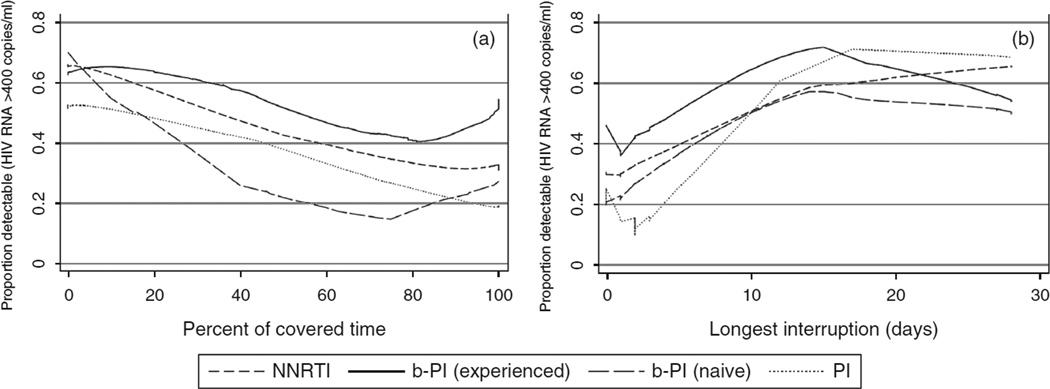
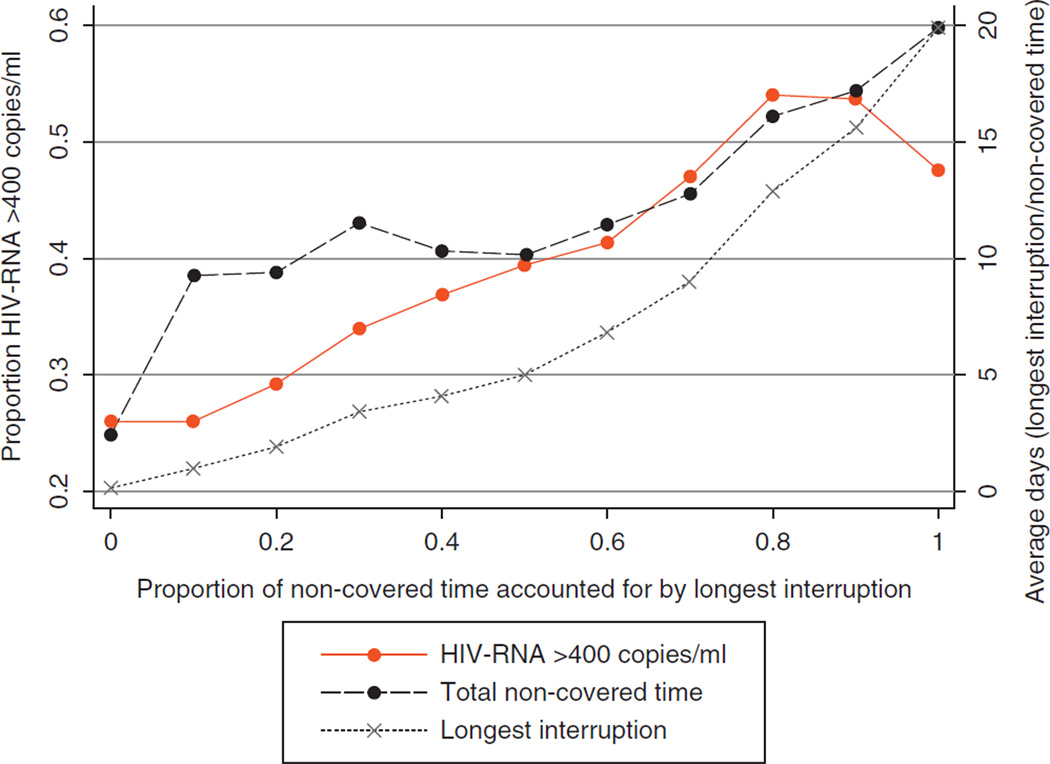
Methods: Adherence was measured using Medication Event Monitoring System. Percentage of time with sufficient drug concentrations (covered time) and the length of the longest treatment interruption during the 28 days prior to plasma HIV-RNA measurements were calculated. Logistic regression with generalized estimating equations was used to estimate medication-specific adherence estimates on detectable HIV-RNA (>400 copies/ml).
Results: One thousand and eighty-eight participants with 3795 HIV-RNA measures were studied. Both lower covered time and greater longest interruption showed dose-response relationships with the odds of detectable HIV-RNA; however, estimates did not vary by medication regimen. Compared with 93-100% coverage, periods of 0-25% covered time had a three-fold increased risk of detectable HIV-RNA [odds ratio (OR) = 3.22, 95% confidence interval (CI): 2.48-4.19]. Similarly, compared to longest interruptions of 0-48 h, longest interruptions of 21-28 days had a nearly four-fold increased risk of detectable HIV-RNA (OR = 3.65, 95% CI: 2.77, 4.81).
Conclusion: We found that adherence was consistently strongly associated with treatment response across ART regimens. Of the patterns of adherence, longer interruptions may have greater impact than covered time. Future research should investigate additional methods for examining adherence patterns, understanding the determinants of consecutive missed doses and the evaluation of interventions designed to address interruptions in treatment.
Conflict of interest statement
The authors have no conflicts of interest to declare.
Figures
References
-
- Bangsberg DR, Perry S, Charlebois ED, Clark RA, Roberston M, Zolopa AR, et al. Nonadherence to highly active antiretroviral therapy predicts progression to AIDS. AIDS. 2001;15:1181–1183. - PubMed
-
- Paterson DL, Swindells S, Mohr J, Brester M, Vergis EN, Squier C, et al. Adherence to protease inhibitor therapy and outcomes in patients with HIV infection. Ann Intern Med. 2000;133:21–30. - PubMed
-
- Gross R, Bilker WB, Friedman HM, Strom BL. Effect of adherence to newly initiated antiretroviral therapy on plasma viral load. AIDS. 2001;15:2109–2117. - PubMed
-
- Liu H, Golin CE, Miller LG, Hays RD, Beck CK, Sanandaji S, et al. A comparison study of multiple measures of adherence to HIV protease inhibitors. Ann Intern Med. 2001;134:968–977. - PubMed
Publication types
MeSH terms
Substances
Grants and funding
- R01 MH058986/MH/NIMH NIH HHS/United States
- R01 MH078773/MH/NIMH NIH HHS/United States
- R01 MH054907/MH/NIMH NIH HHS/United States
- R01MH61173/MH/NIMH NIH HHS/United States
- R01 DA015215/DA/NIDA NIH HHS/United States
- R01DA015679/DA/NIDA NIH HHS/United States
- P01MH49548/MH/NIMH NIH HHS/United States
- T32HS01965/HS/AHRQ HHS/United States
- P01 MH049548/MH/NIMH NIH HHS/United States
- U01 AI069419/AI/NIAID NIH HHS/United States
- P30 AI050410/AI/NIAID NIH HHS/United States
- R01MH61695/MH/NIMH NIH HHS/United States
- AI069419/AI/NIAID NIH HHS/United States
- R01MH078773/MH/NIMH NIH HHS/United States
- R01 MH061695/MH/NIMH NIH HHS/United States
- AI38858/AI/NIAID NIH HHS/United States
- P30 MH043520/MH/NIMH NIH HHS/United States
- K24 MH087227/MH/NIMH NIH HHS/United States
- R01 NR004749/NR/NINR NIH HHS/United States
- R01MH68197/MH/NIMH NIH HHS/United States
- R01DA13826/DA/NIDA NIH HHS/United States
- K24 MH092242/MH/NIMH NIH HHS/United States
- R01MH58986/MH/NIMH NIH HHS/United States
- K02DA017277/DA/NIDA NIH HHS/United States
- K23 MH001862/MH/NIMH NIH HHS/United States
- R01 DA015679/DA/NIDA NIH HHS/United States
- R01 MH061173/MH/NIMH NIH HHS/United States
- R01MH01584/MH/NIMH NIH HHS/United States
- K23MH01862/MH/NIMH NIH HHS/United States
- U01 AI038858/AI/NIAID NIH HHS/United States
- K08 MH001584/MH/NIMH NIH HHS/United States
- R01AI41413/AI/NIAID NIH HHS/United States
- R25 DA023021/DA/NIDA NIH HHS/United States
- K02 DA017277/DA/NIDA NIH HHS/United States
- R01DA11869/DA/NIDA NIH HHS/United States
- K24 HD069204/HD/NICHD NIH HHS/United States
- R01 MH068197/MH/NIMH NIH HHS/United States
- R01 DA011869/DA/NIDA NIH HHS/United States
- R01MH54907/MH/NIMH NIH HHS/United States
- P30 AI042853/AI/NIAID NIH HHS/United States
- R01DA15215/DA/NIDA NIH HHS/United States
- UM1 AI069419/AI/NIAID NIH HHS/United States
- R01NR04749/NR/NINR NIH HHS/United States
- R01 DA013826/DA/NIDA NIH HHS/United States
LinkOut - more resources
Full Text Sources
Medical
