


Association of a genetic risk score with prevalent and incident myocardial infarction in subjects undergoing coronary angiography
- PMID: 22767652
- PMCID: PMC3459582
- DOI: 10.1161/CIRCGENETICS.111.960229
Association of a genetic risk score with prevalent and incident myocardial infarction in subjects undergoing coronary angiography
Abstract
Background: Genome-wide association studies have identified multiple variants associating with coronary artery disease (CAD) and myocardial infarction (MI). Whether a combined genetic risk score (GRS) is associated with prevalent and incident MI in high-risk subjects remains to be established.
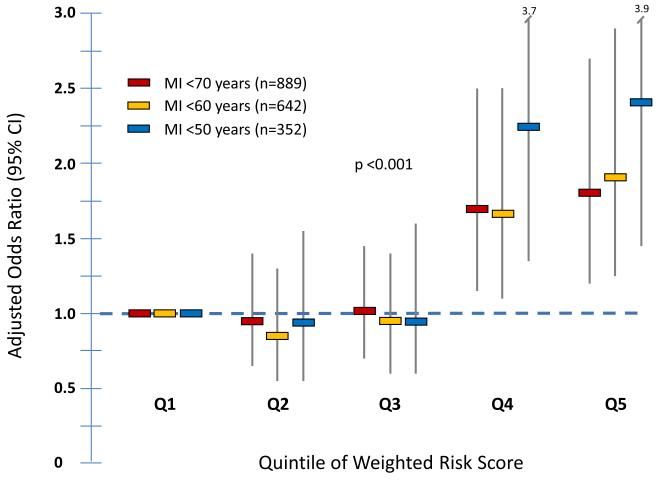
Methods and results: In subjects undergoing cardiac catheterization (n=2597), we identified cases with a history of MI onset at age <70 years and controls ≥70 years without prior MI and followed them for incident MI and death. Genotyping was performed for 11 established CAD/MI variants, and a GRS was calculated based on average number of risk alleles carried at each locus weighted by effect size. Replication of association findings was sought in an independent angiographic cohort (n=2702). The GRS was significantly associated with prevalent MI, occurring before age 70, compared with older controls (≥70 years of age) with no history of MI (P<0.001). This association was successfully replicated in a second cohort, yielding a pooled P value of <0.001. The GRS modestly improved the area-under-the-curve statistic in models of prevalent MI with traditional risk factors; however, the association was not statistically significant when elderly controls without MI but with s\ angiographic CAD were examined (pooled P=0.11). Finally, during a median 2.5-year follow-up, only a nonsignificant trend was noted between the GRS and incident events, which was also not significant in the replication cohort.
Conclusions: A GRS of 11 CAD/MI variants is associated with prevalent MI but not near-term incident adverse events in 2 independent angiographic cohorts. These findings have implications for understanding the clinical use of genetic risk scores for secondary as opposed to primary risk prediction.
Figures
Comment in
-
Clinical utility of genetic variants for cardiovascular risk prediction: a futile exercise or insufficient data?Circ Cardiovasc Genet. 2012 Aug 1;5(4):387-90. doi: 10.1161/CIRCGENETICS.112.964148. Circ Cardiovasc Genet. 2012. PMID: 22896012 No abstract available.
References
-
- McCarthy MI, Abecasis GR, Cardon LR, Goldstein DB, Little J, Ioannidis JP, et al. Genome-wide association studies for complex traits: Consensus, uncertainty and challenges. Nat Rev Genet. 2008;9:356–369. - PubMed
-
- Helgadottir A, Thorleifsson G, Manolescu A, Gretarsdottir S, Blondal T, Jonasdottir A, et al. A common variant on chromosome 9p21 affects the risk of myocardial infarction. Science. 2007;316:1491–1493. - PubMed
Publication types
MeSH terms
Grants and funding
- R01 HL089650/HL/NHLBI NIH HHS/United States
- R01 HL103866/HL/NHLBI NIH HHS/United States
- 1UL1RR024989/RR/NCRR NIH HHS/United States
- R01 HL89650-01/HL/NHLBI NIH HHS/United States
- UL1 TR000454/TR/NCATS NIH HHS/United States
- 1R01HL103931/HL/NHLBI NIH HHS/United States
- UL1 RR025008/RR/NCRR NIH HHS/United States
- R24HL085343/HL/NHLBI NIH HHS/United States
- UL1 RR024989/RR/NCRR NIH HHS/United States
- 1R01HL103866/HL/NHLBI NIH HHS/United States
- R01 HL103931/HL/NHLBI NIH HHS/United States
- P01HL087018/HL/NHLBI NIH HHS/United States
- P01HL076491/HL/NHLBI NIH HHS/United States
- R24 HL085343/HL/NHLBI NIH HHS/United States
LinkOut - more resources
Full Text Sources
Other Literature Sources
Medical
Miscellaneous
