


The constructive nature of affective vision: seeing fearful scenes activates extrastriate body area
- PMID: 22768039
- PMCID: PMC3387182
- DOI: 10.1371/journal.pone.0038118
The constructive nature of affective vision: seeing fearful scenes activates extrastriate body area
Abstract
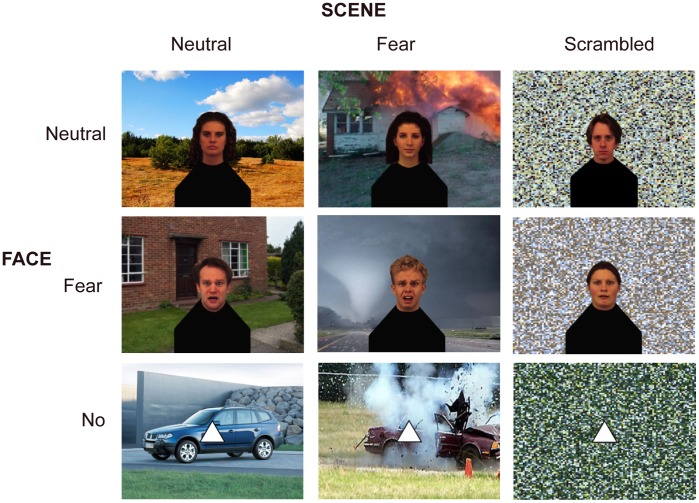
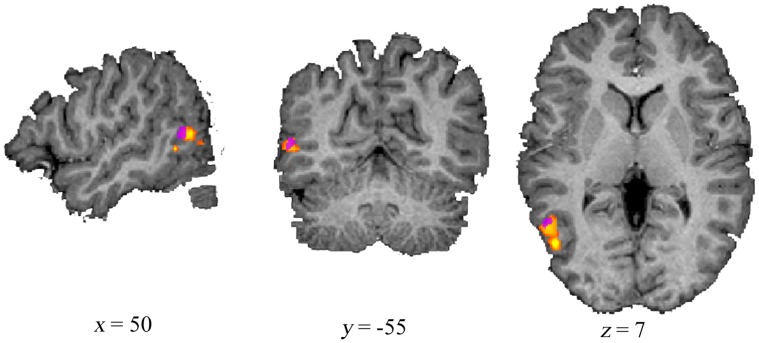
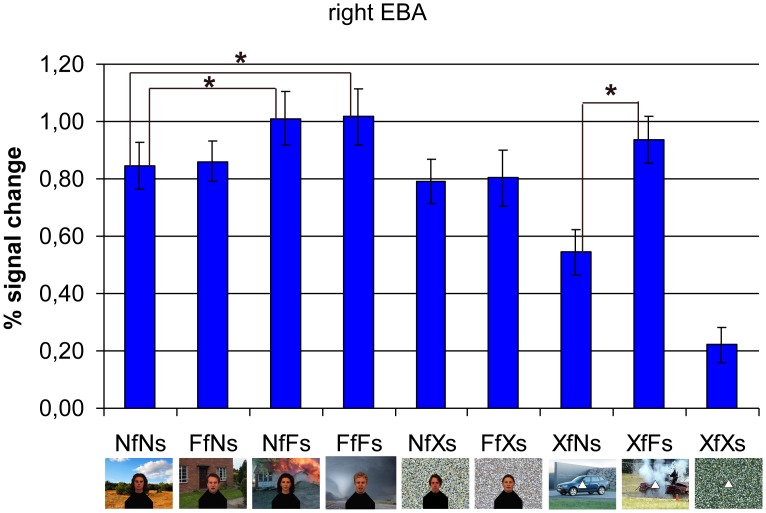
It is part of basic emotions like fear or anger that they prepare the brain to act adaptively. Hence scenes representing emotional events are normally associated with characteristic adaptive behavior. Normally, face and body representation areas in the brain are modulated by these emotions when presented in the face or body. Here, we provide neuroimaging evidence (using functional magnetic resonance imaging) that the extrastriate body area (EBA) is highly responsive when subjects observe isolated faces presented in emotional scenes. This response of EBA to threatening scenes in which no body is present gives rise to speculation about its function. We discuss the possibility that the brain reacts proactively to the emotional meaning of the scene.
Conflict of interest statement
Figures
References
-
- Goebel R, Khorram-Sefat D, Muckli L, Hacker H, Singer W. The constructive nature of vision: direct evidence from functional magnetic resonance imaging studies of apparent motion an motion imagery. Eur J Neurosci. 1998;10:1563. - PubMed
-
- Bar M, Ullman S. Spatial context in recognition. Perception. 1996;25:343. - PubMed
-
- Cox D, Meyers E, Sinha P. Contextually evoked object-specific responses in human visual cortex. Science. 2004;304:115. - PubMed
-
- Sabatinelli D, Bradley MM, Lang PJ. Affective startle modulation in anticipation and perception. Psychophysiology. 2001;38:719. - PubMed
Publication types
MeSH terms
LinkOut - more resources
Full Text Sources
