


Non-dipping blood pressure profile in narcolepsy with cataplexy
- PMID: 22768053
- PMCID: PMC3387234
- DOI: 10.1371/journal.pone.0038977
Non-dipping blood pressure profile in narcolepsy with cataplexy
Abstract
Background: Patients with narcolepsy-cataplexy (NC) mostly exhibit undetectable hypocretin levels. Hypocretin system is one of the key players in the complex interaction between sleep and the cardiovascular system. We tested the hypothesis that hypocretin deficiency affects cardiovascular risk factors by measuring nighttime and daytime ambulatory blood pressure (BP) and the night-to-day BP ratio as well as endothelial dysfunction by the digital pulse amplitude response in drug-free patients with NC compared to controls.
Methodology: Sleep, clinical and biological cardiovascular risk factors, fingertip peripheral arterial tonometry, and 24-hour ambulatory BP monitoring were recorded in 50 drug-free patients with NC and 42 healthy control subjects, except for BP monitoring available in all controls but in 36 patients with NC.
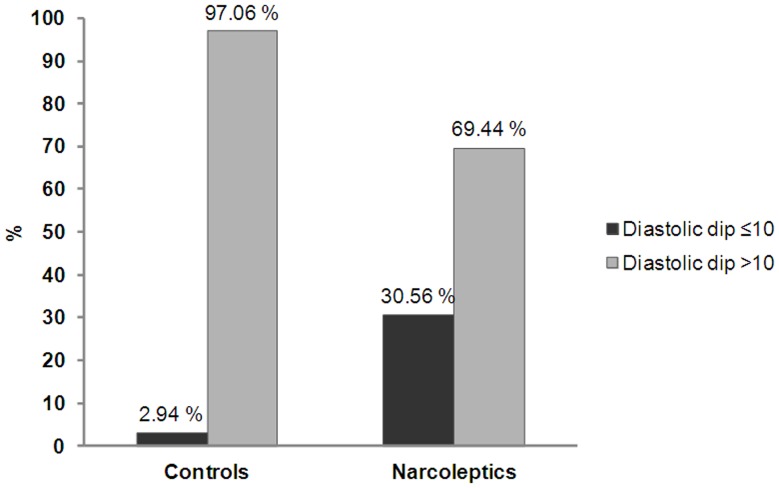
Principal findings: More patients than controls were smokers, obese and with dyslipidemia. One-third of patients with NC were "non-dippers" (defined as <10% drop in BP during sleep) compared to only 3% of controls. The diastolic non-dipper BP profile had up to 12-fold higher odds of being associated with NC. We noted negative correlations between mean diastolic BP fall during night, REM sleep percentage and number of sleep onset REM periods, and a positive correlation with mean sleep latency on the MSLT. The digital pulse amplitude response measured by fingertip was similar between NC and controls.
Conclusion: We found a high percentage of non-dippers in patients with NC with association with REM sleep dysregulation. The blunted sleep-related BP dip in NC may be of clinical relevance, as it may indicate increased risk for cardiovascular events.
Conflict of interest statement
Figures
References
-
- Dauvilliers Y, Arnulf I, Mignot E. Narcolepsy with cataplexy. Lancet. 2007;369:499–511. - PubMed
-
- Plazzi G, Serra L. Ferri R. Nocturnal aspects of narcolepsy with cataplexy. Sleep Med. 2008;Rev(12):109–128. - PubMed
-
- Peyron C, Faraco J, Rogers W, Ripley B, Overeem S, et al. A mutation in a case of early onset narcolepsy and a generalized absence of hypocretin peptides in human narcoleptic brains. Nat. 2000;Med6:991–7. - PubMed
-
- Mignot E, Lammers GJ, Ripley B, Okun M, Nevsimalova S, et al. The role of cerebrospinal fluid hypocretin measurement in the diagnosis of narcolepsy and other hypersomnias. Arch. 2002;Neurol59:1553–62. - PubMed
-
- Shirasaka T, Kunitake T, Takasaki M, Kannan H. Neuronal effects of orexins: relevant to sympathetic and cardiovascular functions. Regul. 2002;Pept104:91–5. - PubMed
MeSH terms
LinkOut - more resources
Full Text Sources
