


How similar are the mice to men? Between-species comparison of left ventricular mechanics using strain imaging
- PMID: 22768220
- PMCID: PMC3386935
- DOI: 10.1371/journal.pone.0040061
How similar are the mice to men? Between-species comparison of left ventricular mechanics using strain imaging
Abstract
Background: While mammalian heart size maintains constant proportion to whole body size, scaling of left ventricular (LV) function parameters shows a more complex scaling pattern. We used 2-D speckle tracking strain imaging to determine whether LV myocardial strains and strain rates scale to heart size.
Methods: We studied 18 mice, 15 rats, 6 rabbits, 12 dogs and 20 human volunteers by 2-D echocardiography. Relationship between longitudinal or circumferential strains/strain rates (S(Long)/SR(Long), S(Circ)/SR(Circ)), and LV end-diastolic volume (EDV) or mass were assessed by the allometric (power-law) equation Y = kM(β).
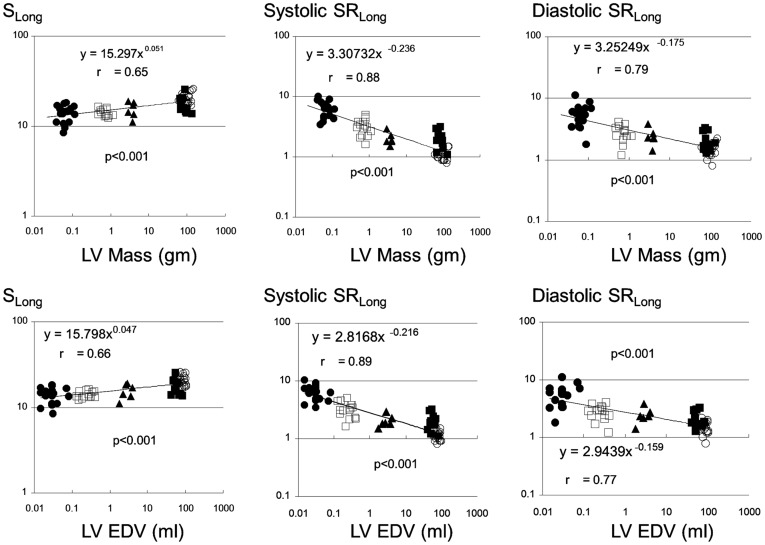
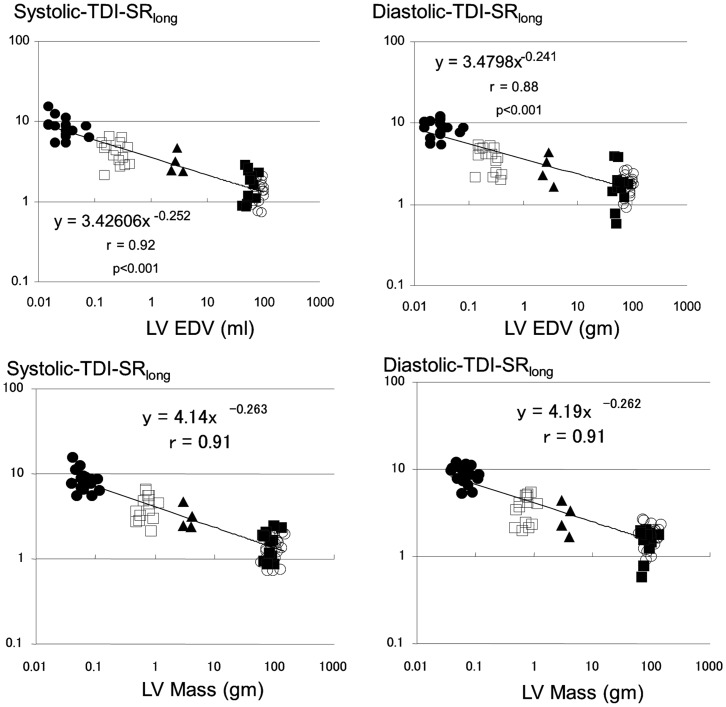
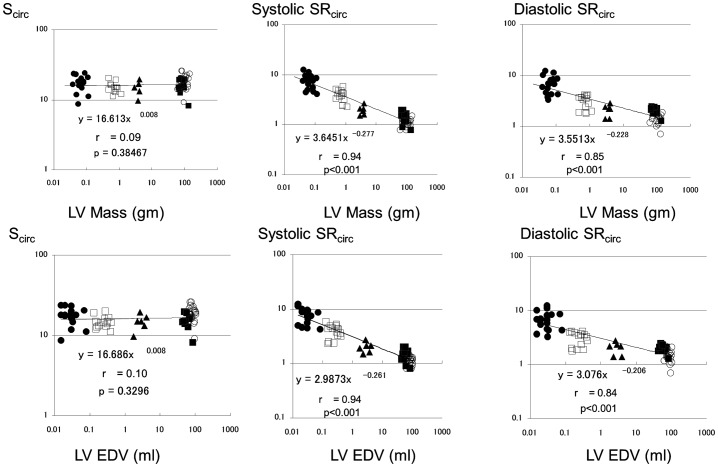
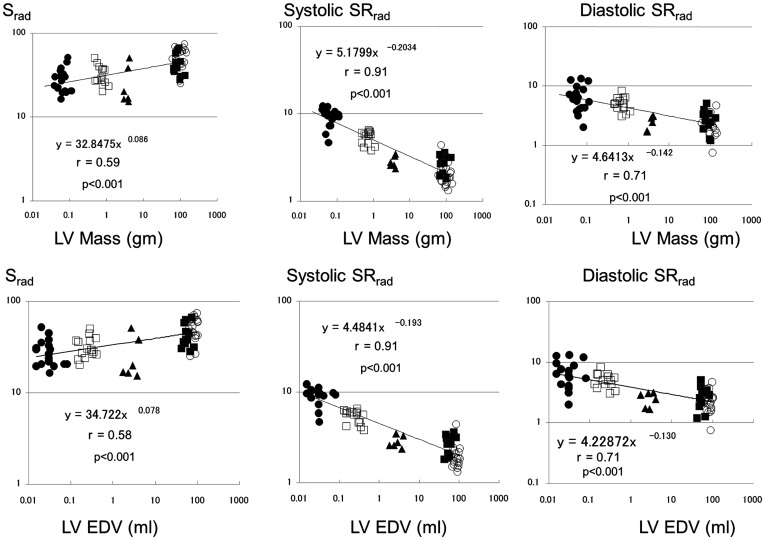
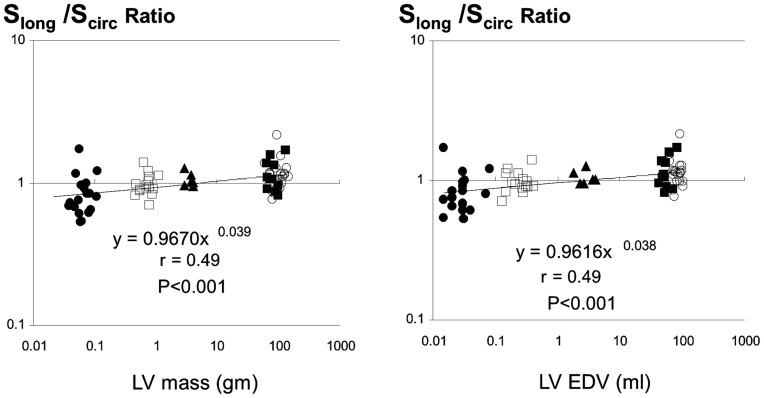
Results: Mean LV mass in individual species varied from 0.038 to 134 g, LV EDV varied from 0.015 to 102 ml, while RR interval varied from 81 to 1090 ms. While S(Long) increased with increasing LV EDV or mass (β values 0.047±0.006 and 0.051±0.005, p<0.0001 vs. 0 for both) S(Circ) was unchanged (p = NS for both LV EDV or mass). Systolic and diastolic SR(Long) and SR(Circ) showed inverse correlations to LV EDV or mass (p<0.0001 vs. 0 for all comparisons). The ratio between S(Long) and S(Circ) increased with increasing values of LV EDV or mass (β values 0.039±0.010 and 0.040±0.011, p>0.0003 for both).
Conclusions: While S(Circ) is unchanged, S(Long) increases with increasing heart size, indicating that large mammals rely more on long axis contribution to systolic function. SR(Long) and SR(Circ), both diastolic and systolic, show an expected decrease with increasing heart size.
Conflict of interest statement
Figures

References
-
- Grimm AF, Katele KV, Lin HL. Fiber bundle direction in the mammalian heart. An extension of the “nested shells” model. Basic Res Cardiol. 1976;71:381–388. - PubMed
-
- Prothero J. Heart weight as a function of body weight in mammals. Growth. 1979;43:139–150. - PubMed
-
- Noujaim SF, Lucca E, Munoz V, Persaud D, Berenfeld O, et al. From mouse to whale: a universal scaling relation for the PR Interval of the electrocardiogram of mammals. Circulation. 2004;110:2802–2808. - PubMed
-
- Liu W, Ashford MW, Chen J, Watkins MP, Williams TA, et al. MR tagging demonstrates quantitative differences in regional ventricular wall motion in mice, rats, and men. American Journal of Physiology - Heart and Circulatory Physiology. 2006;291:H2515–H2521. - PubMed
Publication types
MeSH terms
LinkOut - more resources
Full Text Sources
Other Literature Sources
Research Materials
Miscellaneous
