


Reaching out, inviting back: using Interactive voice response (IVR) technology to recycle relapsed smokers back to Quitline treatment--a randomized controlled trial
- PMID: 22768793
- PMCID: PMC3438078
- DOI: 10.1186/1471-2458-12-507
Reaching out, inviting back: using Interactive voice response (IVR) technology to recycle relapsed smokers back to Quitline treatment--a randomized controlled trial
Abstract
Background: Tobacco dependence is a chronic, relapsing condition that typically requires multiple quit attempts and extended treatment. When offered the opportunity, relapsed smokers are interested in recycling back into treatment for a new, assisted quit attempt. This manuscript presents the results of a randomized controlled trial testing the efficacy of interactive voice response (IVR) in recycling low income smokers who had previously used quitline (QL) support back to QL support for a new quit attempt.
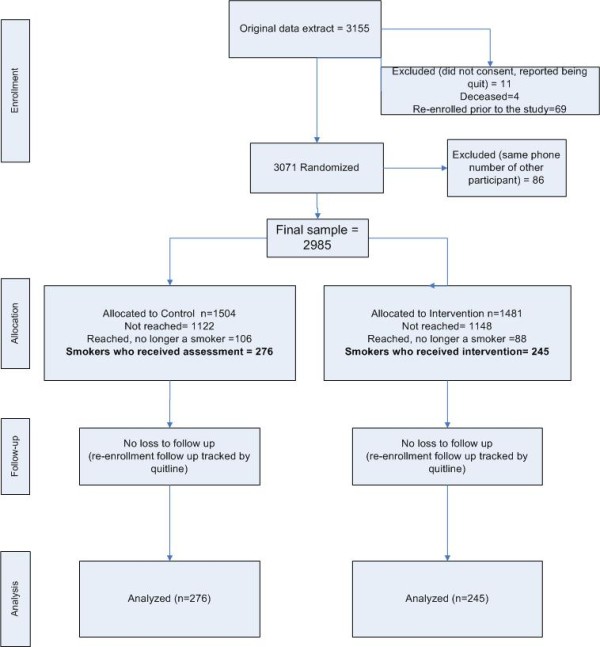
Methods: A sample of 2985 previous QL callers were randomized to either receive IVR screening for current smoking (control group) or IVR screening plus an IVR intervention. The IVR intervention consists of automated questions to identify and address barriers to re-cycling in QL support, followed by an offer to be transferred to the QL and reinitiate treatment. Re-enrollment in QL services for both groups was documented.
Results: The IVR system successfully reached 715 (23.9%) former QL participants. Of those, 27% (194/715) reported to the IVR system that they had quit smoking and were therefore excluded from the study and analysis. The trial's final sample was composed of 521 current smokers. The re-enrollment rate was 3.3% for the control group and 28.2% for the intervention group (p < .001). Logistic regression results indicated an 11.2 times higher odds for re-enrollment of the intervention group than the control group (p < .001). Results did not vary by gender, race, ethnicity, or level of education, however recycled smokers were older (Mean = 45.2; SD = 11.7) than smokers who declined a new treatment cycle (Mean = 41.8; SD = 13.2); (p = 0.013). The main barriers reported for not engaging in a new treatment cycle were low self-efficacy and lack of interest in quitting. After delivering IVR messages targeting these reported barriers, 32% of the smokers reporting low self-efficacy and 4.8% of those reporting lack of interest in quitting re-engaged in a new QL treatment cycle.
Conclusion: Proactive IVR outreach is a promising tool to engage low income, relapsed smokers back into a new cycle of treatment. Integration of IVR intervention for recycling smokers with previous QL treatment has the potential to decrease tobacco-related disparities.
Trial registration: ClinicalTrials.gov Identifier: NCT01260597.
References
-
- Fiore MC, Jaen CR, Baker TB, Bailey WC, Benowitz NL, Curry SJ, Treating tobacco use and dependence: 2008 Update. Clinical practice guideline. US Department of Health and Human Services. Public Health Service, Rockville, MD; 2008.
-
- Fu SS, Partin MR, Snyder A, An LC, Nelson DB, Clothier B. et al.Promoting repeat tobacco dependence treatment: are relapsed smokers interested? American Journal of Managed Care. 2006;12:235–243. - PubMed
Publication types
MeSH terms
Associated data
Grants and funding
LinkOut - more resources
Full Text Sources
Medical
