Comparative Study
. 2012 Jul 7:12:135.
doi: 10.1186/1471-2180-12-135.

Complete genome sequence of Enterococcus faecium strain TX16 and comparative genomic analysis of Enterococcus faecium genomes

Affiliations
Comparative Study

Complete genome sequence of Enterococcus faecium strain TX16 and comparative genomic analysis of Enterococcus faecium genomes

Xiang Qin et al. BMC Microbiol. .

Abstract

Background: Enterococci are among the leading causes of hospital-acquired infections in the United States and Europe, with Enterococcus faecalis and Enterococcus faecium being the two most common species isolated from enterococcal infections. In the last decade, the proportion of enterococcal infections caused by E. faecium has steadily increased compared to other Enterococcus species. Although the underlying mechanism for the gradual replacement of E. faecalis by E. faecium in the hospital environment is not yet understood, many studies using genotyping and phylogenetic analysis have shown the emergence of a globally dispersed polyclonal subcluster of E. faecium strains in clinical environments. Systematic study of the molecular epidemiology and pathogenesis of E. faecium has been hindered by the lack of closed, complete E. faecium genomes that can be used as references.

Results: In this study, we report the complete genome sequence of the E. faecium strain TX16, also known as DO, which belongs to multilocus sequence type (ST) 18, and was the first E. faecium strain ever sequenced. Whole genome comparison of the TX16 genome with 21 E. faecium draft genomes confirmed that most clinical, outbreak, and hospital-associated (HA) strains (including STs 16, 17, 18, and 78), in addition to strains of non-hospital origin, group in the same clade (referred to as the HA clade) and are evolutionally considerably more closely related to each other by phylogenetic and gene content similarity analyses than to isolates in the community-associated (CA) clade with approximately a 3-4% average nucleotide sequence difference between the two clades at the core genome level. Our study also revealed that many genomic loci in the TX16 genome are unique to the HA clade. 380 ORFs in TX16 are HA-clade specific and antibiotic resistance genes are enriched in HA-clade strains. Mobile elements such as IS16 and transposons were also found almost exclusively in HA strains, as previously reported.

Conclusions: Our findings along with other studies show that HA clonal lineages harbor specific genetic elements as well as sequence differences in the core genome which may confer selection advantages over the more heterogeneous CA E. faecium isolates. Which of these differences are important for the success of specific E. faecium lineages in the hospital environment remain(s) to be determined.


Figures
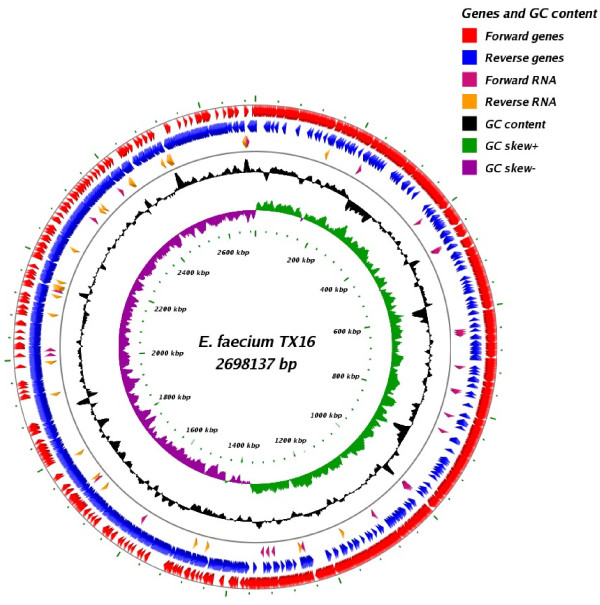
Figure 1
Figure 1
Circular map of theE. faeciumTX16 genome. Tracks from inside to outside are as follows: GC skew (G-C)/(G + C), GC content, forward and reverse RNA, reverse genes, and forward genes.
Figure 2
Figure 2
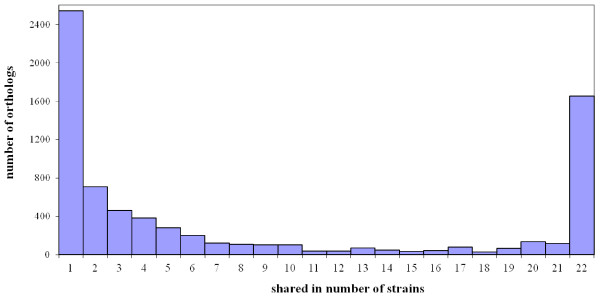
Distribution of orthologs in 22E. faeciumstrains. The orthologs were determined by orthoMCL as described in the Material and Methods. ORFs of the 3 plasmids in E. faecium TX16 were not included in the ortholog analysis.
Figure 3
Figure 3
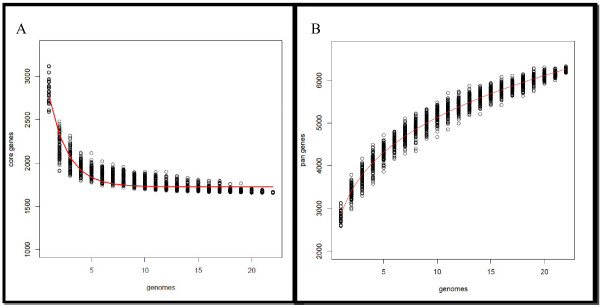
E. faeciumcore and pan genomes.A. E. faecium core genes. The number of shared genes is plotted as the function of number of strains (n) added sequentially. An open circle represents the number of shared genes for each permutation at a give number of strains (n). 1,608 single copy genes are shared by all 22 genomes. The red line represents the least-squares fit to the exponential decay function Fc = κc exp[−n/τc] + Ω (κc = 1871 ± 25, τc = 1.751 ± 0.027, Ω = 1726 ± 2). B. E. faecium pan-genes. The number of total genes is plotted as the function of strains (n). The open circle represents the number of total genes for each permutation at a give number of strains (n). The red line represents the least-squares fit to the power law function n = κ Nγ (κ = 2876 ± 7, γ = 0.2517 ± 0.009).
Figure 4
Figure 4
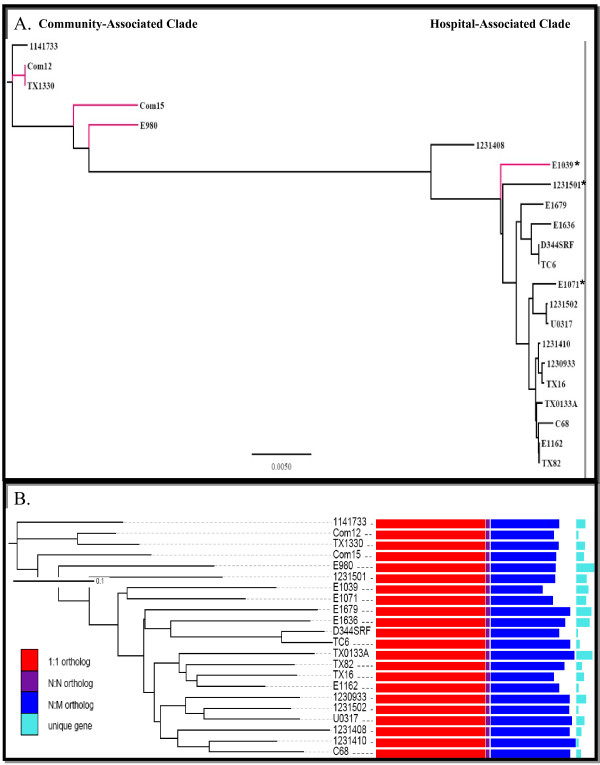
Enterococcus faeciumphylogenetics. 4A. A maximum-likelihood phylogenetic tree using 628 core genes. Distance bar indicates the sequence divergence. Strains isolated from the community are labeled with branches in red. An asterisk (*) indicates a strain within the HA clade lacking IS16. 4B. A hierarchical clustering using Jaccard distance of gene content by unweighted pair group method with arithmetic mean (UPGMA) (see Materials and Methods). The core, distributed and unique gene counts are also presented in the right panel. 1:1 ortholog, orthologs present with one copy in all strains; N:N ortholog, orthologs present with multiple copies in all strains; N:M ortholog, orthologs present in some strains.
Figure 5
Figure 5
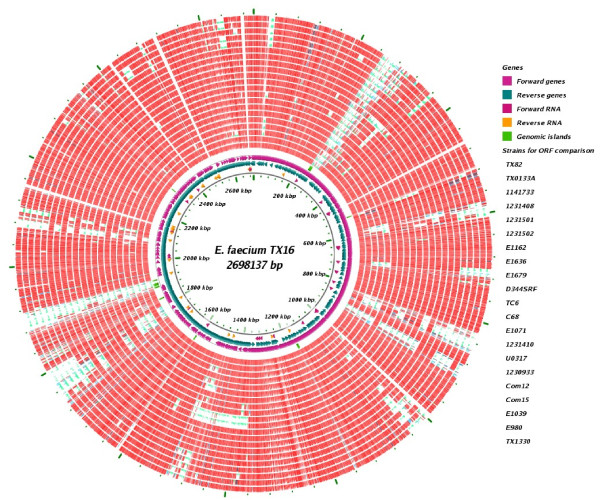
ORF comparisons of the 22E. faeciumgenomes. A circular map of BLASTP identity of predicted proteins from TX16 against the predicted proteins from other 21 E. faecium strains. Tracks from inside to outside: forward and reverse RNAs, reverse genes, foward genes, and genomic islands. In outer strain circles from inside to outside are the BLASTP precent identity of TX16 against ORFs from TX82, TX0133A, 1,141,733, 1,231,408, 1,231,501, 1,231,502, E1162, E1636, E1679, D344SRF, TC6, C68, E1071, 1,231,410, U0317, 1,230,933, Com12, Com15, E1039, E980, and TX1330. Red is 90–100% identity, purple is 60–89% identity, green is 0–59% identity.
Figure 6
Figure 6
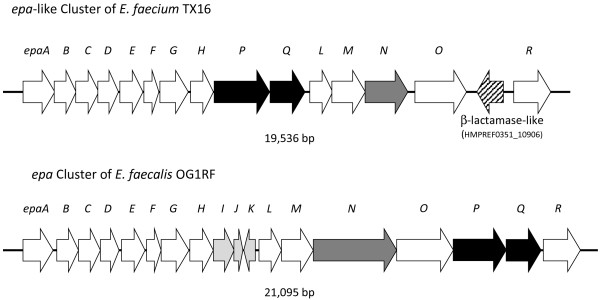
Comparison of the homologousepa-like loci ofE. faeciumTX16 andE. faecalisOG1RF. Orthologs of epaP and epaQ, located at different positions in the E. faecium and E. faecalis genomes, are indicated by black arrows. Genes epaI, epaJ and epaK, present only in E. faecalis, are indicated by light grey arrows. The epaN homolog of E. faecium, which is shorter than epaN of E. faecalis, is shown by a dark grey arrow. The TX16 ORF (HMPREF0351_10906) with relatively low similarity to the β-lactamase superfamily is shown by a hatched arrow. The epaA to epaR region of E. faecium TX16 corresponds to locus tags HMPREF0351_10891 to HMPREF0351_10907.
Figure 7
Figure 7
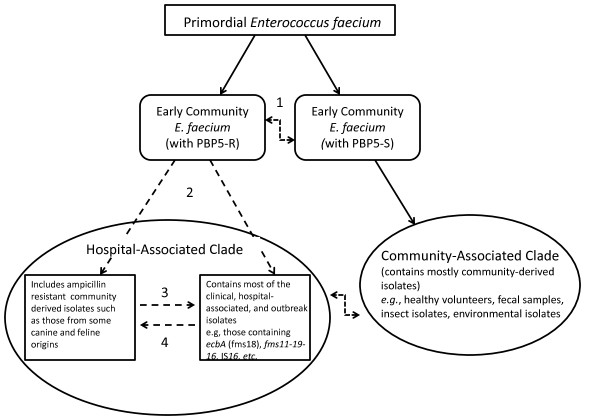
The projected evolution of the two clades ofE. faecium. A figure addressing the possible scenarios which may have occurred in the evolution of Enterococcus faecium resulting in the HA-clade and CA-clade. Specifically, a primordial type of Enterococcus faecium split into early community isolates which had homologous core genomes with significant sequence differences (e.g., the pbp5-S or pbp5-R allele). These early community groups further segmented into a hospital-associated clade and the community clade. Scenario one depicts that these lineages could recombine with each other (represented by the bent dashed arrow) resulting in hybrid strains, scenario two depicts community and hospital ARE isolates splitting from the same ancestor, scenario three depicts ARE clones evolving from the animal reservoir, and scenario four depicts animal ARE isolates representing descendants of hospital ARE transferred from humans to their pets.

References

    1. Murray BE. The life and times of the Enterococcus. Clin Microbiol Rev. 1990;3(1):46–65. - PMC - PubMed
    1. Willems RJ, Hanage WP, Bessen DE, Feil EJ. Population biology of Gram-positive pathogens: high-risk clones for dissemination of antibiotic resistance. FEMS Microbiol Rev. 2011;35(5):872–900. - PMC - PubMed
    1. Willems RJ, van Schaik W. Transition of Enterococcus faecium from commensal organism to nosocomial pathogen. Future Microbiol. 2009;4(9):1125–1135. - PubMed
    1. Hidron AI, Edwards JR, Patel J, Horan TC, Sievert DM, Pollock DA, Fridkin SK. NHSN annual update: antimicrobial-resistant pathogens associated with healthcare-associated infections: annual summary of data reported to the National Healthcare Safety Network at the Centers for Disease Control and Prevention, 2006–2007. Infect Control Hosp Epidemiol. 2008;29(11):996–1011. - PubMed
    1. Leavis HL, Bonten MJ, Willems RJ. Identification of high-risk enterococcal clonal complexes: global dispersion and antibiotic resistance. Curr Opin Microbiol. 2006;9(5):454–460. - PubMed

Publication types

MeSH terms

LinkOut - more resources