


Functional brain activation to emotionally valenced faces in school-aged children with a history of preschool-onset major depression
- PMID: 22770650
- PMCID: PMC3498571
- DOI: 10.1016/j.biopsych.2012.06.009
Functional brain activation to emotionally valenced faces in school-aged children with a history of preschool-onset major depression
Abstract
Background: Recent research has demonstrated that clinical depression can emerge as early as the preschool period. Here, we examine brain function in children with a history of preschool-onset depression (PO-MDD) in comparison with healthy children.
Methods: Participants were medication naïve school-aged children (ages 7-11) with PO-MDD (n = 22) or no psychiatric history (n = 16) followed longitudinally as part of the Preschool Depression Study. We used functional magnetic resonance imaging measures of blood oxygen level-dependent signal to examine functional brain activity in response to emotionally valenced faces (sad, fearful, angry, happy, neutral) following a negative mood induction provided to all children.
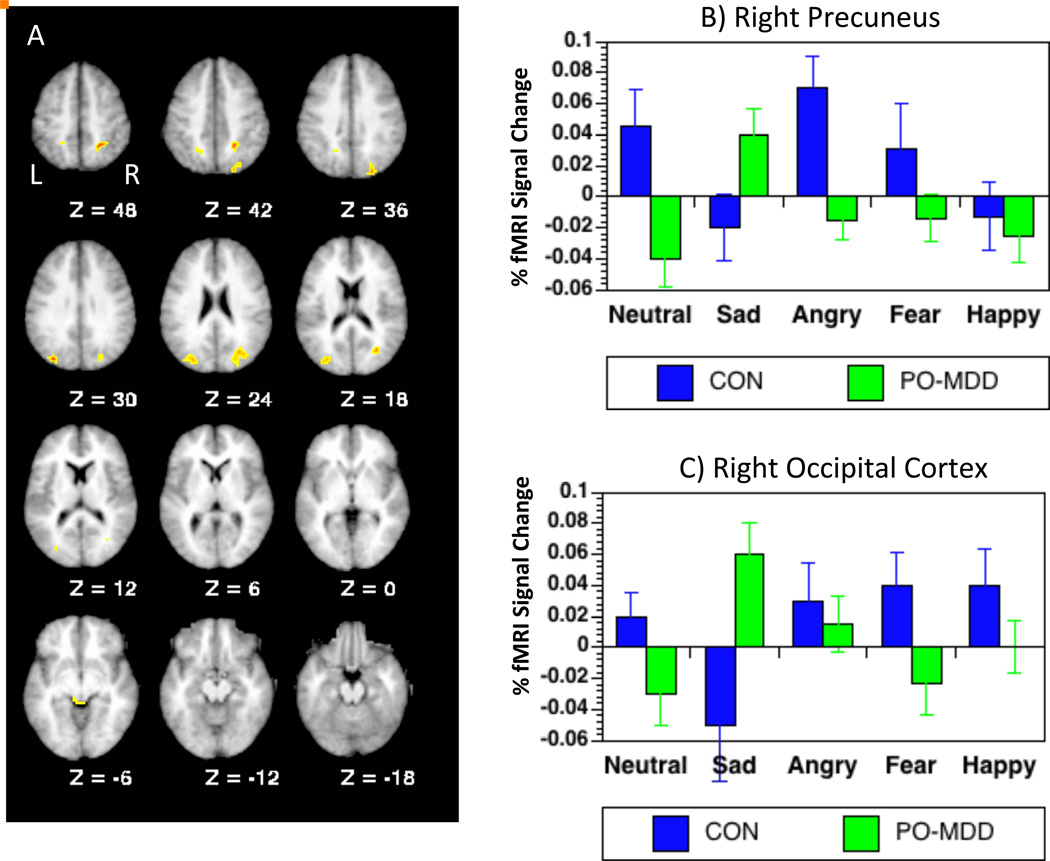
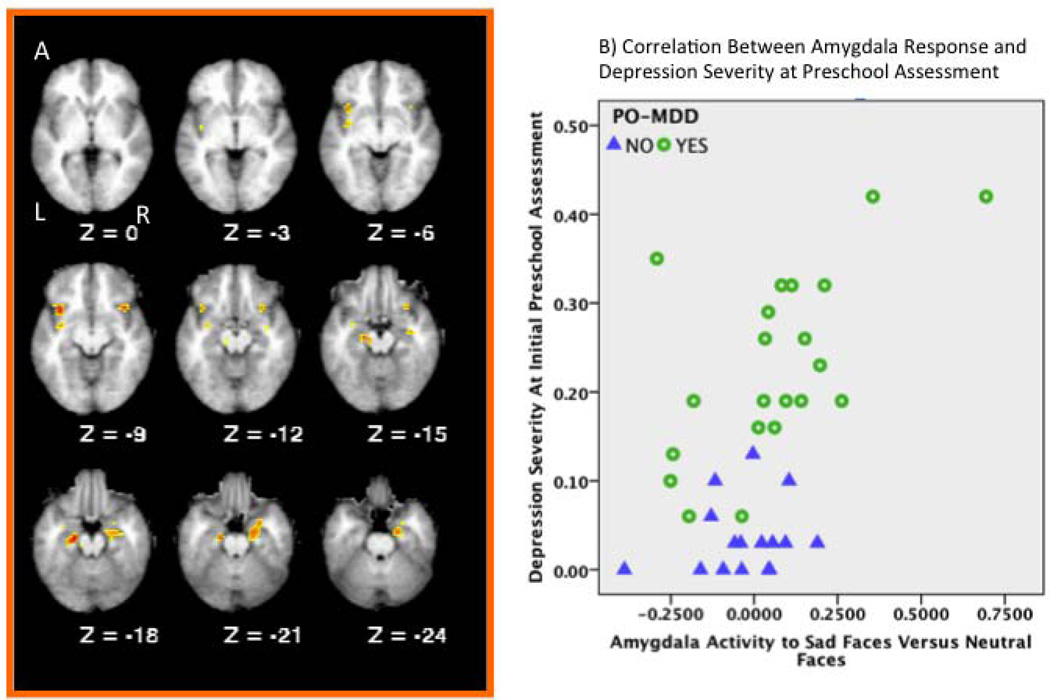
Results: In categorical group comparisons, children with PO-MDD demonstrated increased activity in parietal cortex in response to sad faces but no differences in brain activity in a priori regions of interest (e.g., amygdala). However, in dimensional analyses, the severity of depression symptoms at the baseline preschool assessment predicted increased responses to sad faces in amygdala, hippocampal, parietal, and orbital frontal regions.
Conclusions: School-aged children with a history of PO-MDD showed patterns of functional brain responses to emotionally evocative stimuli similar to patterns found in adults and adolescents with major depression. These patterns were most strongly related to the severity of depression during the preschool period, suggesting that the magnitude of early symptoms may be particularly important for understanding altered brain function. These findings suggest that an early episode of depression before age 6 may be associated with enduring brain change or may represent a biomarker that was present even before the preschool episode.
Copyright © 2012 Society of Biological Psychiatry. Published by Elsevier Inc. All rights reserved.
Conflict of interest statement
The authors report no biomedical financial interests or potential conflicts of interest.
Figures
References
-
- Kessler RC, Berglund P, Demler O, Jin R, Koretz D, Merikangas KR, et al. The epidemiology of major depressive disorder: results from the National Comorbidity Survey Replication (NCS-R) JAMA. 2003;289:3095–3105. - PubMed
-
- Costello EJ, Pine DS, Hammen C, March JS, Plotsky PM, Weissman MM, et al. Development and natural history of mood disorders. Biological Psychiatry. 2002;52:529–542. - PubMed
-
- Egger HL, Angold A. Common emotional and behavioral disorders in preschool children: presentation, nosology, and epidemiology. Journal of child psychology and psychiatry, and allied disciplines. 2006;47:313–337. - PubMed
-
- Luby JL, Heffelfinger AK, Mrakotsky C, Hessler MJ, Brown KM, Hildebrand T. Preschool major depressive disorder: preliminary validation for developmentally modified DSM-IV criteria. J Am Acad Child Adolesc Psychiatry. 2002;41:928–937. - PubMed
Publication types
MeSH terms
Grants and funding
LinkOut - more resources
Full Text Sources
