. 2012 Sep;33(9):429-36.
doi: 10.1016/j.it.2012.05.005. Epub 2012 Jul 6.

Reconciling views on T cell receptor germline bias for MHC

Affiliations

Reconciling views on T cell receptor germline bias for MHC

K Christopher Garcia. Trends Immunol. 2012 Sep.

Abstract

Whether MHC restriction by the T cell receptor (TCR) is a product of evolutionary pressures leading to germline-encoded 'rules of engagement' remains avidly debated. Structural results derived from analysis of TCR-peptide-MHC complexes appear to support a model of physical specificity between TCR germline V regions and MHC. Yet, some recent evidence suggests that thymic selection, and co-receptors may have misled us into thinking the TCR is exclusively MHC-specific, when in fact, TCRs can robustly engage non-MHC ligands when given the chance. Here, I propose that seemingly contradictory data and hypotheses for, and against, germline bias are, in fact, compatible and can be reconciled into a unifying model.


Figures

Figure 1
Figure 1
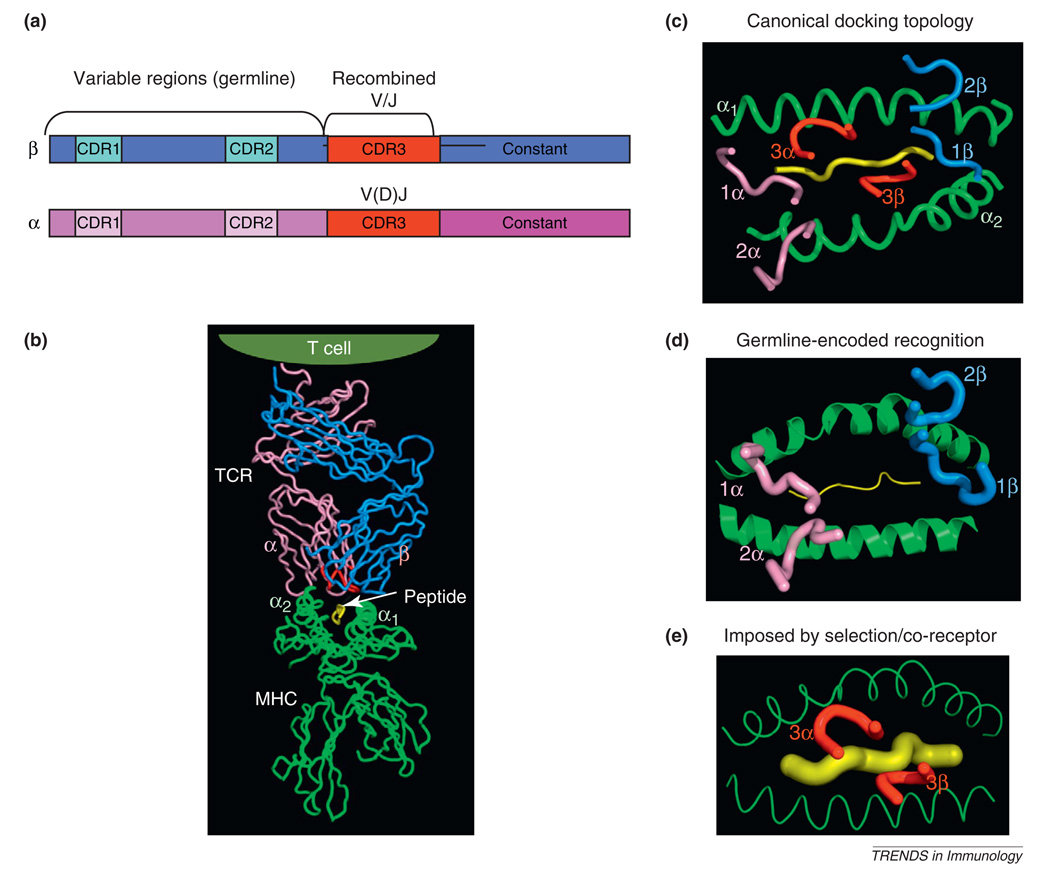
Structural models of T cell receptor (TCR) recognition of peptide–MHC. (a) Schematic of TCR α and β chain genes showing segregation of the germline and recombined regions. (b) Structure of an αβ TCR bound to a class I MHC presenting a peptide antigen [56]. The CDR3 loops in the TCR binding site are colored red. (c) Classical ‘footprint’ view of the CDR loops of the TCR overlaying the peptide and MHC. This view shows the roughly diagonal binding orientation with the germline-derived CDRs 1 and 2 primarily engaging the MHC helices, and the TCR CDR3s engaging the peptide. The angular orientation of these CDR loops to the long axis of the MHC groove is referred to as the docking angle or docking topology. (d) The germline hypothesis is indicated by the primacy of the CDR1 and CDR2 germline derived TCR loops forming the principal interactions with the MHC independently of CDR3. (e) In contrast to (d), the alternative model proposes that the CDR3–peptide interaction, or the influence of co-receptor during thymic selection, underlies TCR–MHC specificity irrespective of germline influences.
Figure 2
Figure 2
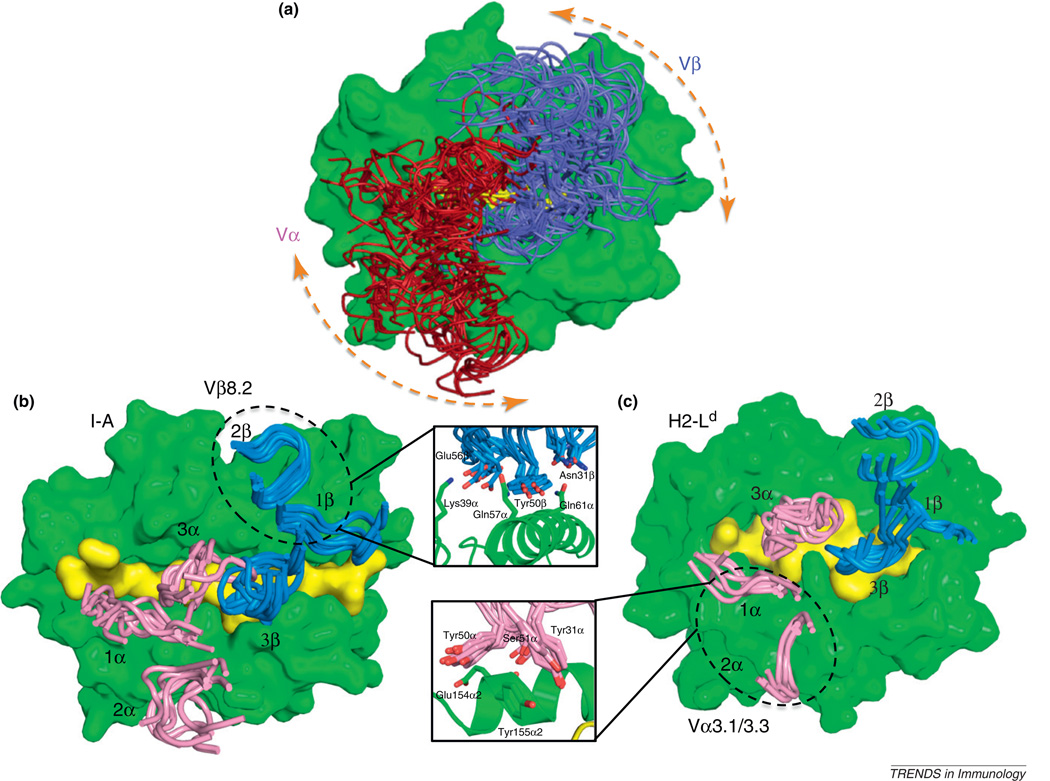
Interaction codons mediating germline specificity of the T cell receptor (TCR) for MHC. (a) This panel shows the wide range of TCR docking angles on MHC seen from an overlap for ~40 different class I TCR–MHC complex crystal structures. Conserved interactions that might denote germline contacts have not been evident from this type of analysis. (b) Focused structural studies of Vβ8.2 containing TCRs recognizing similar type of MHC (class II I-A allotypes) reveal a highly convergent mode of germline contact between the TCR CDR1β and CDR2β with the MHC, which we refer to as an interaction codon. The inset shows the amino acids involved in this contact, and the degree of superposition, and also wobble, in the manner by which approximately 10 Vβ8.2 TCRs engage with I-A MHC. (c) Another germline codon, involving a TCR Vα3 and class I MHC H-2Ld also indicates a close structural superposition.
Figure 3
Figure 3
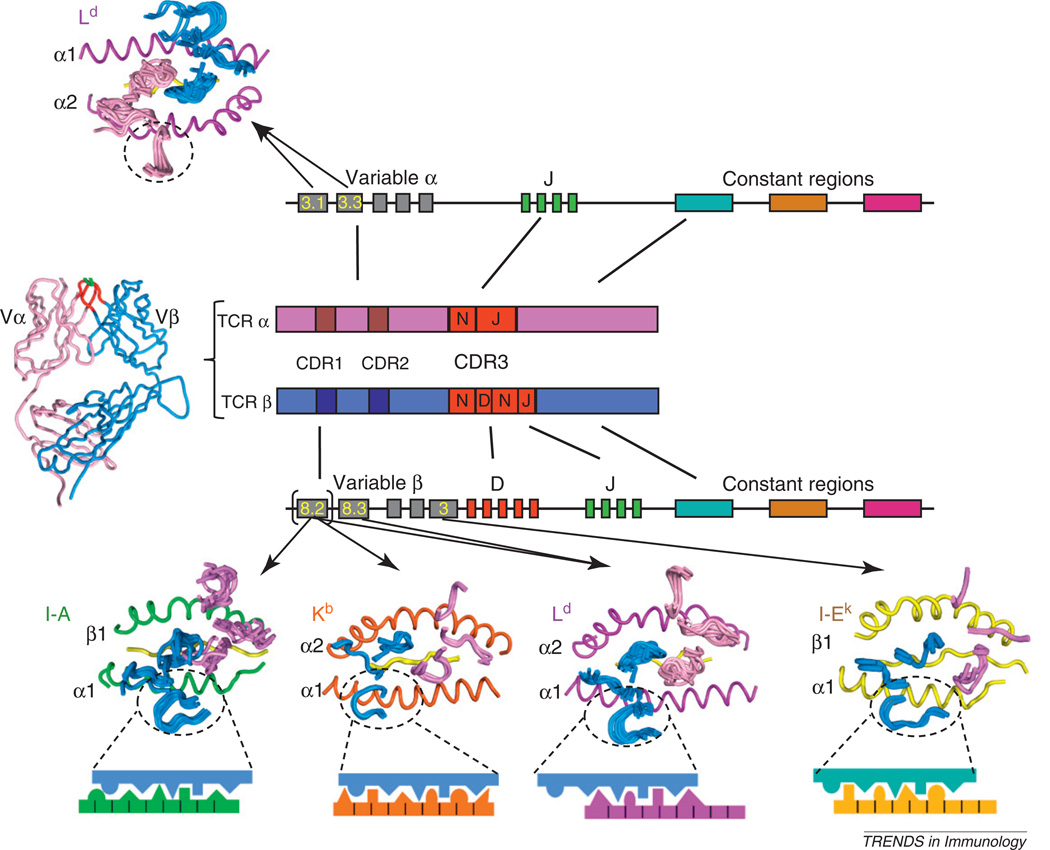
Model for germline specificity of the T cell receptor (TCR) V region repertoire for MHC. TCR–MHC binding footprints, represented by the TCR CDR loops only, are shown for several different TCR germline types that appear illustrative of distinct specificities of each type of V region for each type of MHC. Note that, for the example of Vβ8.2 recognizing three different types of MHC, the chemistry of the interactions differ (cartoon blowups) yet within each MHC the interactions are similar.
Figure 4
Figure 4
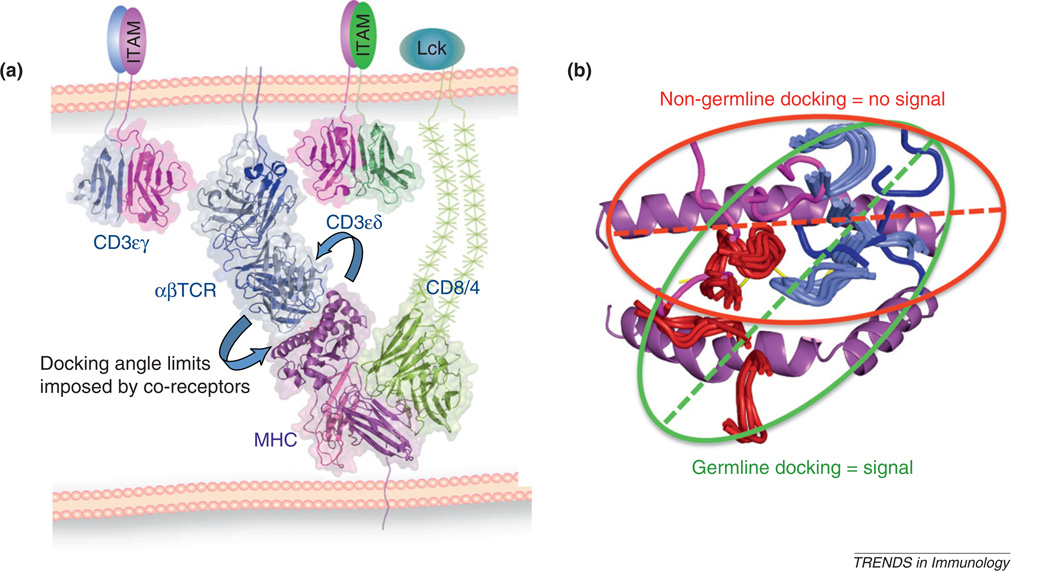
Constraints on germline-encoded T cell receptor (TCR)–MHC engagement imposed by co-receptors. (a) Model of a signaling complex of TCR–CD3–peptide–MHC and CD8 intended to indicate the geometric constraints imposed by simultaneous association of all of the subunits that might limit the TCR–pMHC docking angle. (b) Docking footprints of signaling-productive, presumably germline-encoded TCR docking footprints that are highly convergent shown compared to a non-signaling docking footprint that has potentially exceeded the geometric tolerances highlighted in panel A.

References

    1. Scott-Browne JP, et al. Germline-encoded amino acids in the alphabeta T-cell receptor control thymic selection. Nature. 2009;458:1043–1046. - PMC - PubMed
    1. Huseby E, et al. TCR-MHC/peptide interactions: kissing-cousins or a shotgun wedding? Eur. J. Immunol. 2004;34:1243–1250. - PubMed
    1. Felix NJ, Allen PM. Specificity of T-cell alloreactivity. Nat. Rev. Immunol. 2007;7:942–953. - PubMed
    1. Germain RN. Immunology. Making a molecular match. Nature. 1990;344:19–22. - PubMed
    1. Collins EJ, Riddle DS. TCR-MHC docking orientation: natural selection, or thymic selection? Immunol. Res. 2008;41:267–294. - PubMed

Publication types

MeSH terms

Substances