


Hiding in plain sight: use of realistic surrogates to reduce exposure of protected health information in clinical text
- PMID: 22771529
- PMCID: PMC3638183
- DOI: 10.1136/amiajnl-2012-001034
Hiding in plain sight: use of realistic surrogates to reduce exposure of protected health information in clinical text
Abstract
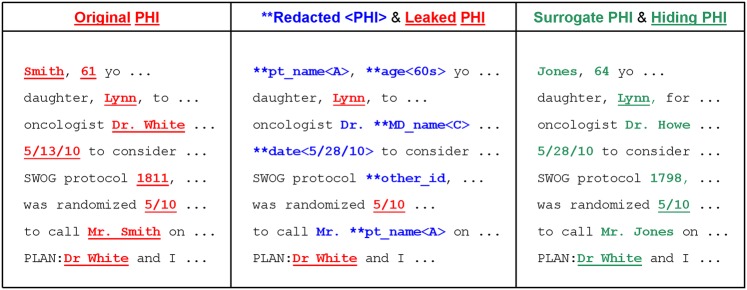
Objective: Secondary use of clinical text is impeded by a lack of highly effective, low-cost de-identification methods. Both, manual and automated methods for removing protected health information, are known to leave behind residual identifiers. The authors propose a novel approach for addressing the residual identifier problem based on the theory of Hiding In Plain Sight (HIPS).
Materials and methods: HIPS relies on obfuscation to conceal residual identifiers. According to this theory, replacing the detected identifiers with realistic but synthetic surrogates should collectively render the few 'leaked' identifiers difficult to distinguish from the synthetic surrogates. The authors conducted a pilot study to test this theory on clinical narrative, de-identified by an automated system. Test corpora included 31 oncology and 50 family practice progress notes read by two trained chart abstractors and an informaticist.
Results: Experimental results suggest approximately 90% of residual identifiers can be effectively concealed by the HIPS approach in text containing average and high densities of personal identifying information.
Discussion: This pilot test suggests HIPS is feasible, but requires further evaluation. The results need to be replicated on larger corpora of diverse origin under a range of detection scenarios. Error analyses also suggest areas where surrogate generation techniques can be refined to improve efficacy.
Conclusions: If these results generalize to existing high-performing de-identification systems with recall rates of 94-98%, HIPS could increase the effective de-identification rates of these systems to levels above 99% without further advancements in system recall. Additional and more rigorous assessment of the HIPS approach is warranted.
Conflict of interest statement
Figures
References
-
- Elkin PL, Froehling DA, Wahner-Roedler DL, et al. Comparison of natural language processing biosurveillance methods for identifying influenza from encounter notes. Ann Intern Med 2012;156:11–18 - PubMed
-
- Matheny ME, Fitzhenry F, Speroff T, et al. Detection of infectious symptoms from VA emergency department and primary care clinical documentation. Int J Med Inform 2012;81:143–56 - PubMed
Publication types
MeSH terms
Grants and funding
LinkOut - more resources
Full Text Sources
Other Literature Sources
