


Validating a widely used measure of frailty: are all sub-components necessary? Evidence from the Whitehall II cohort study
- PMID: 22772579
- PMCID: PMC3705104
- DOI: 10.1007/s11357-012-9446-2
Validating a widely used measure of frailty: are all sub-components necessary? Evidence from the Whitehall II cohort study
Abstract
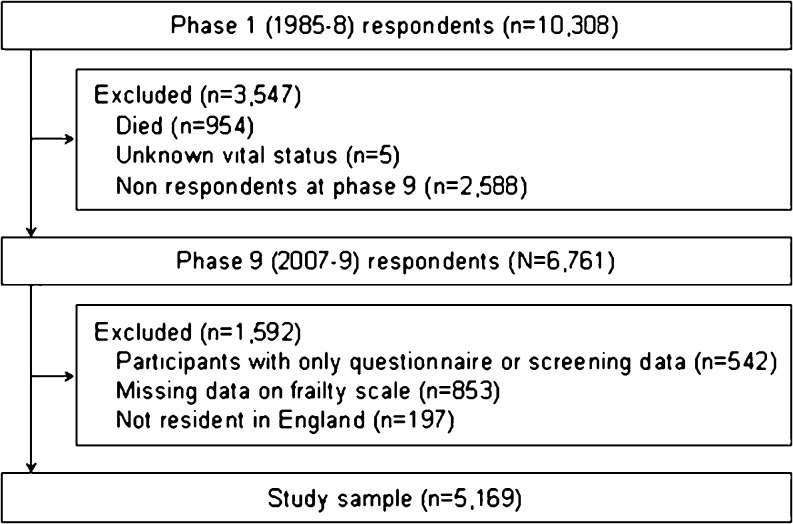
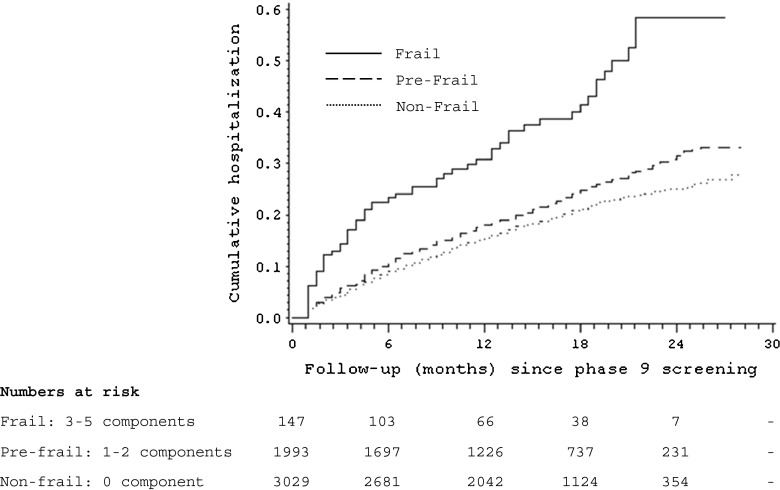
There is growing interest in the measurement of frailty in older age. The most widely used measure (Fried) characterizes this syndrome using five components: exhaustion, physical activity, walking speed, grip strength, and weight loss. These components overlap, raising the possibility of using fewer, and therefore making the device more time- and cost-efficient. The analytic sample was 5,169 individuals (1,419 women) from the British Whitehall II cohort study, aged 55 to 79 years in 2007-2009. Hospitalization data were accessed through English national records (mean follow-up 15.2 months). Age- and sex-adjusted Cox models showed that all components were significantly associated with hospitalization, the hazard ratios (HR) ranging from 1.18 (95 % confidence interval = 0.98, 1.41) for grip strength to 1.60 (1.35, 1.90) for usual walking speed. Some attenuation of these effects was apparent following mutual adjustment for frailty components, but the rank order of the strength of association remained unchanged. We observed a dose-response relationship between the number of frailty components and the risk for hospitalization [1 component-HR = 1.10 (0.96, 1.26); 2-HR = 1.52 (1.26, 1.83); 3-5-HR = 2.41 (1.84, 3.16), P trend <0.0001]. A concordance index used to evaluate the predictive power for hospital admissions of individual components and the full scale was modest in magnitude (range 0.57 to 0.58). Our results support the validity of the multi-component frailty measure, but the predictive performance of the measure is poor.
Figures

References
-
- Avila-Funes JA, Helmer C, Amieva H, Barberger-Gateau P, Le Goff M, Ritchie K, Portet F, Carriere I, Tavernier B, Gutierrez-Robledo LM, Dartigues JF. Frailty among community-dwelling elderly people in France: the three-city study. J Gerontol A Biol Sci Med Sci. 2008;63:1089–1096. doi: 10.1093/gerona/63.10.1089. - DOI - PMC - PubMed
Publication types
MeSH terms
Grants and funding
- R01 HL036310/HL/NHLBI NIH HHS/United States
- G19/35/MRC_/Medical Research Council/United Kingdom
- G0100222/MRC_/Medical Research Council/United Kingdom
- R01 AG034454/AG/NIA NIH HHS/United States
- MC_UP_A620_1014/MRC_/Medical Research Council/United Kingdom
- WT_/Wellcome Trust/United Kingdom
- G0400491/MRC_/Medical Research Council/United Kingdom
- MC_U147585824/MRC_/Medical Research Council/United Kingdom
- R01AG013196/AG/NIA NIH HHS/United States
- RG/07/008/23674/BHF_/British Heart Foundation/United Kingdom
- RG/13/2/30098/BHF_/British Heart Foundation/United Kingdom
- MC_UP_A620_1015/MRC_/Medical Research Council/United Kingdom
- G8802774/MRC_/Medical Research Council/United Kingdom
- MC_U147585819/MRC_/Medical Research Council/United Kingdom
- G0902037/MRC_/Medical Research Council/United Kingdom
- R01 AG013196/AG/NIA NIH HHS/United States
- PG/11/63/29011/BHF_/British Heart Foundation/United Kingdom
- R01AG034454/AG/NIA NIH HHS/United States
- R01HL036310/HL/NHLBI NIH HHS/United States
LinkOut - more resources
Full Text Sources
Medical