


Impact of smoking status on outcome in patients with ST-segment elevation myocardial infarction treated with primary percutaneous coronary intervention
- PMID: 22773074
- PMCID: PMC3459076
- DOI: 10.1007/s11239-012-0764-0
Impact of smoking status on outcome in patients with ST-segment elevation myocardial infarction treated with primary percutaneous coronary intervention
Abstract
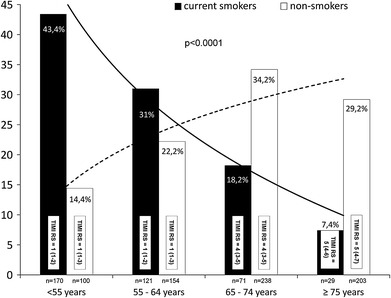
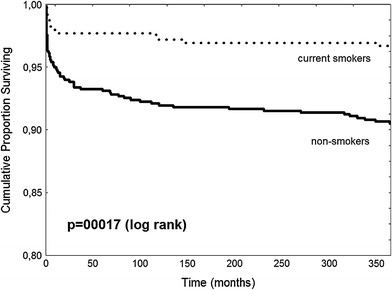
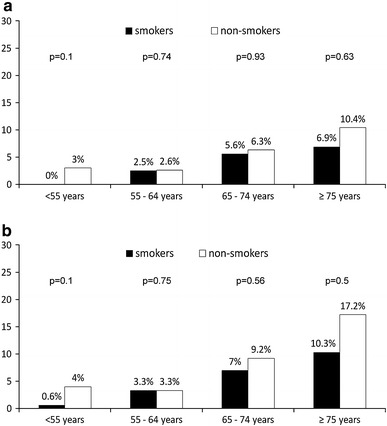
There are some data showing lower mortality of smokers comparing to non-smokers in patients with ST-segment elevation myocardial infarction (STEMI) when treated with thrombolysis or without reperfusion therapy. However, the role of smoking status is less established in patients with STEMI undergoing mechanical reperfusion. We evaluate the influence of smoking on outcome in patients with STEMI treated with primary percutaneous coronary intervention (PCI). A total of 1,086 patients enrolled into EUROTRANSFER Registry were included into present analysis. Patients were divided according to smoking status during STEMI presentation into those who were current smokers (391 patients, 36 %) and non-smokers (695 patients, 64 %). Current smokers were younger and more often men and less frequently had high-risk features as previous myocardial infarction, history of chronic renal failure, previous PCI, diabetes mellitus, anterior wall STEMI, and multivessel disease. Unadjusted mortality at 1 year was lower in current smokers comparing to non-smokers (3.3 vs. 9.5 %; OR 0.33 CI 0.18-0.6; p = 0.0001). However, after adjustment for age and gender by logistic regression, there was no longer significant difference between groups (OR 0.7; CI 0.37-1.36; p = 0.30). In conclusion, current smokers with STEMI treated with primary PCI have lower mortality at 1 year comparing to non-smokers, but this result may be explained by differences in baseline characteristics and not by smoking status itself. Current smokers developed STEMI more than 10 years earlier than non-smokers with similar age and sex-adjusted risk of death at 1 year. These results emphasize the role of efforts to encourage smoking cessation as prevention of myocardial infarction.
Figures
References
-
- Kannel WB, Higgins M. Smoking and hypertension as predictors of cardiovascular risk in population studies. J Hypertens Suppl. 1990;8:S3–S8. - PubMed
-
- Barbash GI, White HD, Modan M, et al. Significance of smoking in patients receiving thrombolytic therapy for acute myocardial infarction. Experience gleaned from the International Tissue Plasminogen Activator/Streptokinase Mortality Trial. Circulation. 1993;87:53–58. doi: 10.1161/01.CIR.87.1.53. - DOI - PubMed
-
- Barbash GI, Reiner J, White HD, et al. Evaluation of paradoxic beneficial effects of smoking in patients receiving thrombolytic therapy for acute myocardial infarction: mechanism of the “smoker’s paradox” from the GUSTO-I trial, with angiographic insights. Global Utilization of Streptokinase and Tissue-Plasminogen Activator for Occluded Coronary Arteries. J Am Coll Cardiol. 1995;26:1222–1229. doi: 10.1016/0735-1097(95)00299-5. - DOI - PubMed
Publication types
MeSH terms
LinkOut - more resources
Full Text Sources
Medical
Miscellaneous
