


doi: 10.1128/AEM.01015-12.
Epub 2012 Jul 6.
Phosphate starvation promotes swarming motility and cytotoxicity of Pseudomonas aeruginosa
Affiliations
- PMID: 22773629
- PMCID: PMC3426718
- DOI: 10.1128/AEM.01015-12
Item in Clipboard
Phosphate starvation promotes swarming motility and cytotoxicity of Pseudomonas aeruginosa
Appl Environ Microbiol.
2012 Sep.
Abstract
We investigated the transcriptional responses of Pseudomonas aeruginosa under phosphate-deficient (0.2 mM) conditions compared to phosphate sufficiency (1 mM). This elicited enormous transcriptional changes in genes related to phosphate acquisition, quorum sensing, chemotaxis, toxin secretion, and regulation. This dysregulation also led to increased virulence-associated phenotypes, including swarming motility and cytotoxicity.
Figures

Growth curve of P. aeruginosa PAO1 under phosphate (Pi)-deficient (0.2 mM) and phosphate-sufficient (1 mM) conditions. The results shown in this figure represent the averages and standard deviations of the results of three independent experiments.
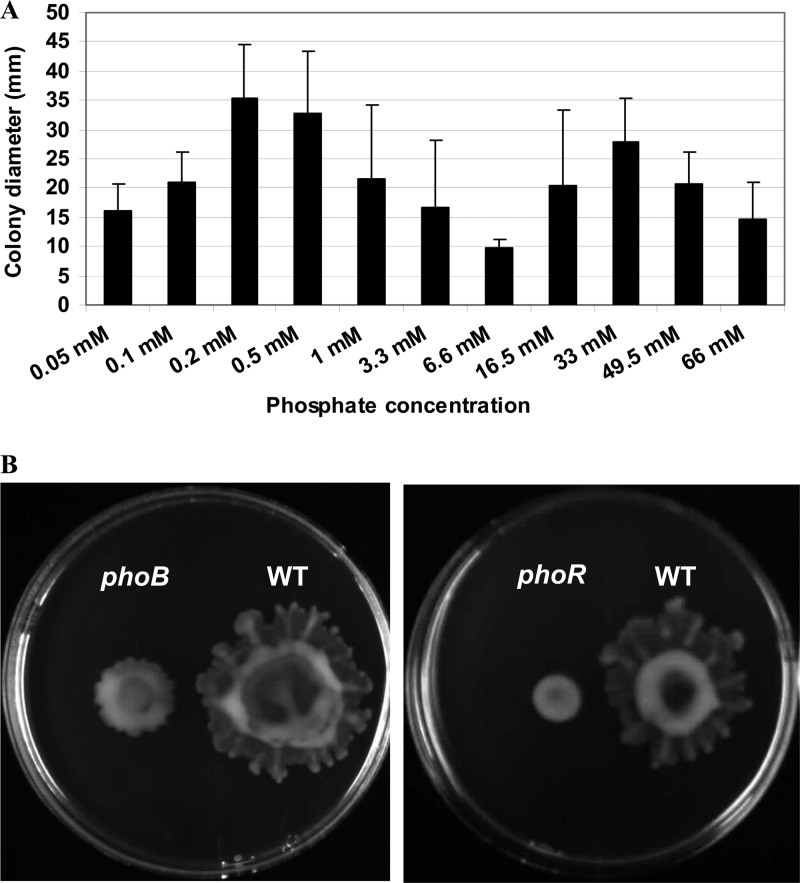
Effect of phosphate availability on swarming motility. (A) Diameters of swarming colonies of wild-type P. aeruginosa on plates containing swarming medium with increasing concentrations of phosphate. (B) Swarming motility phenotypes of the wild type (WT) and the phoB and phoR mutants on plates containing a low (0.2 mM) concentration of phosphate.
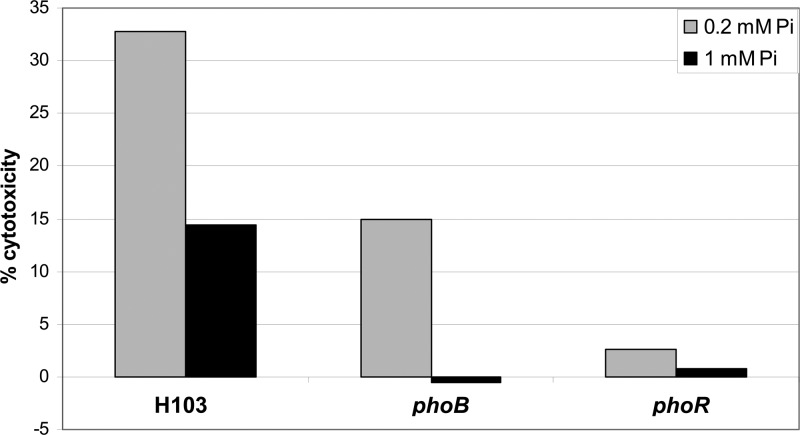
Analysis of the effect on cytotoxicity of phosphate deficiency prior to infection of HBE cells. The graph shows percent cytotoxicity compared to total cell lysis inflicted by treatment with Triton X-100 of the wild-type H103 strain and phoB and phoR mutant strains after growth in a sufficient (1 mM) or deficient (0.2 mM) concentration of phosphate. Data represent the results of a single experiment representative of three with the same trends.
References
-
- Aoyama T, Takanami M, Makino K, Oka A. 1991. Cross-talk between the virulence and phosphate regulons of Agrobacterium tumefaciens caused by an unusual interaction of the transcriptional activator with a regulatory DNA element. Mol. Gen. Genet. 227:385–390 - PubMed
-
- Breidenstein EBM, de la Fuente-Núñez C, Hancock REW. 2011. Pseudomonas aeruginosa: all roads lead to resistance. Trends Microbiol. 19:419–426 - PubMed
-
- Déziel E, Lépine F, Milot S, Villemur R. 2003. rhlA is required for the production of a novel biosurfactant promoting swarming motility in Pseudomonas aeruginosa: 3-(3-hydroxyalkanoyloxy)alkanoic acids (HAAs), the precursors of rhamnolipids. Microbiology 149:2005–2013 - PubMed
Publication types
MeSH terms
Substances
Grants and funding
LinkOut - more resources
Full Text Sources
