Growth-dependent podocyte failure causes glomerulosclerosis
- PMID: 22773827
- PMCID: PMC3402293
- DOI: 10.1681/ASN.2012030271
Growth-dependent podocyte failure causes glomerulosclerosis
Abstract
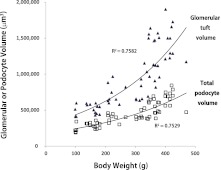
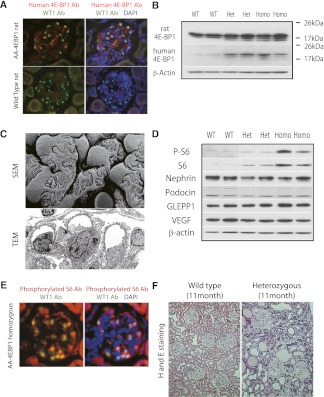
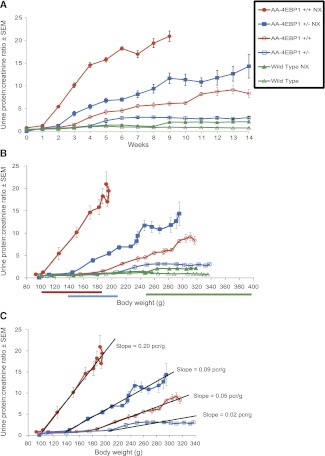
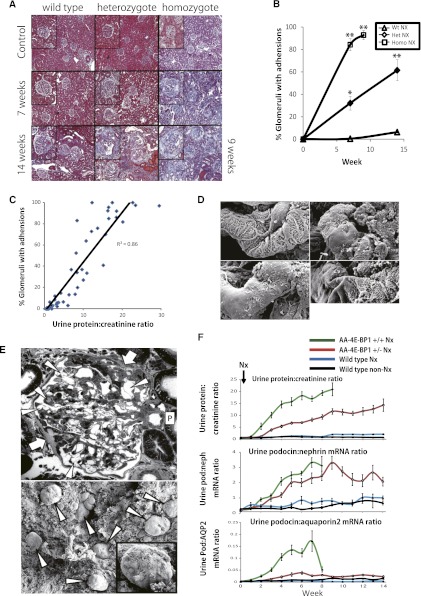
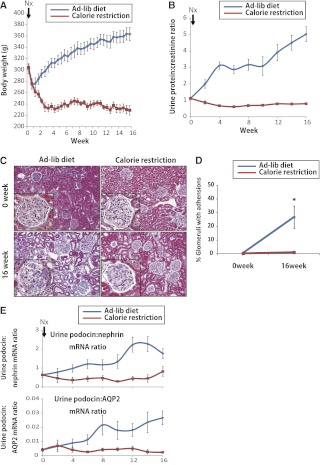
Podocyte depletion leads to glomerulosclerosis, but whether an impaired capacity of podocytes to respond to hypertrophic stress also causes glomerulosclerosis is unknown. We generated transgenic Fischer 344 rats that express a dominant negative AA-4E-BP1 transgene driven by the podocin promoter; a member of the mammalian target of rapamycin complex 1 (mTORC1) pathway, 4E-BP1 modulates cap-dependent translation, which is a key determinant of a cell's hypertrophic response to nutrients and growth factors. AA-4E-BP1 rat podocytes expressed the transgene and had normal kidney histology and protein excretion at 100 g of body weight but developed ESRD by 12 months. Proteinuria and glomerulosclerosis were linearly related to both increasing body weight and transgene dose. Uni-nephrectomy reduced the body weight at which proteinuria first developed by 40%-50%. The initial histologic manifestation of disease was the appearance of bare areas of glomerular basement membrane from the pulling apart of podocyte foot processes, followed by adhesions to the Bowman capsule. Morphometric analysis confirmed the mismatch between glomerular tuft volume and total podocyte volume (number × size) per tuft in relation to weight gain and nephrectomy. Proteinuria and glomerulosclerosis did not develop if dietary calorie restriction prevented weight gain and glomerular enlargement. In summary, failure of podocytes to match glomerular tuft growth in response to growth signaling through the mTORC1 pathway can trigger proteinuria, glomerulosclerosis, and progression to ESRD. Reducing body weight and glomerular growth may be useful adjunctive therapies to slow or prevent progression to ESRD.
Figures
Comment in
-
Glomerular homeostasis requires a match between podocyte mass and metabolic load.J Am Soc Nephrol. 2012 Aug;23(8):1273-5. doi: 10.1681/ASN.2012060618. Epub 2012 Jul 12. J Am Soc Nephrol. 2012. PMID: 22797185 Free PMC article. No abstract available.
References
-
- Kriz W, Gretz N, Lemley KV: Progression of glomerular diseases: Is the podocyte the culprit? Kidney Int 54: 687–697, 1998 - PubMed
-
- Kim YH, Goyal M, Kurnit D, Wharram B, Wiggins J, Holzman L, Kershaw D, Wiggins R: Podocyte depletion and glomerulosclerosis have a direct relationship in the PAN-treated rat. Kidney Int 60: 957–968, 2001 - PubMed
-
- Kriz W: Podocyte is the major culprit accounting for the progression of chronic renal disease. Microsc Res Tech 57: 189–195, 2002 - PubMed
-
- Wharram BL, Goyal M, Wiggins JE, Sanden SK, Hussain S, Filipiak WE, Saunders TL, Dysko RC, Kohno K, Holzman LB, Wiggins RC: Podocyte depletion causes glomerulosclerosis: Diphtheria toxin-induced podocyte depletion in rats expressing human diphtheria toxin receptor transgene. J Am Soc Nephrol 16: 2941–2952, 2005 - PubMed
-
- Wiggins RC: The spectrum of podocytopathies: A unifying view of glomerular diseases. Kidney Int 71: 1205–1214, 2007 - PubMed
Publication types
MeSH terms
Substances
Grants and funding
LinkOut - more resources
Full Text Sources
Other Literature Sources
Miscellaneous