. 2012 Feb;21(1):8-14.
doi: 10.1177/0963721411429458.

The Nature and Organization of Individual Differences in Executive Functions: Four General Conclusions

Affiliations

The Nature and Organization of Individual Differences in Executive Functions: Four General Conclusions

Akira Miyake et al. Curr Dir Psychol Sci. 2012 Feb.

Abstract

Executive functions (EFs)-a set of general-purpose control processes that regulate one's thoughts and behaviors-have become a popular research topic lately and have been studied in many subdisciplines of psychological science. This article summarizes the EF research that our group has conducted to understand the nature of individual differences in EFs and their cognitive and biological underpinnings. In the context of a new theoretical framework that we have been developing (the unity/diversity framework), we describe four general conclusions that have emerged from our research. Specifically, we argue that individual differences in EFs, as measured with simple laboratory tasks, (1) show both unity and diversity (different EFs are correlated yet separable); (2) reflect substantial genetic contributions; (3) are related to various clinically and societally important phenomena; and (4) show some developmental stability.


Figures
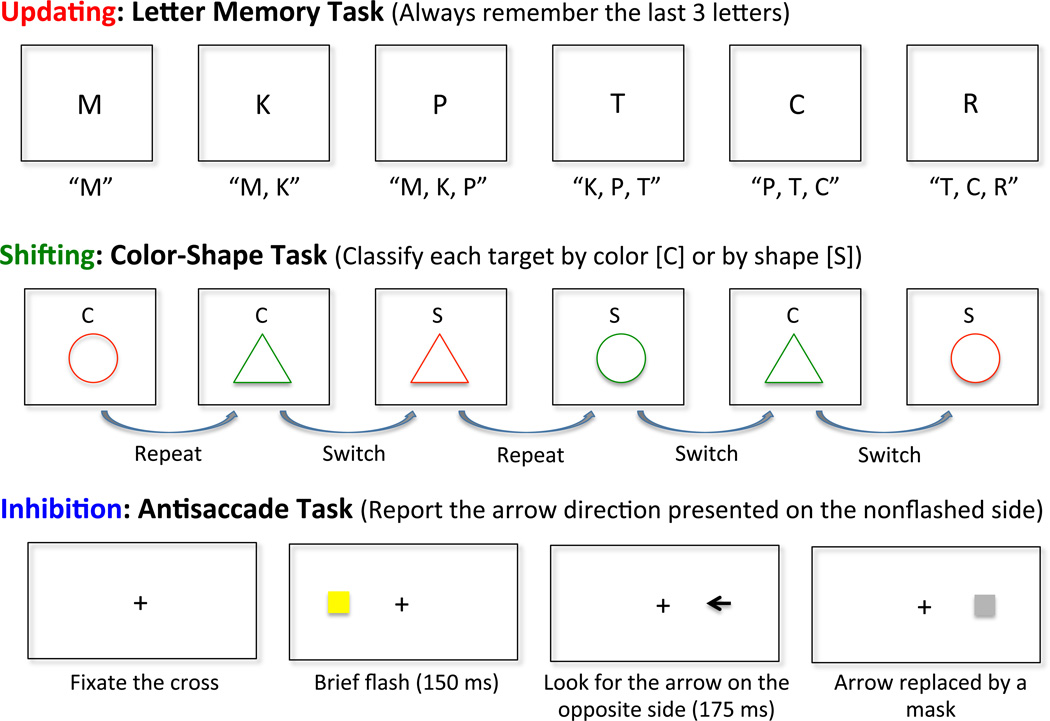
Figure 1
Figure 1
Schematic illustrations of three executive function (EF) tasks used in our current EF test battery. (A) In the letter memory task (an example of an updating task), participants are presented with a series of consonant letters one at a time. Their task is to report the last three letters after the presentation of the letter sequence ends. To ensure that participants constantly update their working memory contents, they are required to say aloud what the last three letters are after each letter. The dependent measure is the accuracy of the recalled letters at the end. (B) In the color-shape task (an example of a shifting task), participants see a letter cue first (either C or S) and, depending on the cue, they make a classification decision about the target item presented shortly afterwards in terms of color (green or red) or shape (circle or triangle) by pressing appropriate buttons on a button box. The dependent measure is the switch cost, namely, a reaction time difference between switch and repeat trials. (C) In the antisaccade task (an example of an inhibition task), participants first fixate on the center cross. When a brief flash occurs, they need to avoid looking at that flash and instead move their gaze toward the opposite side of the screen so that they can correctly identify and report the direction of an arrow briefly presented there. The dependent measure is the proportion of correctly reported arrows. More procedural details of these tasks and the details of other EF measures we use are provided inFriedman et al. (2008).
Figure 2
Figure 2
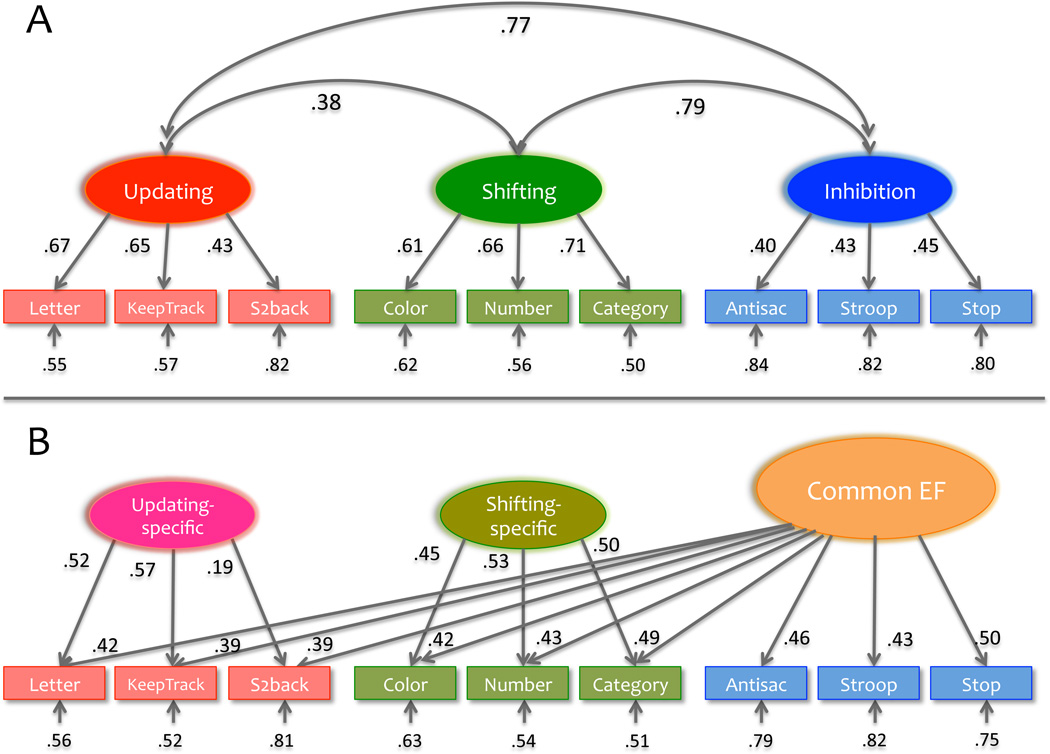
Two complementary ways of representing the unity and diversity of EFs, adapted from the confirmatory factor analysis results reported inFriedman et al. (2011). Numbers on arrows are standardized factor loadings, those under the smaller arrows are residual variances, and those on curved double-headed arrows are interfactor correlations (task names are abbreviated). (A) This panel illustrates the unity and diversity of EFs by showing that the three types of EFs (updating, shifting, and inhibition) are substantially correlated with each other (unity) but are separable (diversity) in that those correlations are far from 1.0. This was the way our research initially examined individual differences in EFs (e.g., Miyake et al., 2000). (B) This panel illustrates the unity and diversity of EFs in a way that is more consistent with the unity/diversity framework we have been developing. As Panel B shows, there is a Common EF latent variable on which all nine EF tasks load (unity), as well as two “nested” latent variables on which the updating and shifting tasks, respectively, also load (diversity). Because the Common EF variance happened to be perfectly correlated with the inhibition latent variable, no inhibition-specific factor is represented in the figure. Letter = letter memory, Keep = keep track, S2back = Spatial 2-back, Color = color-shape, Number = number-letter, Category = category-switch, Antisac = antisaccade, and Stop = stop-signal (for details about these tasks, see Friedman et al., 2008).
Figure 3
Figure 3
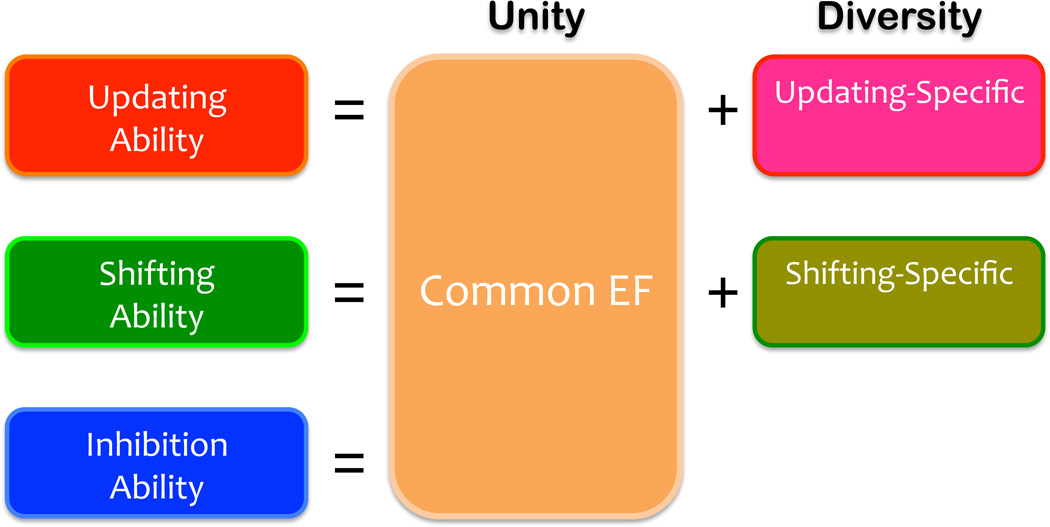
Schematic representation of the unity and diversity of three executive functions (EFs). Each EF (e.g., updating) is really a combination of what is common to all three EFs (Common EF) and what is specific to that EF (e.g., updating-specific). Although our initial research has focused on three types of EFs (the left side of the equation) and how they relate to other psychological measures of interest, the unity/diversity framework we have been developing focuses on the right side of the equation (Common EF, updating-specific, shifting-specific) so that we can more directly specify the cognitive and biological underpinnings of EF’s unity and diversity. In this figure, the inhibition-specific component is absent, because we have found repeatedly that, once the unity (Common EF) is accounted for, there is no unique variance left for the inhibition-specific factor, a point also illustrated in Figure 2B in the data from a large twin sample (Friedman et al., 2011).
Figure 4
Figure 4
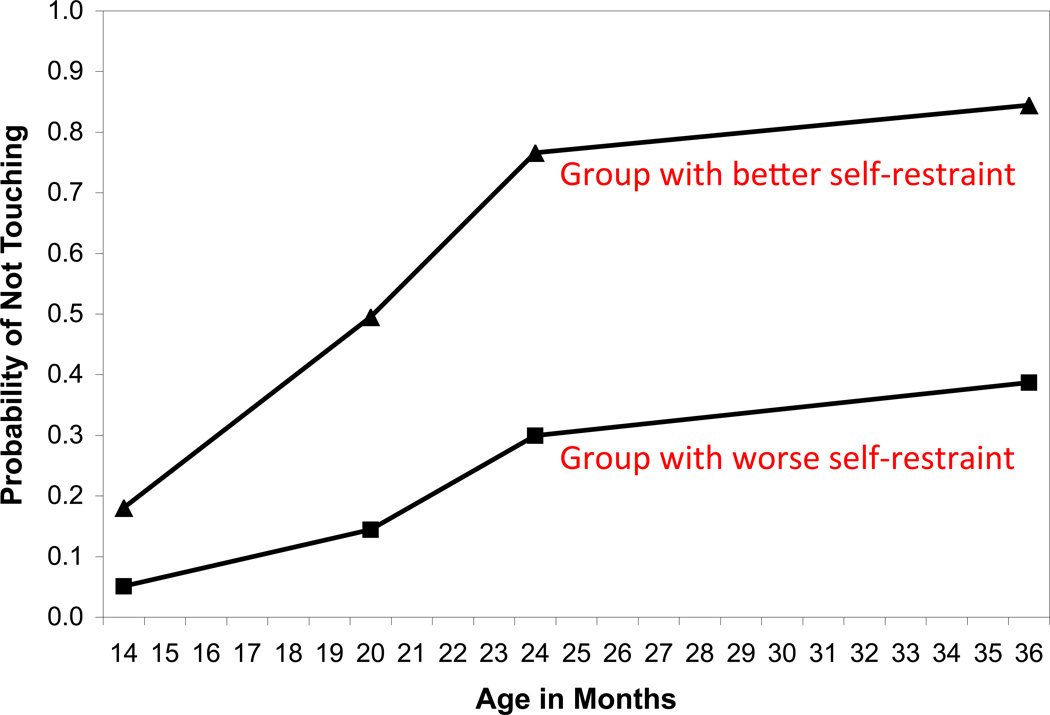
Growth trajectories of the two groups identified in the latent class growth model illustrating the development of self-restraint ability, as measured by a simple prohibition task (Friedman et al., 2011). In this task, a child is shown an attractive toy and then told not to touch it for 30 seconds. One group (55% of the sample) showed better self-restraint than the other group (45%), and this group difference was significant at all four time points (14, 20, 24, and 36 months of age). As explained in the main text, this group difference was also reflected in their performance of executive function (EF) tasks, assessed 14 years later at age 17. For simplicity, the figure shown here is based on the data based on the dichotomous scoring of the prohibition task performance (pass or fail). The analyses and results reported in theFriedman et al. (2011) article takes into account the durations for which each child was able to not touch the toy.

References

    1. Altamirano LJ, Miyake A, Whitmer AJ. When mental inflexibility facilitates executive control: Beneficial side effects of ruminative tendencies on goal maintenance. Psychological Science. 2010;21:1377–1382. - PMC - PubMed
    1. Barnes JM, Dean AJ, Nandam S, O’Connell RG, Bellgrove MA. The molecular genetics of executive function: Role of monoamine system genes. Biological Psychiatry. 2011;69:e127–e143. - PubMed
    1. Chatham CH, Herd SA, Brant AM, Hazy TE, Miyake A, O’Reilly RC, Friedman NP. From an executive network to executive control: A computational model of the n-back task. Journal of Cognitive Neuroscience. 2011 Advance online publication. - PMC - PubMed
    1. Dahlin E, Neely AS, Larsson A, Bäckman L, Nyberg L. Transfer of learning after updating training mediated by the striatum. Science. 2008;320:1510–1512. - PubMed
    1. Friedman NP, Haberstick BC, Willcutt EG, Miyake A, Young SE, Corley RP, Hewitt JK. Greater attention problems during childhood predict poorer executive functioning in late adolescence. Psychological Science. 2007;18:893–900. - PubMed

LinkOut - more resources