. 2012 Jul;3 Suppl 1(S1):S119-24.
doi: 10.1007/s12975-012-0157-x. Epub 2012 Apr 13.

Neuregulin-1 effects on endothelial and blood-brain-barrier permeability after experimental injury

Affiliations

Neuregulin-1 effects on endothelial and blood-brain-barrier permeability after experimental injury

Josephine Lok et al. Transl Stroke Res. 2012 Jul.

Abstract

Blood-brain-barrier disruption occurs with a high incidence after traumatic brain injury, and is an important contributor to many pathological processes, including brain edema, inflammation, and neuronal cell death. Therefore, blood-brain-barrier integrity is an important potential therapeutic target in the treatment of the acute phase of brain trauma. In this short communication, we report our data showing that neuregulin-1 (NRG1), a growth factor with diverse functions in the CNS, ameliorates pathological increases in endothelial permeability and in BBB permeability in experimental models of injury. For in-vitro studies, rat brain endothelial cells were incubated with the inflammatory cytokine IL-1β, which caused an increase in permeability of the cell layer. Co-incubation with NRG1 ameliorated this permeability increase. For in-vivo studies, C57Bl mice were subjected to controlled cortical impact (CCI) under anesthesia, and BBB permeability was assessed by measuring the amount of Evans blue dye extravasation at 2h. NRG1 administered by tail-vein injection 10 minutes after CCI resulted in a decrease in Evans blue dye extravasation by 35%. Since Evans blue extravasation may result from an increase in BBB permeability or from bleeding due to trauma, hemoglobin ELISA was also performed at the same time point. There was a trend towards lower levels of hemoglobin extravasation in the NRG1 group, but the results did not reach statistical significance. MMP-9 activity was not different between groups at 2h. These data suggest that NRG1 has beneficial effects on endothelial permeability and BBB permeability following experimental trauma, and may have neuroprotective potential during CNS injury.


Figures
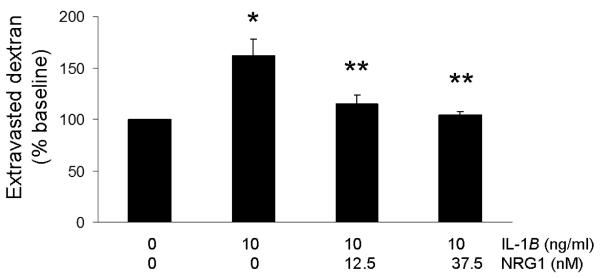
Fig. 1
Fig. 1. NRG1 reduces endothelial permeability induced by IL-1β
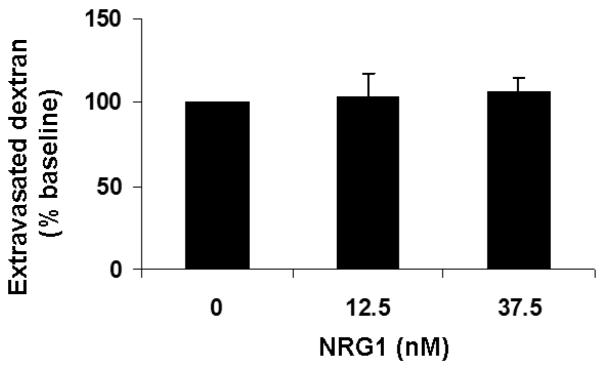
Fig. 1a 24h incubation with IL-1β (10ng/ml) resulted in an increase in permeability of the endothelial monolayer, measured as extravasated dextran-40, averaging 1.5-fold that of the baseline level (*p<.01). The presence of NRG1 during IL-1β incubation reduced endothelial permeability to baseline (**p<.01, comparing incubation with IL-1β vs. IL-1β and NRG1). Values are expressed as % of baseline. n = 3 experiments. Fig.1b NRG1 alone did not alter permeability.
Fig. 1
Fig. 1. NRG1 reduces endothelial permeability induced by IL-1β
Fig. 1a 24h incubation with IL-1β (10ng/ml) resulted in an increase in permeability of the endothelial monolayer, measured as extravasated dextran-40, averaging 1.5-fold that of the baseline level (*p<.01). The presence of NRG1 during IL-1β incubation reduced endothelial permeability to baseline (**p<.01, comparing incubation with IL-1β vs. IL-1β and NRG1). Values are expressed as % of baseline. n = 3 experiments. Fig.1b NRG1 alone did not alter permeability.
Fig. 2
Fig. 2. Tail-vein administration of NRG1 after brain trauma decreases acute BBB permeability
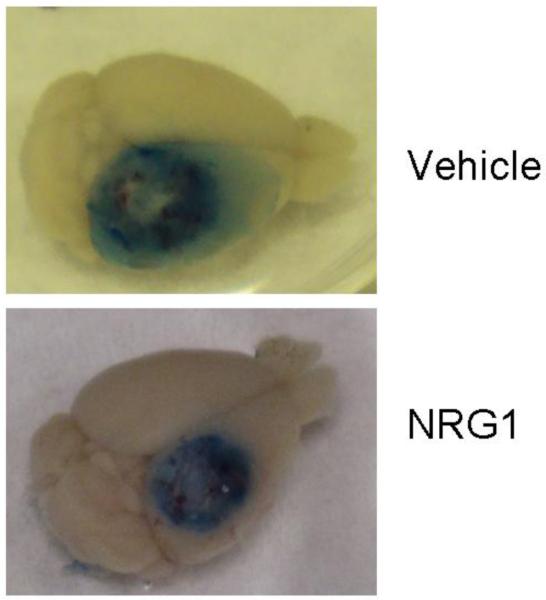
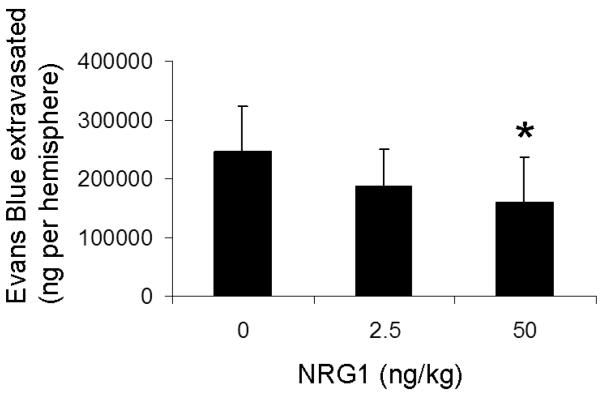
Fig. 2a Increased Evans blue extravasation is evident in the ipsilateral hemisphere 2h after CCI. Fig. 2b Evans blue extravasation is reduced by 35% in NRG1-treated mice (50ng/kg) (*p<.01). Values are expressed as ng of extravasated Evans Blue per gm brain tissue (+/− SD). n=9 in vehicle group; 9 in 2.5ng/kg NRG1 group; 12 in 50ng/kg NRG1 group
Fig. 2
Fig. 2. Tail-vein administration of NRG1 after brain trauma decreases acute BBB permeability
Fig. 2a Increased Evans blue extravasation is evident in the ipsilateral hemisphere 2h after CCI. Fig. 2b Evans blue extravasation is reduced by 35% in NRG1-treated mice (50ng/kg) (*p<.01). Values are expressed as ng of extravasated Evans Blue per gm brain tissue (+/− SD). n=9 in vehicle group; 9 in 2.5ng/kg NRG1 group; 12 in 50ng/kg NRG1 group
Fig. 3
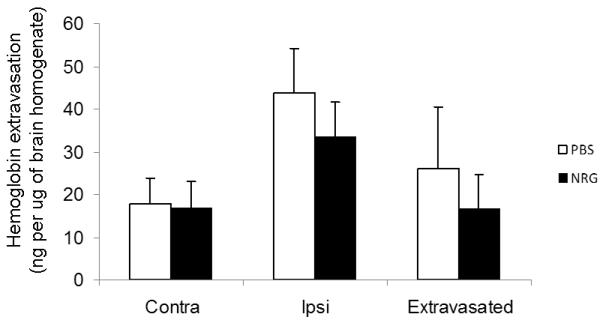
Fig. 3. Hgb ELISA did not show a significant reduction in hemoglobin extravasation
There was a trend towards lower levels of hemoglobin extravasation in the NRG1 group, but the results did not reach statistical significance with n=5 per group (p=0.24).
Fig. 4
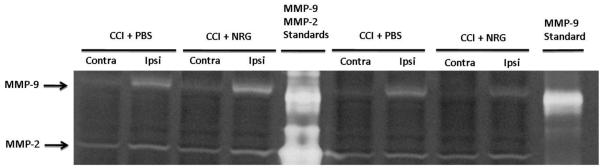
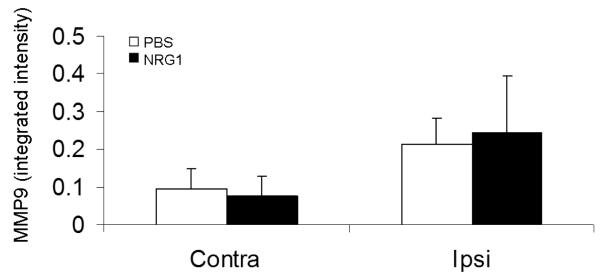
Fig. 4. Tail-vein administration of NRG1 after brain trauma does not affect MMP-9 activity at 2h after CCI
Fig. 4a A representative zymogram shows MMP-9 and MMP-2 levels in contralateral and ipsilateral hemispheres of PBS- and NRG1-treated mice 2h after CCI. Mouse MMP-MMP-9 standard was used for calibration of the amount of MMP-9 activity Fig. 4b Integrated band intensities were expressed as a percentage of the loaded MMP-9 control. n=9 in vehicle group; 9 in 2.5ng/kg NRG1 group; 12 in 50ng/kg NRG1 group.
Fig. 4
Fig. 4. Tail-vein administration of NRG1 after brain trauma does not affect MMP-9 activity at 2h after CCI
Fig. 4a A representative zymogram shows MMP-9 and MMP-2 levels in contralateral and ipsilateral hemispheres of PBS- and NRG1-treated mice 2h after CCI. Mouse MMP-MMP-9 standard was used for calibration of the amount of MMP-9 activity Fig. 4b Integrated band intensities were expressed as a percentage of the loaded MMP-9 control. n=9 in vehicle group; 9 in 2.5ng/kg NRG1 group; 12 in 50ng/kg NRG1 group.

References

    1. Langlois JA, Rutland-Brown W, Wald MM. The epidemiology and impact of traumatic brain injury: a brief overview. J Head Trauma Rehabil. 2006 Sep-Oct;21(5):375–8. - PubMed
    1. Rutland-Brown W, Langlois JA, Thomas KE, Xi YL. Incidence of traumatic brain injury in the United States, 2003. J Head Trauma Rehabil. 2006 Nov-Dec;21(6):544–8. - PubMed
    1. Thurman DJ, Alverson C, Dunn KA, Guerrero J, Sniezek JE. Traumatic brain injury in the United States: A public health perspective. J Head Trauma Rehabil. 1999 Dec;14(6):602–15. - PubMed
    1. Korn A, Golan H, Melamed I, Pascual-Marqui R, Friedman A. Focal cortical dysfunction and blood-brain barrier disruption in patients with Postconcussion syndrome. J Clin Neurophysiol. 2005 Jan-Feb;22(1):1–9. - PubMed
    1. Tomkins O, Friedman O, Ivens S, Reiffurth C, Major S, Dreier JP, et al. Blood-brain barrier disruption results in delayed functional and structural alterations in the rat neocortex. Neurobiol Dis. 2007 Feb;25(2):367–77. - PubMed

LinkOut - more resources