


Characterization of clinical study populations by race and ethnicity in biomedical literature
- PMID: 22774316
- PMCID: PMC3412405
Characterization of clinical study populations by race and ethnicity in biomedical literature
Abstract
Objective: The importance of race and ethnicity in biomedical research has long been a subject of debate, recently heightened by data revealed by the completion of the sequencing of the human genome and the mapping of human genetic variation. We aimed to determine whether and how the reporting of race has changed over the last three decades and how the practice may differ given study location, where the journal of publication is based, and decade of publication.
Design: We analyzed a sample of studies published in the Journal of the American Medical Association, The Lancet, and the Canadian Medical Association Journal from 1980 to 2009.
Main outcome measures: The number of articles that reported race by journal and decade and the descriptors used.
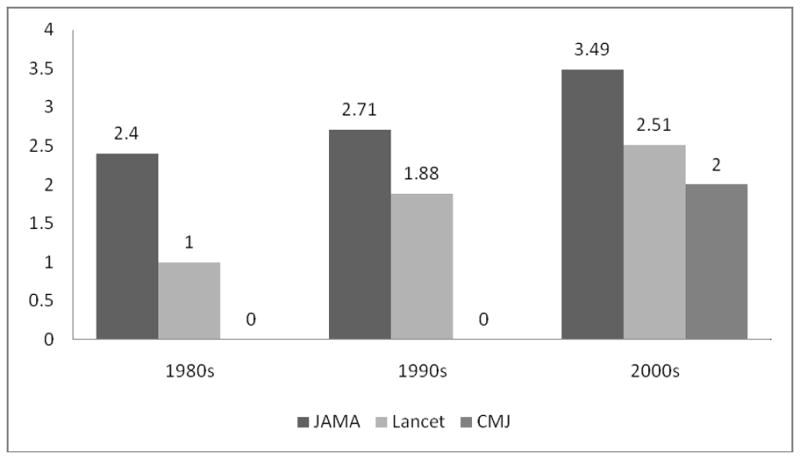
Results: Of 1867 articles analyzed, 17.30% reported race. The reporting of race and number of populations reported increased over time for all three journals. In addition, the diversity of race/ethnicity descriptors increased, with increased use of race/ethnicity combinations and nationality of research subjects.
Conclusion: Though it has increased over the past few decades, the reporting of race/ethnicity of study populations is relatively low, ambiguous and inconsistent, likely influenced by the uncertain relevance of these variables to the study's outcomes, study location, researcher views, and the policies of journals and funding agencies. Thus, due to the inconsistent and ambiguous practice of reporting race/ethnicity, comparison of study outcomes can result in misleading conclusions. Improvements in standardization of terms and new approaches to characterize research participants related to race/ethnicity are imperative.
Figures
References
-
- National Institutes of Health, National Human Genome Research Institute. International Human Genome Sequencing Consortium Describes Finished Human Genome Sequence. 2004 http://www.genome.gov/12513430.
-
- Gabriel SB, Schaffner SF, Nguyen H, et al. The structure of haplotype blocks in the human genome. Science. 2002 Jun 21;296(5576):2225–2229. - PubMed
-
- Rosenberg NA, Pritchard JK, Weber JL, et al. Genetic Structure of Human Populations. Science. 2002 Dec 20;298(5602):2381–2385. - PubMed
Publication types
MeSH terms
Grants and funding
LinkOut - more resources
Full Text Sources
Miscellaneous