An oral TRPV1 antagonist attenuates laser radiant-heat-evoked potentials and pain ratings from UV(B)-inflamed and normal skin
- PMID: 22775239
- PMCID: PMC3579255
- DOI: 10.1111/j.1365-2125.2012.04377.x
An oral TRPV1 antagonist attenuates laser radiant-heat-evoked potentials and pain ratings from UV(B)-inflamed and normal skin
Abstract
Aims: Laser (radiant-heat) evoked potentials (LEPs) from vertex-EEG peak-to-peak (PtP) amplitude were used to determine acute antinociceptive/antihyperalgesic efficacy of ABT-102, a novel TRPV1 antagonist efficacious in preclinical pain models, compared with active controls and placebo in normal and UV(B)-inflamed skin.
Methods: This was a randomized, placebo- and active-controlled, double-blind, intra-individual, crossover trial. Twenty-four healthy subjects received six sequences of single doses of ABT-102 (0.5, 2, 6 mg), etoricoxib 90 mg, tramadol 100 mg and placebo. Painful stimuli were induced by CO(2) -laser on normal and UV(B) -inflamed skin. LEPs and visual analogue scale (VAS-pain) ratings were taken at baseline and hourly up to 8 h post-dose from both skin types.
Results: Compared with placebo, significant mean decreases in the primary variable of LEP PtP-amplitude from UV(B)-inflamed skin were observed with ABT-102 6 mg (P < 0.001), ABT-102 2 mg (P = 0.002), tramadol 100 mg (P < 0.001), and etoricoxib 90 mg (P = 0.001) over the 8 h period; ABT-102 0.5 mg was similar to placebo. ABT-102 6 mg was superior to active controls over the 8 h period (P < 0.05) whereas ABT-102 2 mg was comparable. Improvements in VAS scores compared with placebo were observed with ABT-102 6 mg (P < 0.001) and ABT-102 2 mg (P = 0.002). ABT-102 average plasma concentrations were 1.3, 4.4 and 9.4 ng ml(-1) for the 0.5, 2 and 6 mg doses, respectively. There were no clinically significant safety findings.
Conclusions: TRPV-1 antagonism appears promising in the management of clinical pain, but requires further investigation.
© 2012 Abbott. British Journal of Clinical Pharmacology © 2012 The British Pharmacological Society.
Figures


 , ABT-102 0.5 mg;
  , ABT-102 2 mg;
  , ABT-102 6 mg;
  , Tramadol 100 mg;
  , Etoricoxib 90 mg;
  , Placebo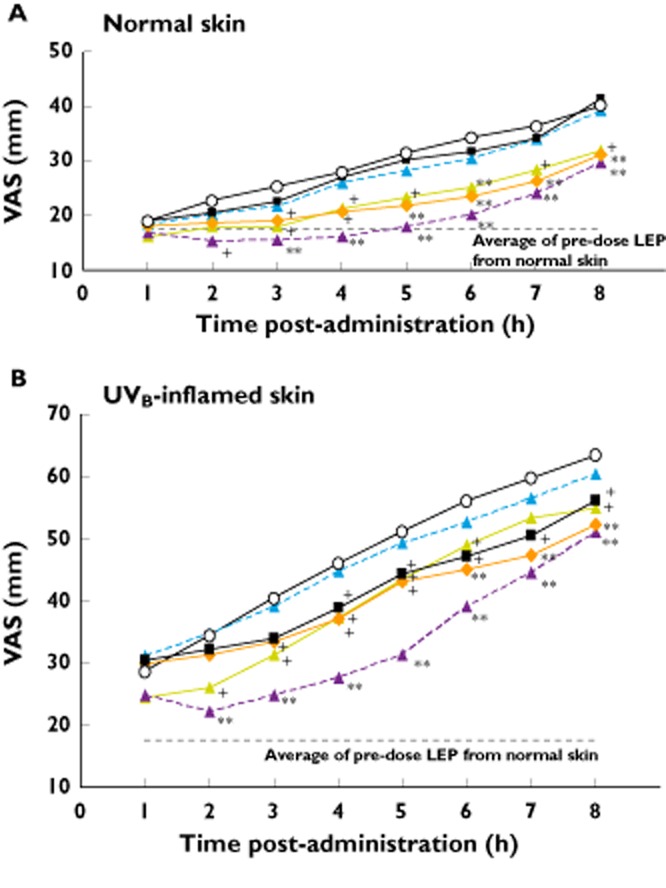
 , ABT-102 0.5 mg;
  , ABT-102 2 mg;
  , ABT-102 6 mg;
  , Tramadol 100 mg;
  , Etoricoxib 90 mg;
  , Placebo
References
-
- Katz WA, Barkin RL. Dilemmas in chronic/persistent pain management. Am J Ther. 2008;15:256–264. - PubMed
-
- Langman MJ, Jensen DM, Watson DJ, Harper SE, Zhao PL, Quan H, Bolognese JA, Simon TJ. Adverse upper gastrointestinal effects of rofecoxib compared with NSAIDs. JAMA. 1999;282:1929–1933. - PubMed
-
- Swegle JM, Logemann C. Management of common opioid-induced adverse effects. Am Fam Physician. 2006;74:1347–1354. - PubMed
-
- Morley-Forster PK, Clark AJ, Speechley M, Moulin DE. Attitudes toward opioid use for chronic pain: a Canadian physician survey. Pain Res Manag. 2003;8:189–194. - PubMed
Publication types
MeSH terms
Substances
LinkOut - more resources
Full Text Sources
Other Literature Sources
Miscellaneous