Effort-based decision-making in major depressive disorder: a translational model of motivational anhedonia
- PMID: 22775583
- PMCID: PMC3730492
- DOI: 10.1037/a0028813
Effort-based decision-making in major depressive disorder: a translational model of motivational anhedonia
Abstract
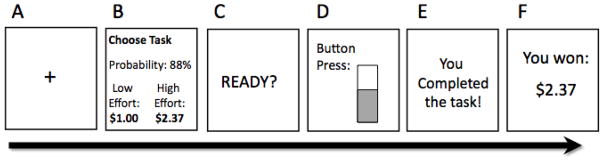
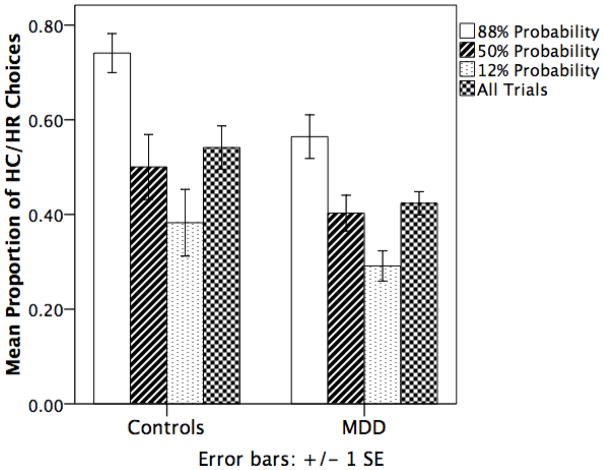
Anhedonia is a core feature of major depressive disorder (MDD), but the precise nature of anhedonic symptoms is unknown. Whereas anhedonia has traditionally been viewed as a deficit in the experience of pleasure, more recent evidence suggests that reduced anticipation and motivation may also be a core feature of this symptom. Here, we provide data from a study in MDD patients and healthy controls using a translational measure of reward motivation, the Effort Expenditure for Rewards Task (EEfRT or "effort"). This task offers subjects a series of trials where they may choose to expend more or less effort for the opportunity to win varying amounts of monetary rewards. We found that MDD patients were less willing to expend effort for rewards than controls. Additionally, we observed that patients were less able to effectively use information about magnitude and probability of rewards to guide their choice behavior. Finally, within the MDD patient group, duration of the current episode was a significant negative predictor of EEfRT task performance. These findings offer novel support for theoretical models proposing that anhedonia in MDD may reflect specific impairments in motivation and reward-based decision-making.
PsycINFO Database Record (c) 2012 APA, all rights reserved.
Conflict of interest statement
The authors report no financial interests or conflicts of interest.
Figures
References
-
- Abramson LY, Metalsky GI, Alloy LB. Hoplessness depression: a theory-based sub-type of depression. Psychological Review. 1989;96(2):358–372.
-
- Abramson LY, Seligman ME, Teasdale JD. Learned helplessness in humans: cirtique and reformulation. Journal of Abnormal Psychology. 1978;87(1):49–74. - PubMed
-
- Amsterdam JD, Settle RG, Doty RL, Abelman E, Winokur A. Taste and smell perception in depression. Biological Psychiatry. 1987;22(12):1481–1485. - PubMed
-
- Beck AT, Steer RA, Ball R, Ranieri W. Comparison of Beck Depression Inventories -IA and -II in psychiatric outpatients. Journal of Personality Assessment. 1996;67(3):588–597. - PubMed
Publication types
MeSH terms
Grants and funding
LinkOut - more resources
Full Text Sources
Other Literature Sources
Medical
Miscellaneous