


Development and validation of IIKC: an interactive identification key for Culicoides (Diptera: Ceratopogonidae) females from the Western Palaearctic region
- PMID: 22776566
- PMCID: PMC3483010
- DOI: 10.1186/1756-3305-5-137
Development and validation of IIKC: an interactive identification key for Culicoides (Diptera: Ceratopogonidae) females from the Western Palaearctic region
Abstract
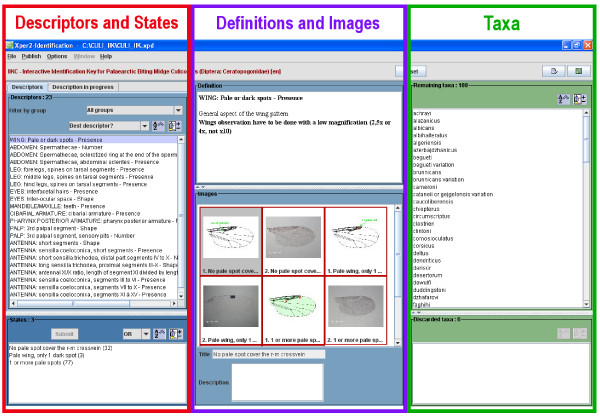
Background and methods: The appearance of bluetongue virus (BTV) in 2006 within northern Europe exposed a lack of expertise and resources available across this region to enable the accurate morphological identification of species of Culicoides Latreille biting midges, some of which are the major vectors of this pathogen. This work aims to organise extant Culicoides taxonomic knowledge into a database and to produce an interactive identification key for females of Culicoides in the Western Palaearctic (IIKC: Interactive identification key for Culicoides). We then validated IIKC using a trial carried out by six entomologists based in this region with variable degrees of experience in identifying Culicoides.
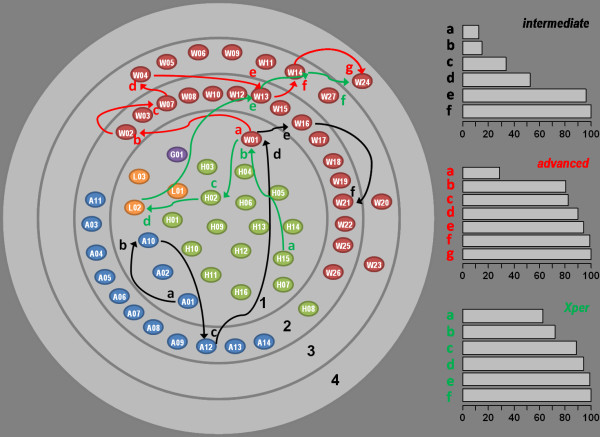
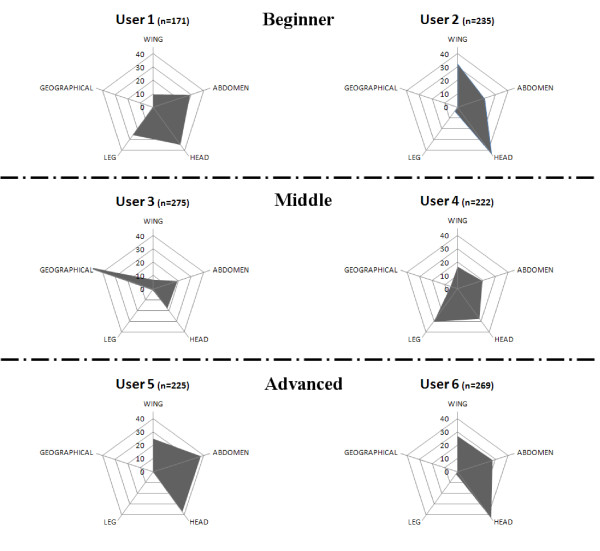
Results: The current version of the key includes 98 Culicoides species with 10 morphological variants, 61 descriptors and 837 pictures and schemes. Validation was carried out by six entomologists as a blind trial with two users allocated to three classes of expertise (beginner, intermediate and advanced). Slides were identified using a median of seven steps and seven minutes and user confidence in the identification varied from 60% for failed identifications to a maximum of 80% for successful ones. By user class, the beginner group successfully identified 44.6% of slides, the intermediate 56.8% and the advanced 74.3%.
Conclusions: Structured as a multi-entry key, IIKC is a powerful database for the morphological identification of female Culicoides from the Western Palaearctic region. First developed for use as an interactive identification key, it was revealed to be a powerful back-up tool for training new taxonomists and to maintain expertise level. The development of tools for arthropod involvement in pathogen transmission will allow clearer insights into the ecology and dynamics of Culicoides and in turn assist in understanding arbovirus epidemiology.
Figures
References
-
- Agosti D. Biodiversity data are out of local taxonomists' reach. Nature. 2006;439:392. - PubMed
-
- Song H. Grasshopper Systematics: Past, Present and Future. J Orthopt Res. 2010;19:57–68. doi: 10.1665/034.019.0112. - DOI
-
- Vignes-Lebbe R, Gallut C. Computer Aided Identification of Phlebotomine sandflies of Americas (CIPA) Université Pierre et Marie Curie, Paris; 1997. http://lis-upmc.snv.jussieu.fr/xper2/infosXper2Bases/
Publication types
MeSH terms
Grants and funding
LinkOut - more resources
Full Text Sources
