Persistent effects of women's parity and breastfeeding patterns on their body mass index: results from the Million Women Study
- PMID: 22777544
- PMCID: PMC3647235
- DOI: 10.1038/ijo.2012.76
Persistent effects of women's parity and breastfeeding patterns on their body mass index: results from the Million Women Study
Abstract
Objective: To explore the long-term effects of women's childbearing patterns on their body mass index.
Design: Cross-sectional analysis.
Setting: Population-based study of UK women.
Participants: 740 628 postmenopausal participants in the Million Women Study who reported their height, weight, reproductive histories and other relevant factors.
Main outcome measures: Standardized mean BMI (kg m(-2)) in groups defined by their parity and breastfeeding history.
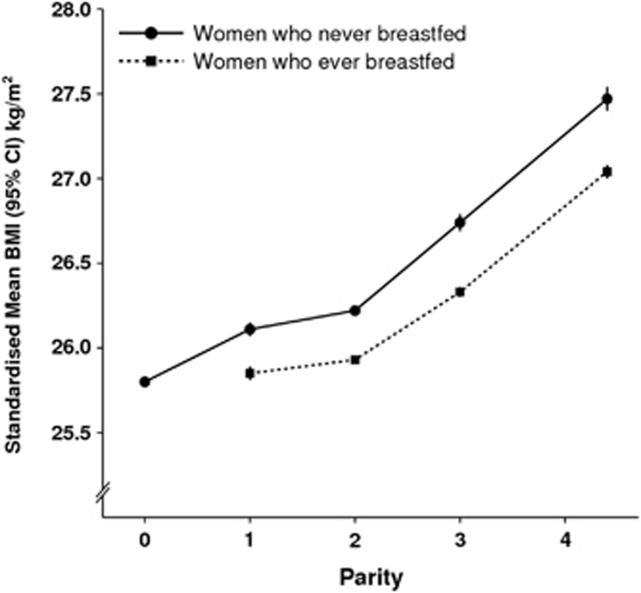
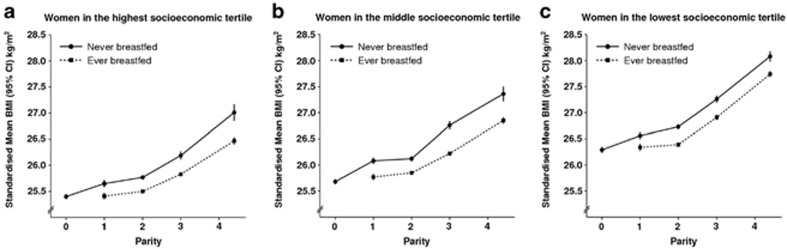
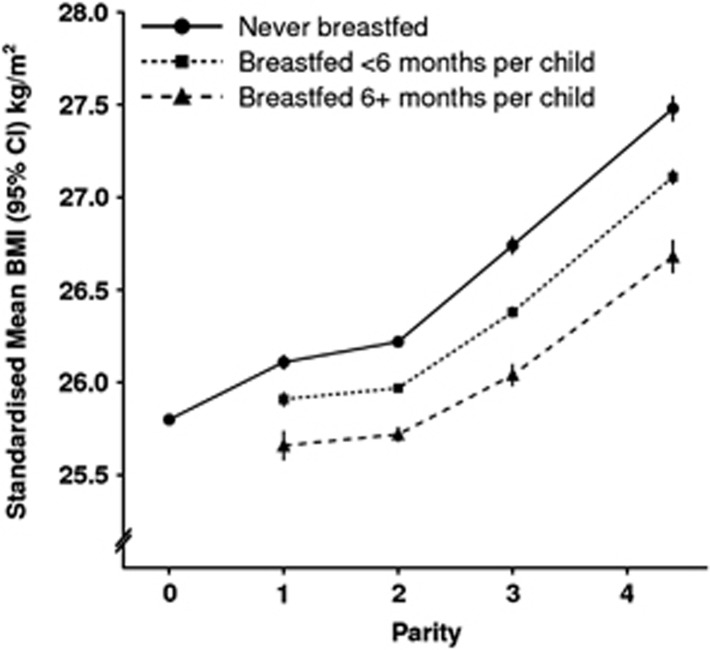
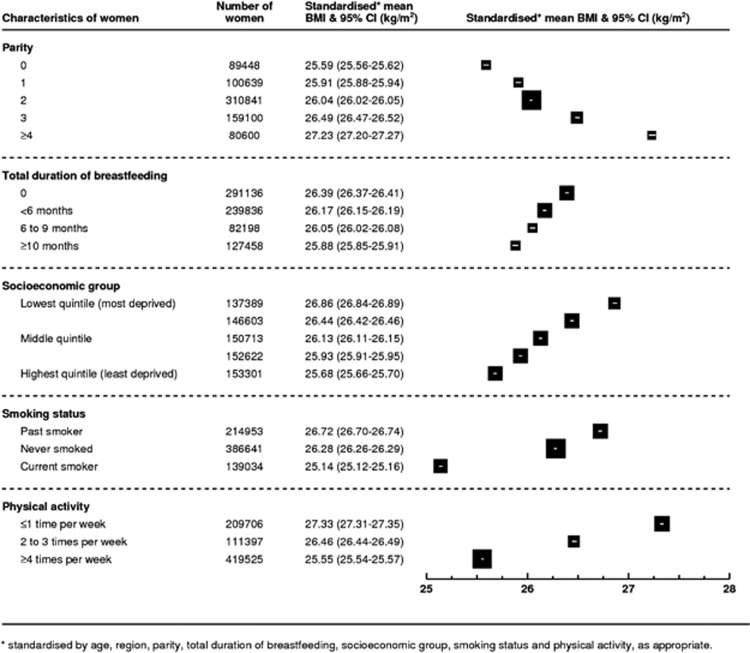
Results: Women were aged 57.5 (s.d. 4) years on average, and had a mean BMI of 26.2 kg m(-2) (s.d. 5); 88% were parous, with 2.1 (s.d. 1.2) children on average. The standardised mean BMI increased progressively with the number of births from 25.6 kg m(-2) (95% confidence interval (CI): 25.5-25.6) in nulliparous women up to 27.2 kg m(-2) (CI: 27.2-27.3) for women with four or more births, a difference of 1.7 kg m(-2) (CI: 1.6-1.7). Among the parous women 70% had ever breastfed and their average total duration of breastfeeding was 7.7 (s.d. 8.8) months. At every parity level the standardised mean BMI was significantly lower among women who had breastfed than those who had not, decreasing by 0.22 kg m(-2) (CI: 0.21-0.22) for every 6 months of breastfeeding, that is, women's mean BMI was 1% lower for every 6 months that they had breastfed. These associations were highly statistically significant (P<0.0001) and independent of the effects of socioeconomic group, region of residence, smoking and physical activity.
Conclusions: Childbearing patterns have a persistent effect on adiposity in this population. The reduction in BMI associated with just 6 months breastfeeding in UK women could importantly reduce their risk of obesity-related disease as they age.
Figures