Regression trees for predicting mortality in patients with cardiovascular disease: what improvement is achieved by using ensemble-based methods?
- PMID: 22777999
- PMCID: PMC3470596
- DOI: 10.1002/bimj.201100251
Regression trees for predicting mortality in patients with cardiovascular disease: what improvement is achieved by using ensemble-based methods?
Abstract
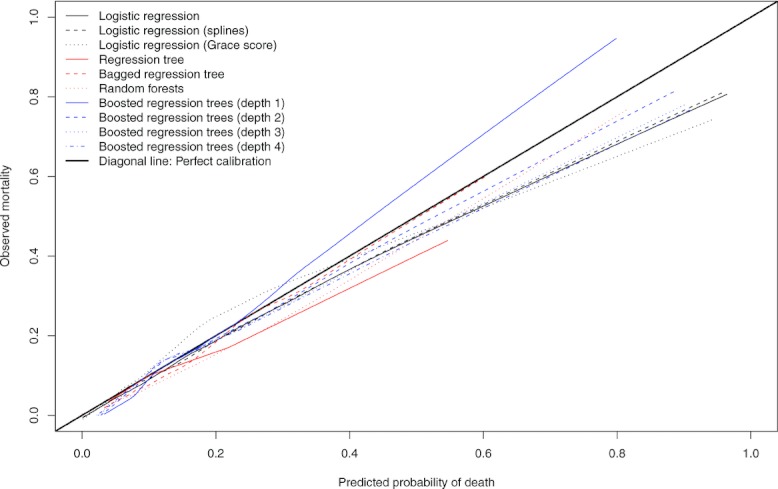
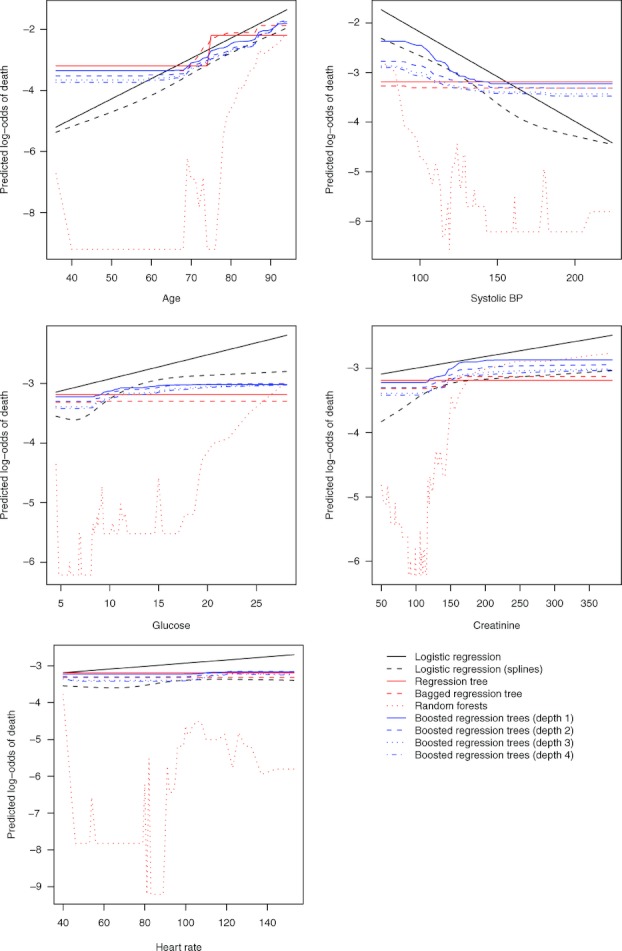
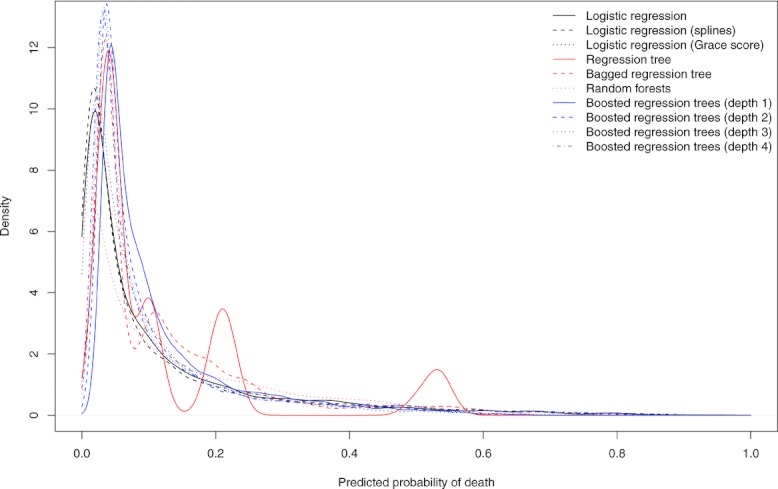
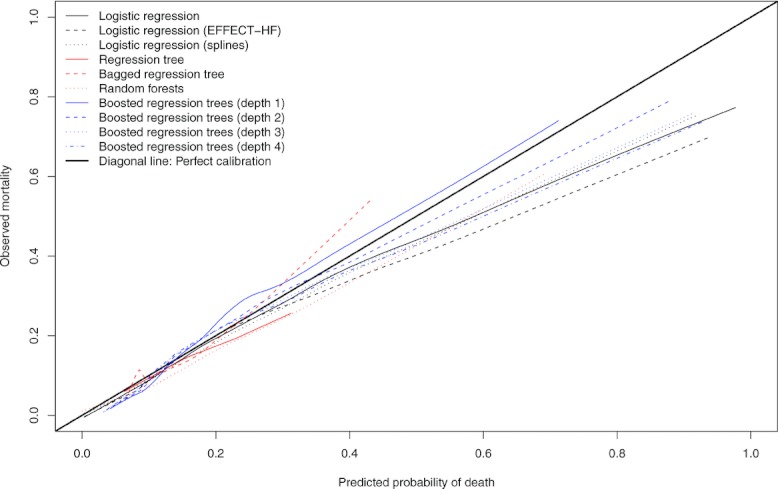
In biomedical research, the logistic regression model is the most commonly used method for predicting the probability of a binary outcome. While many clinical researchers have expressed an enthusiasm for regression trees, this method may have limited accuracy for predicting health outcomes. We aimed to evaluate the improvement that is achieved by using ensemble-based methods, including bootstrap aggregation (bagging) of regression trees, random forests, and boosted regression trees. We analyzed 30-day mortality in two large cohorts of patients hospitalized with either acute myocardial infarction (N = 16,230) or congestive heart failure (N = 15,848) in two distinct eras (1999-2001 and 2004-2005). We found that both the in-sample and out-of-sample prediction of ensemble methods offered substantial improvement in predicting cardiovascular mortality compared to conventional regression trees. However, conventional logistic regression models that incorporated restricted cubic smoothing splines had even better performance. We conclude that ensemble methods from the data mining and machine learning literature increase the predictive performance of regression trees, but may not lead to clear advantages over conventional logistic regression models for predicting short-term mortality in population-based samples of subjects with cardiovascular disease.
© 2012 WILEY-VCH Verlag GmbH & Co. KGaA, Weinheim.
Figures
References
-
- Austin PC. A comparison of regression trees, logistic regression, generalized additive models, and multivariate adaptive regression splines for predicting AMI mortality. Statistics in Medicine. 2007;26:2937–2957. - PubMed
-
- Breiman L. Random forests. Machine Learning. 2001;45:5–32.
-
- Breiman L, Freidman JH, Olshen RA, Stone CJ. Classification and Regression Trees. Boca Raton: Chapman & Hall/CRC; 1998.
-
- Buhlmann P, Hathorn T. Boosting algorithms: Regularization, prediction and model fitting. Statistical Science. 2007;22:477–505.
-
- Clark LA, Pregibon D. Tree-based methods. In: Chambers JM, Hastie TJ, editors. Statistical Models in S. New York, NY: Chapman & Hall; 1993.
Publication types
MeSH terms
Grants and funding
LinkOut - more resources
Full Text Sources
Other Literature Sources