. 2012 Jul 30;209(8):1401-8.
doi: 10.1084/jem.20120845. Epub 2012 Jul 9.

Thymocytes may persist and differentiate without any input from bone marrow progenitors

Affiliations

Thymocytes may persist and differentiate without any input from bone marrow progenitors

Laetitia Peaudecerf et al. J Exp Med. .

Abstract

Thymus transplants can correct deficiencies of the thymus epithelium caused by the complete DiGeorge syndrome or FOXN1 mutations. However, thymus transplants were never used to correct T cell-intrinsic deficiencies because it is generally believed that thymocytes have short intrinsic lifespans. This notion is based on thymus transplantation experiments where it was shown that thymus-resident cells were rapidly replaced by progenitors originating in the bone marrow. In contrast, here we show that neonatal thymi transplanted into interleukin 7 receptor-deficient hosts harbor populations with extensive capacity to self-renew, and maintain continuous thymocyte generation and export. These thymus transplants reconstitute the full diversity of peripheral T cell repertoires one month after surgery, which is the earliest time point studied. Moreover, transplantation experiments performed across major histocompatibility barriers show that allogeneic transplanted thymi are not rejected, and allogeneic cells do not induce graft-versus-host disease; transplants induced partial or total protection to infection. These results challenge the current dogma that thymocytes cannot self-renew, and indicate a potential use of neonatal thymus transplants to correct T cell-intrinsic deficiencies. Finally, as found with mature T cells, they show that thymocyte survival is determined by the competition between incoming progenitors and resident cells.


Figures
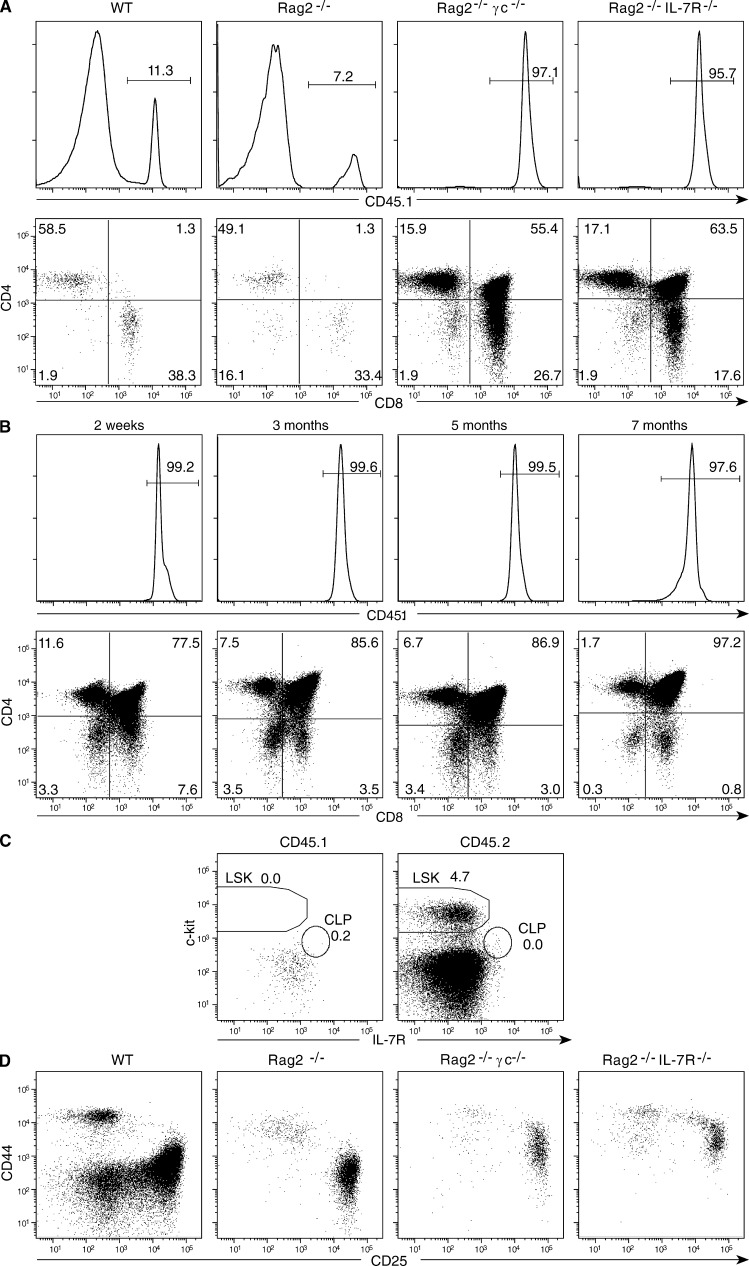
Figure 1.
Figure 1.
CD45.2+ B6 mice were transplanted with a single thymus lobe from 1-d-old CD45.1+ B6 mice. (A and B). Frequencies (histograms) and CD4/CD8β phenotypes (dot plots) of CD45.1+ donor thymocytes persisting in the thymus graft. (A). Hosts were WT, Rag2, Rag2γc, or Rag2 IL-7R–deficient, studied 1 mo after transplantation. (B) Hosts were Rag2γc-deficient, studied at different time points after transplantation. Similar results were obtained when hosts were Rag2 IL-7R–deficient. Results are from 1 experiment representative of 8 WT, 12 RagIL-7R–deficient, and 45 Rag2γc-deficient grafted mice, studied from 2 wk to 7 mo after grafting. (C) Stem cell precursors in the BM of host Rag2γc transplanted mice, 3 mo after grafting. Results show Ter119GR1Mac1 cells of graft (CD45.1+) and the host (CD45.2+), and are representative of 5 individual mice studied in two experiments. (D) Repopulation of the transplanted thymi in different host mice. The CD44/CD25 phenotypes of CD45.2+ TN thymocytes derived from the host BM, 1 mo after grafting. They are representative of three experiments.
Figure 2.
Figure 2.
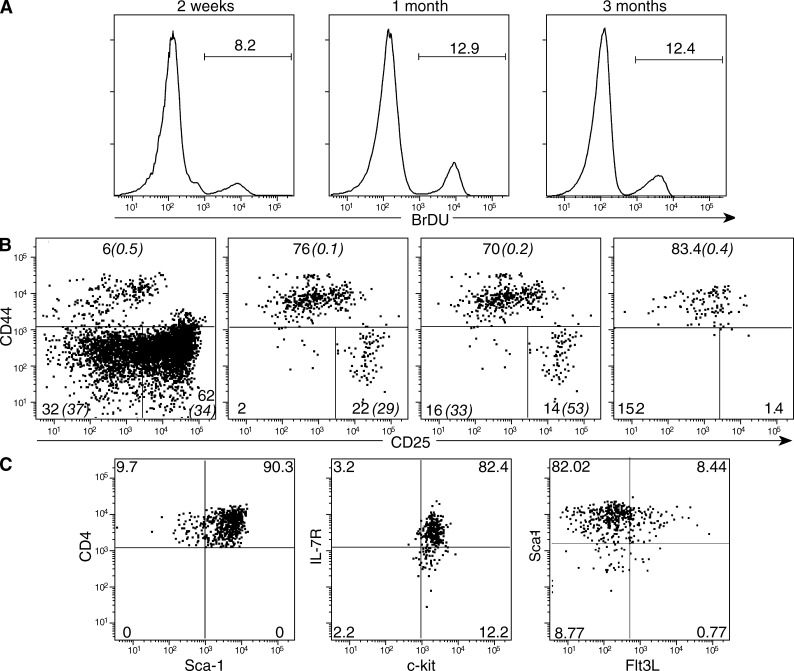
The phenotype and division rates of the grafts’ thymocytes. Grafts were performed as in Fig. 1 B. At different time points, mice were injected with BrdU 1 h before sacrifice. (A) BrdU incorporation in DP cells in 1 out of 8 experiments with similar results. (B) The phenotype of CD45.1+ TN donor thymocytes at different time points after grafting. The percentage of cells incorporating BrdU in is italicized and in brackets. Results are from one out of 15 equivalent experiments (C) The phenotype of CD45.1+ TN1–TN2 thymocytes. Results are from one of five identical experiments.
Figure 3.
Figure 3.
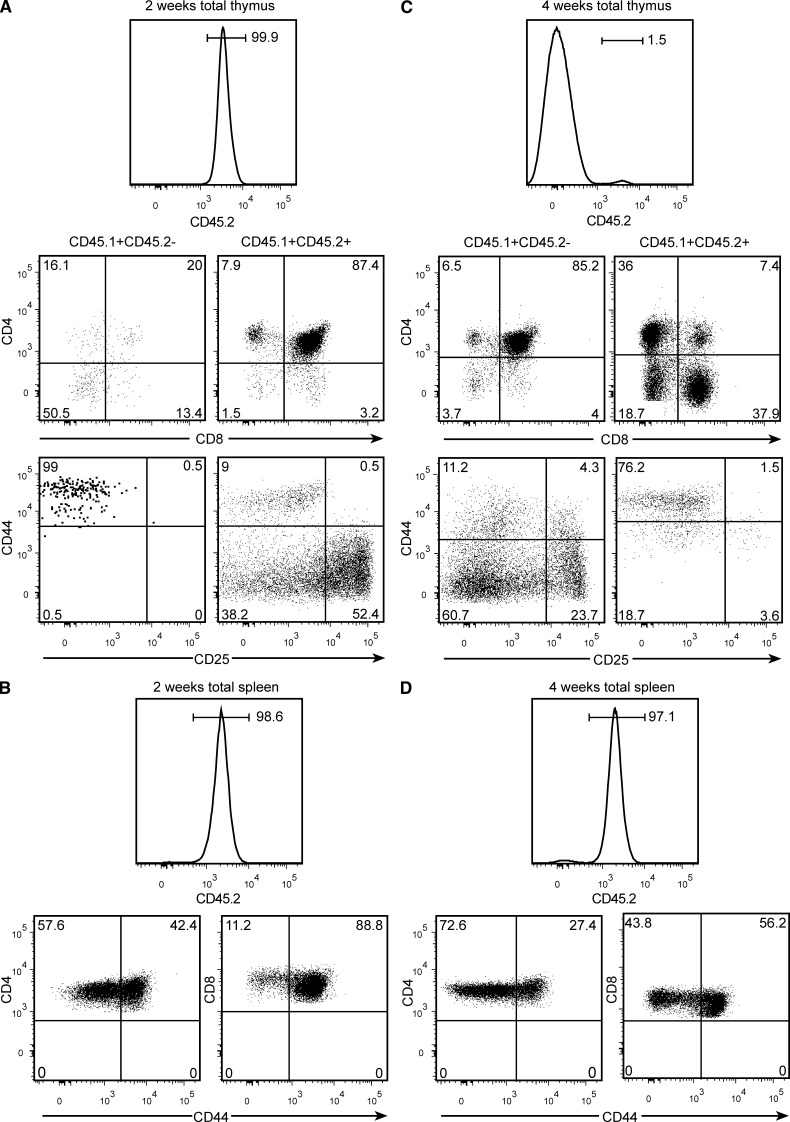
The kinetics of peripheral reconstitution after BM or thymus grafts. CD45.2+ B6 Rag2γc mice were sublethally irradiated (600 rads) and grafted simultaneously with 2 × 10⁴ WT CD45.1+ LSKs, and a single thymus lobe from CD45.2+xCD45.1+ WT B6 neonatal mice and studied for 2 wk (A and B) and 1 mo later (C and D). (A and C) Percentages (histograms) and the phenotypes (dot plots) of thymus graft–derived (right) and BM-derived (left) cells in the grafted thymus. Top dot plots showing the CD4/CD8β profile, and bottom dot plots show TN cells. (B and D) Percentages (histograms) and CD44 expression (dot plots) of CD45.2+ T cells of thymus graft origin in the spleen. Results are from one mouse at each time point representative for the four mice studied.
Figure 4.
Figure 4.
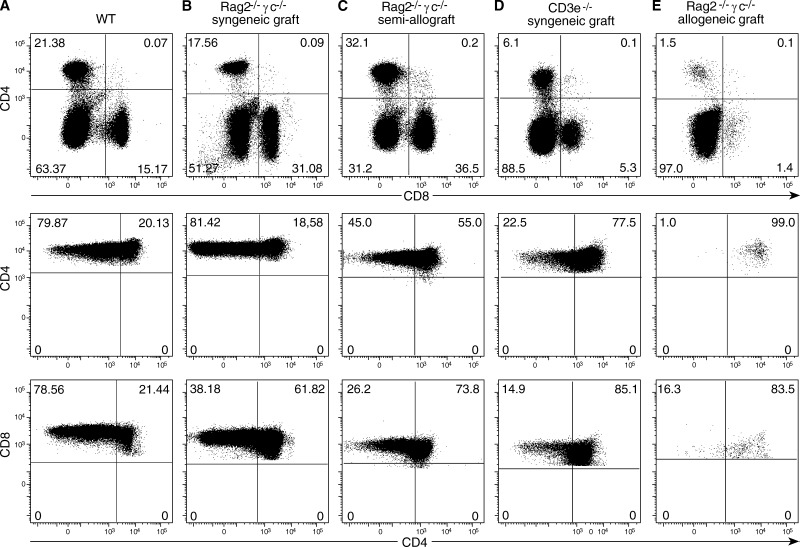
Peripheral reconstitution after thymus transplantation in different conditions. Different host mice were transplanted with neonatal thymi and studied 1 mo later. Top dot plots show the distribution of CD4/CD8 T cells, and bottom dot blots show the ratio of naive and CD44+ activated cells in the spleen, in one out of five equivalent experiments.
Figure 5.
Figure 5.
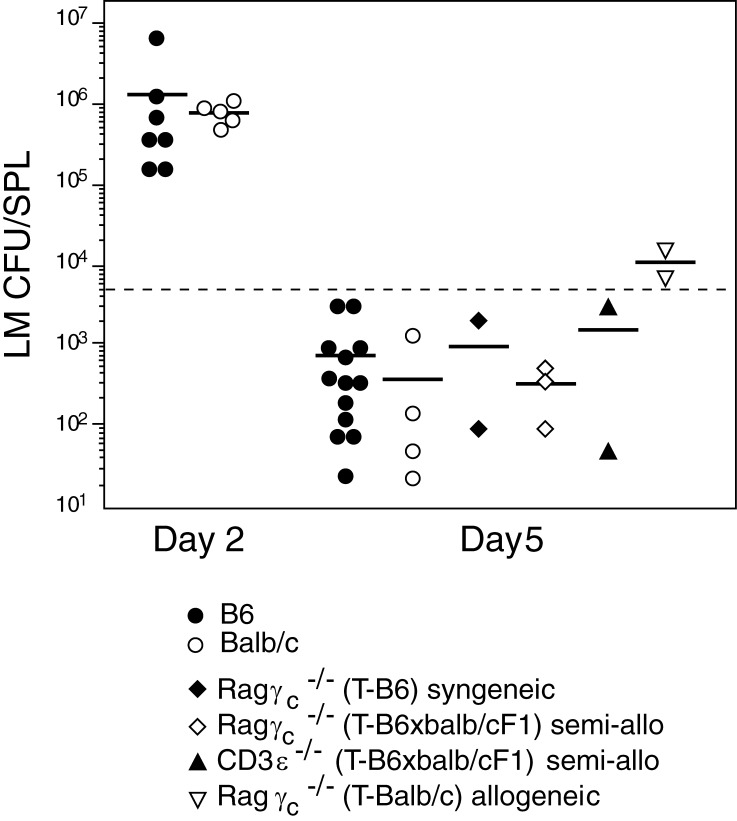
The capacity of thymus transplants to protect from infection. WT B6 and BALB/c controls and the transplanted mice described in Fig. 4 were injected i.v with live LM. The dotted line shows the number of injected LM. Results show bacteria loads evaluated as LM CFU/spleen at day 2 and 5 after infection, each point showing an individual mouse. T denotes the genotype of donor thymus.

References

    1. Almeida A.R., Borghans J.A., Freitas A.A. 2001. T cell homeostasis: thymus regeneration and peripheral T cell restoration in mice with a reduced fraction of competent precursors. J. Exp. Med. 194:591–599 10.1084/jem.194.5.591 - DOI - PMC - PubMed
    1. Arnold B., Schüler T., Hämmerling G.J. 2005. Control of peripheral T-lymphocyte tolerance in neonates and adults. Trends Immunol. 26:406–411 10.1016/j.it.2005.06.002 - DOI - PubMed
    1. Berzins S.P., Boyd R.L., Miller J.F. 1998. The role of the thymus and recent thymic migrants in the maintenance of the adult peripheral lymphocyte pool. J. Exp. Med. 187:1839–1848 10.1084/jem.187.11.1839 - DOI - PMC - PubMed
    1. Billingham R.E., Brent L., Medawar P.B. 1953. Actively acquired tolerance of foreign cells. Nature. 172:603–606 10.1038/172603a0 - DOI - PubMed
    1. Cavazzana-Calvo M., André-Schmutz I., Dal Cortivo L., Neven B., Hacein-Bey-Abina S., Fischer A. 2009. Immune reconstitution after haematopoietic stem cell transplantation: obstacles and anticipated progress. Curr. Opin. Immunol. 21:544–548 10.1016/j.coi.2009.08.001 - DOI - PubMed

Publication types

MeSH terms

Substances