. 2012 Aug 14;109(33):13434-9.
doi: 10.1073/pnas.1116633109. Epub 2012 Jul 9.

Sialin (SLC17A5) functions as a nitrate transporter in the plasma membrane

Affiliations

Sialin (SLC17A5) functions as a nitrate transporter in the plasma membrane

Lizheng Qin et al. Proc Natl Acad Sci U S A. .

Abstract

In vivo recycling of nitrate (NO(3)(-)) and nitrite (NO(2)(-)) is an important alternative pathway for the generation of nitric oxide (NO) and maintenance of systemic nitrate-nitrite-NO balance. More than 25% of the circulating NO(3)(-) is actively removed and secreted by salivary glands. Oral commensal bacteria convert salivary NO(3)(-) to NO(2)(-), which enters circulation and leads to NO generation. The transporters for NO(3)(-) in salivary glands have not yet been identified. Here we report that sialin (SLC17A5), mutations in which cause Salla disease and infantile sialic acid storage disorder (ISSD), functions as an electrogenic 2NO(3)(-)/H(+) cotransporter in the plasma membrane of salivary gland acinar cells. We have identified an extracellular pH-dependent anion current that is carried by NO(3)(-) or sialic acid (SA), but not by Br(-), and is accompanied by intracellular acidification. Both responses were reduced by knockdown of sialin expression and increased by the plasma membrane-targeted sialin mutant (L22A-L23A). Fibroblasts from patients with ISSD displayed reduced SA- and NO(3)(-)-induced currents compared with healthy controls. Furthermore, expression of disease-associated sialin mutants in fibroblasts and salivary gland cells suppressed the H(+)-dependent NO(3)(-) conductance. Importantly, adenovirus-dependent expression of the sialinH183R mutant in vivo in pig salivary glands decreased NO(3)(-) secretion in saliva after intake of a NO(3)(-)-rich diet. Taken together, these data demonstrate that sialin mediates nitrate influx into salivary gland and other cell types. We suggest that the 2NO(3)(-)/H(+) transport function of sialin in salivary glands can contribute significantly to clearance of serum nitrate, as well as nitrate recycling and physiological nitrite-NO homeostasis.


Conflict of interest statement

The authors declare no conflict of interest.

Figures
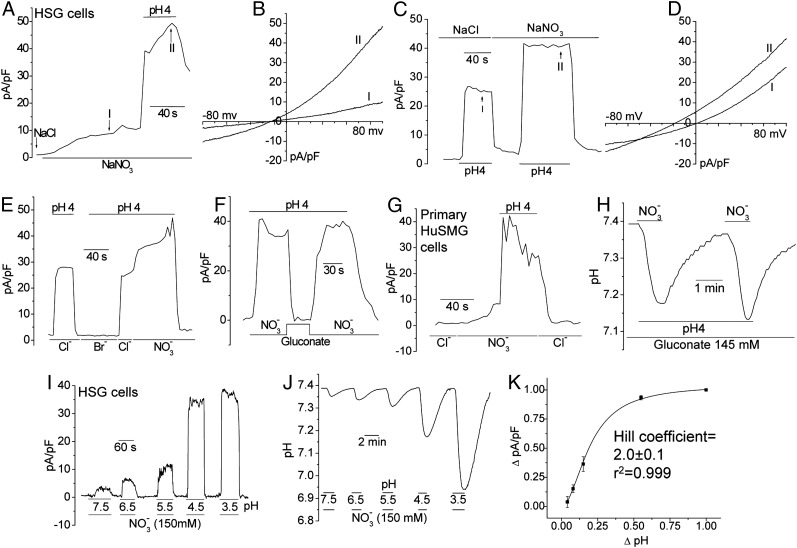
Fig. 1.
Fig. 1.
Coupled NO3 currents and intracellular acidification in HSG cells. NO3 currents in HSG cells (A–F) and primary huSMG cells (G) measured by the whole-cell patch-clamp technique. NaCl was replaced with NaNO3, NaBr, or Na-gluconate as indicated. Changes in extracellular pH are shown in the traces (bar). I-V curves are shown in B and D. (H) External pH and NO3 (5 mM)-dependent acidification of HSG cells measured using BCECF fluorescence. (I) pH dependence of NO3 currents in HSG cells. (J) Intracellular pH changes under the same experimental conditions as shown in I. (K) Data from I and J were used to determined the relationship of NO3 currents and intracellular acidification (Hill coefficient: 2.0 ± 0.1).
Fig. 2.
Fig. 2.
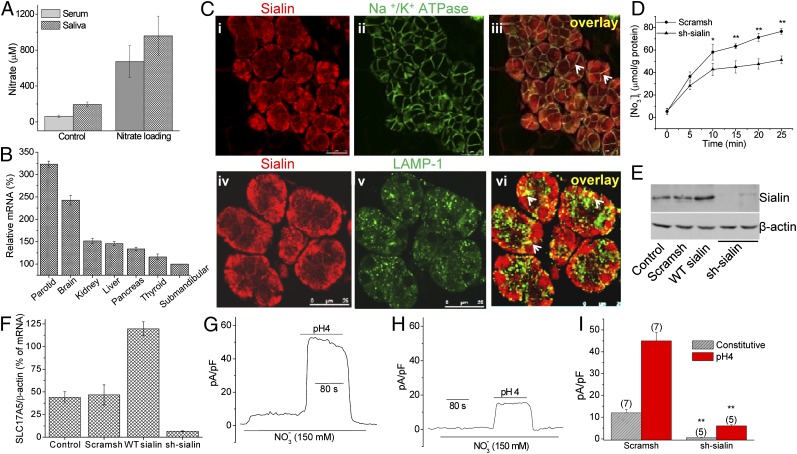
Involvement of sialin in 2NO3/H+ cotransport. (A) Saliva and serum [NO3] in miniature pigs fed on regular fodder or supplemented with 100 mg/kg of nitrate. (B) Validation of gene expression of SLC17A5 based on the MFS gene expression pattern (Table S1). (C) Detection of sialin (i and iv) in human salivary gland. Na/K-ATPase (ii) or LAMP-1 (v) are markers for basolateral membrane and lysosomes, respectively. Colocalization of the two proteins is shown (iii and vi, yellow, indicated by arrows). (D) Nitrate uptake in HSG cells transfected with sh-sialin or scram-sh. The values indicated by * or ** are significantly different from the unmarked values. (P < 0.05 or P < 0.01; n ≥ 3). (E and F) Knockdown of sialin by sh-sialin and overexpression of WT-sialin. (G and H) Effect of sialin knockdown on constitutive and low-pH–induced NO3 current. Levels of current and intracellular pH in control HSG cells transfected with scram-sh (G) or sh-sialin (H) were as described in Fig. 1. (I) Average data obtained from the experiments shown in G and H. The number of cells tested is indicated. Statistically significant differences are indicated by ** (P < 0.01).
Fig. 3.
Fig. 3.
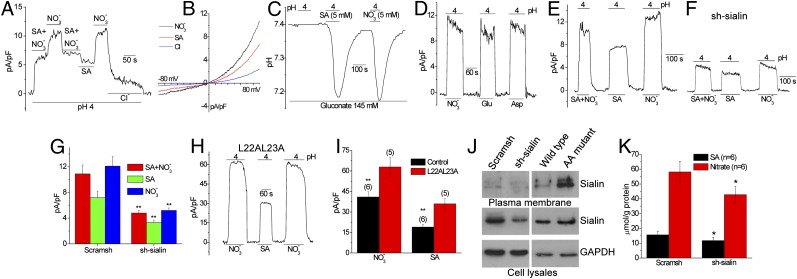
Sialin mediates NO3/H+ as well as SA/H+ cotransporter in HSG cells. (A) Current measurement in cells perfused with medium at pH 4.0 containing 5 mM SA, NO3, or both. (B) I-V curves of the current (Erev= 0 mV for 5 mM SA or NO3) obtained under the different conditions shown in A. (C) Intracellular pH in medium of pH 4.0 containing either SA or NO3. (D) Currents generated by substituting NO3 with glutamate (Glu) or aspartate (Asp), with other anions transported by sialin. (E and F) SA and NO3 currents induced at pH 4.0 in control HSG cells (E) and cells treated with sh-sialin (F). The y-axis scale is the same in E and F. (G) Average of data from the experiments shown in E and F. (H) Effect of expression of plasma membrane-targeted mutant of sialin L22A-L23A on NO3 and SA currents. (I) Average data and statistical evaluation for H. (J) Surface expression of sialin in WT cells and in cells transfected with scram-sh, sh-sialin, or L22A-L23A mutant (AA). (K) NO3 and SA uptake measured at 10 min after loading in HSG cells transfected with sh-sialin or scram-sh. *Values significantly different from the unmarked values (P < 0.05; n = 6).
Fig. 4.
Fig. 4.
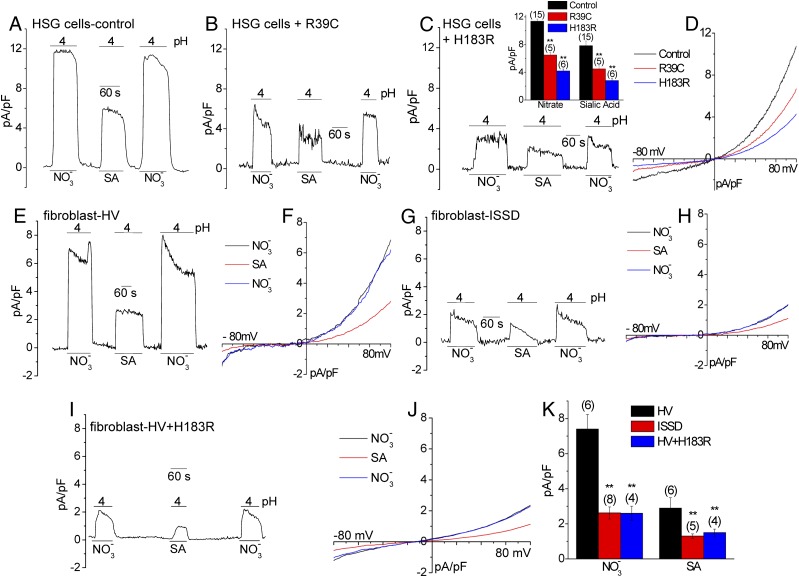
Assessment of sialin-mediated NO3 transport in fibroblasts from patients with ISSD, showing the effect of the Salla disease and ISSD sialin mutations on anion transport. (A–D) NO3 and SA (5 mM each) currents in HSG cells transfected with sialinR39C (B) or sialinH183R (C). (C, Insert) Average data and statistical evaluation. (D) I-V curve of the NO3 current shown in A and B. (E–H) Sialin-mediated current (150 mM SA or NO3) in fibroblasts from healthy volunteers (HV) (E and F) and patients with ISSD (G and H). (I and J) Effect of sialinH183R expression on anion transport in fibroblasts from patients with ISSD. (K) Average data from the experiments with cells from patients.
Fig. 5.
Fig. 5.
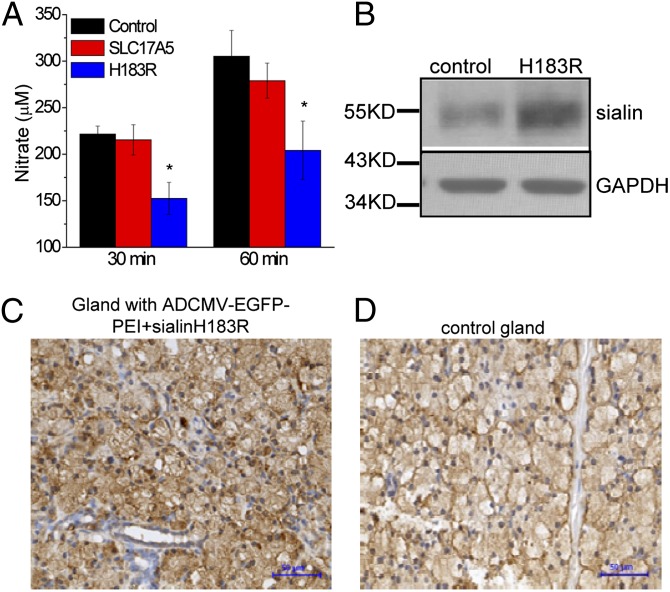
Effect of in vivo suppression of sialin function in salivary glands on salivary nitrate secretion. (A) Salivary nitrate concentrations at 30 min and 60 min after feeding a nitrate-rich diet to miniature pigs after in vivo delivery of plasmids encoding WT-sialin or sialinH183R (Methods). *Values significantly different from the control values (P < 0.05). (B) Sialin expression in control parotid glands and glands receiving the plasmid-PEI-Ad complex as determined by Western blot analysis. (C and D) Detection of sialin in salivary glands at 3 d after transduction with AdCMV-EGFP-PEI plus sialinH183R vector (C) or in control parotid gland (D). (Scale bar: 50 μM.)

Comment in

References

    1. Lundberg JO, Weitzberg E, Gladwin MT. The nitrate-nitrite-nitric oxide pathway in physiology and therapeutics. Nat Rev Drug Discov. 2008;7:156–167. - PubMed
    1. Jansson EA, et al. A mammalian functional nitrate reductase that regulates nitrite and nitric oxide homeostasis. Nat Chem Biol. 2008;4:411–417. - PubMed
    1. Djekoun-Bensoltane S, Kammerer M, Larhantec M, Pilet N, Thorin C. Nitrate and nitrite concentrations in rabbit saliva: Comparison with rat saliva. Environ Toxicol Pharmacol. 2007;23:132–134. - PubMed
    1. Pannala AS, et al. The effect of dietary nitrate on salivary, plasma, and urinary nitrate metabolism in humans. Free Radic Biol Med. 2003;34:576–584. - PubMed
    1. Xia DS, Deng DJ, Wang SL. Destruction of parotid glands affects nitrate and nitrite metabolism. J Dent Res. 2003;82:101–105. - PubMed

Publication types

MeSH terms

LinkOut - more resources