


Macrophages in tumor microenvironments and the progression of tumors
- PMID: 22778768
- PMCID: PMC3385963
- DOI: 10.1155/2012/948098
Macrophages in tumor microenvironments and the progression of tumors
Abstract
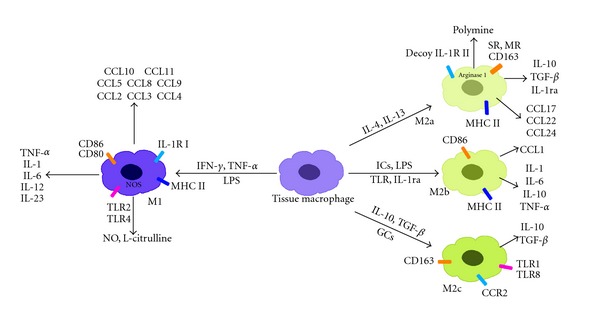
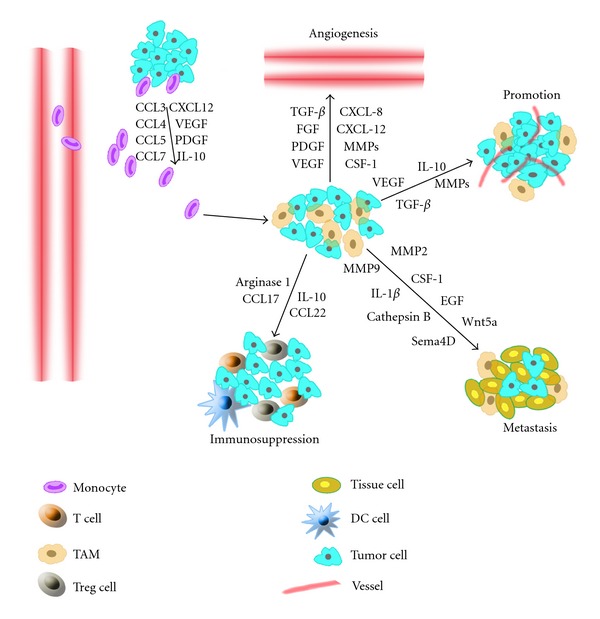
Macrophages are widely distributed innate immune cells that play indispensable roles in the innate and adaptive immune response to pathogens and in-tissue homeostasis. Macrophages can be activated by a variety of stimuli and polarized to functionally different phenotypes. Two distinct subsets of macrophages have been proposed, including classically activated (M1) and alternatively activated (M2) macrophages. M1 macrophages express a series of proinflammatory cytokines, chemokines, and effector molecules, such as IL-12, IL-23, TNF-α, iNOS and MHCI/II. In contrast, M2 macrophages express a wide array of anti-inflammatory molecules, such as IL-10, TGF-β, and arginase1. In most tumors, the infiltrated macrophages are considered to be of the M2 phenotype, which provides an immunosuppressive microenvironment for tumor growth. Furthermore, tumor-associated macrophages secrete many cytokines, chemokines, and proteases, which promote tumor angiogenesis, growth, metastasis, and immunosuppression. Recently, it was also found that tumor-associated macrophages interact with cancer stem cells. This interaction leads to tumorigenesis, metastasis, and drug resistance. So mediating macrophage to resist tumors is considered to be potential therapy.
Figures
References
-
- Nathan C. Metchnikoff’s legacy in 2008. Nature Immunology. 2008;9(7):695–698. - PubMed
-
- Gordon S, Taylor PR. Monocyte and macrophage heterogeneity. Nature Reviews Immunology. 2005;5(12):953–964. - PubMed
-
- Lawrence T, Natoli G. Transcriptional regulation of macrophage polarization: enabling diversity with identity. Nature Reviews Immunology. 2011;11(11):750–761. - PubMed
Publication types
MeSH terms
LinkOut - more resources
Full Text Sources
Other Literature Sources
