. 2012 Sep;85(6):1194-203.
doi: 10.1111/j.1365-2958.2012.08168.x. Epub 2012 Aug 1.

Capreomycin susceptibility is increased by TlyA-directed 2'-O-methylation on both ribosomal subunits

Affiliations

Capreomycin susceptibility is increased by TlyA-directed 2'-O-methylation on both ribosomal subunits

Tanakarn Monshupanee et al. Mol Microbiol. 2012 Sep.

Abstract

The binding site of the cyclic peptide antibiotics capreomycin and viomycin is located on the ribosomal subunit interface close to nucleotides C1409 in 16S rRNA and C1920 in 23S rRNA. In Mycobacterium tuberculosis, the 2'-hydroxyls of both nucleotides are methylated by the enzyme TlyA. Loss of these methylations through inactivation of TlyA confers resistance to capreomycin and viomycin. We report here that TlyA orthologues occur in diverse bacteria and fall into two distinct groups. One group, now termed TlyA(I) , has shorter N- and C-termini and methylates only C1920; the second group (now TlyA(II) ) includes the mycobacterial enzyme, and these longer orthologues methylate at both C1409 and C1920. Ribosomal subunits are the preferred substrates for both groups of orthologues. Amino acid substitutions at the N-terminus of TlyA(II) reduce its ability to methylate these substrates. Growing pairs of recombinant TlyA(II) Escherichia coli strains in competition shows that even subtle changes in the level of rRNA methylation lead to significant differences in susceptibility to sub-inhibitory concentrations of capreomycin. The findings reveal that 2'-O-methyls at both C1409 and C1920 play a role in facilitating the inhibitory effects of capreomycin and viomycin on the bacterial ribosome.


Figures

Fig. 1
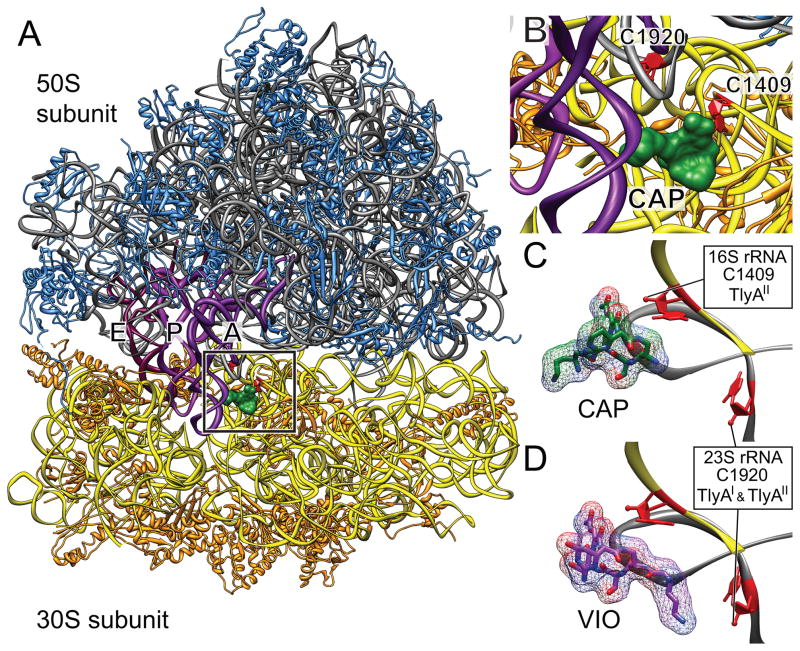
Fig. 1. Capreomycin and viomycin binding site on 70S ribosomes showing nucleotides C1409 and C1920 and methylation by TlyA orthologs
A. Ribosome with capreomycin (green) bound showing interbridge B2a formed between 16S rRNA helix 44 and 23S rRNA helix 69 (boxed). The sites of methylation at nucleotides C1409 and C1920 are highlighted (red) within the box. This region is shown relative to the positions of the A-, P- and E-site tRNAs (purple); backbones of 16S rRNA (yellow), 30S r-proteins (orange), 23S rRNA (grey) and 50S r-proteins (blue) are shown. The ribosome is shown in the classical state (Stanley et al., 2010; Dunkle et al., 2011). B. Enlargement of the boxed region. C. Ribose targets for TlyAI and TlyAII methylation (red) relative to the binding site of capreomycin (drug carbons, green; oxygens, red; nitrogens, blue). In the classical state T. thermophilus (Stanley et al., 2010) and E. coli (Dunkle et al., 2011) ribosome structures, the distance between the 2′-O positions of C1409 and C1920 is approximately 21 Å, and this distance remains virtually unchanged in the intermediate translocation (hybrid)-state of the ribosome (Dunkle et al., 2011). D. Same view with viomycin bound. Drug binding structures redrawn from the X-ray crystal PDB files 3KNH through 3KNO (Stanley et al., 2010).
Fig. 2
Fig. 2
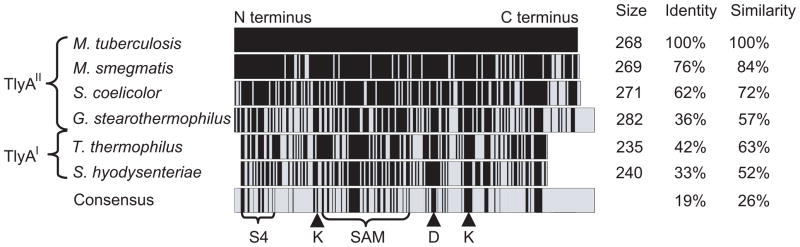
Comparison of TlyA sequences. The sequence of TlyA from M. tuberculosis H37Rv (NCBI accession number: CAB10951) is compared with orthologs from M. smegmatis MC2 155 (NCBI number YP_888048.1), S. coelicolor A3 (NC_003888), G. stearothermophilus (AB126617), T. thermophilus HB8 (AP008226) and S. hyodysenteriae (X61684). The total numbers of residues in the enzymes together with the percentages that are identical and functionally-similar to the M. tuberculosis sequence are listed on the right; these conserved regions are shown as black bars within the sequences. Based on their lengths, the sequences fall into the two distinct groups TlyAI and TlyAII. A consensus from these orthologs is shown highlighting the conserved S4-type RNA binding motif (S4), the S-adenosylmethionine (SAM) binding domain and three motifs indicative of 2′-O-methyltransferases (K, D and K) (Aravind and Koonin, 1999, Feder et al., 2003, Maus et al., 2005b).
Fig. 3
Fig. 3
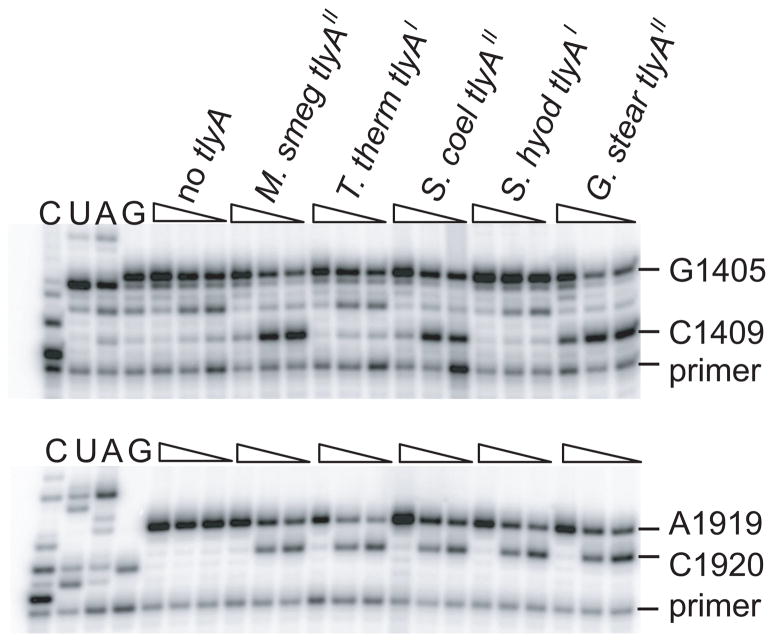
Gel autoradiograms of primer extensions showing 2′-O-methylations on E. coli rRNAs by recombinant TlyA orthologs. rRNAs were isolated from E. coli strains that contained the empty plasmid, pLJ102 (no tlyA), or a plasmid expressing recombinant tlyA from M. smegmatis (M. smeg), T. thermophilus (T. therm), S. coelicolor (S. coel), S. hyodysenteriae (S. hyod) and G. stearothermo-philus (G. stear). Decreasing dGTP concentration (wedges) intensifies reverse transcription termination at 2′-O-methylated C1409 in 16S rRNA (upper panel) and C1920 in 23S rRNA (lower panel). Run-through transcription terminated at G1405 and A1919 upon incorporation of ddCTP and ddTTP, respectively. Lanes C, U, A and G are dideoxy-sequencing reactions on unmodified E. coli rRNAs. Two additional, independent repetitions of the experiment yielded identical results.
Fig. 4
Fig. 4
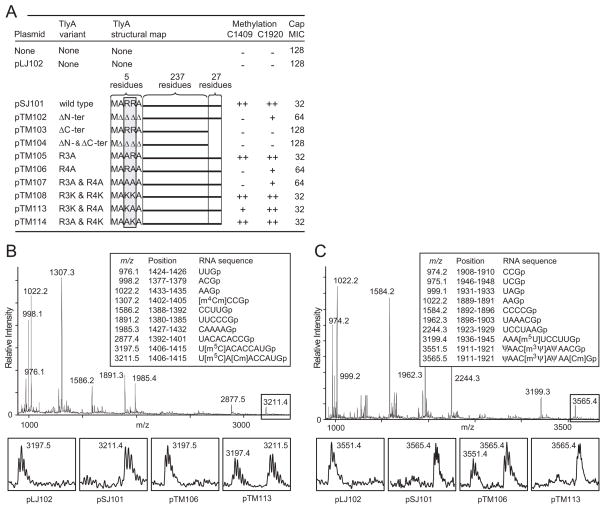
Methylation of rRNA by TlyA mutant enzymes in vivo. A. Mutationsinthe N- and C-terminals of M. smegmatis TlyAII that affect the enzyme’s ability to methylate E. coli 16S and 23S rRNAs in vivo at nucleotides C1409 and C1920 (++, full; + partial; −, no methylation). Methylation levels were measured by both MALDI-MS and primer extension. Altered susceptibility of E. coli to capreomycin (Cap) is shown as MICs (μg ml−1); measurements in triplicate with identical results.Δ, deleted amino acid residue. B. MALDI-MS analyses of 16S rRNA nucleotides 1377–1435 after RNase T1 digestion; rRNA from cells expressing wild-type TlyAII from pSJ101; boxes show the enlarged spectral region with nucleotide C1409 expressed from cells with different TlyA variants. C. Corresponding MALDI-TOF MS analyses of 23S rRNA nucleotides 1889–1948 showing the enlarged peaks containing C1920. The measured m/z values (above the peaks) match the theoretical values (boxed) to within 0.1 Dalton.
Fig. 5
Fig. 5
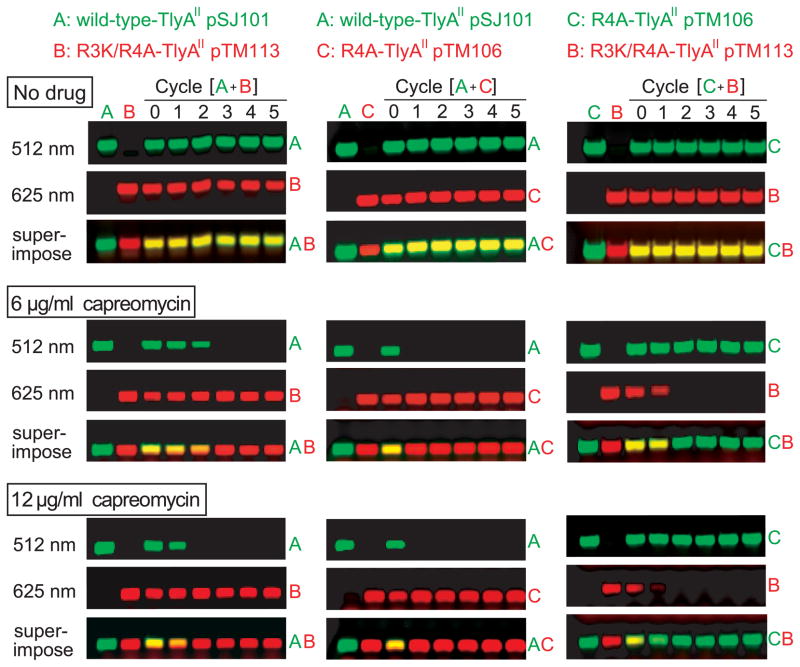
Cell growth competition assay. Pairs of E. coli strains with TlyA variants, differing in the degree of 2′-O-methylation at C1409 and C1920, were grown together through five cycles (with approximately eleven generations per cycle) in the presence of sub-inhibitory concentrations of capreomycin. The proportion of each strain was determined by PCR with fluorescently-labelled primers. Left column: wild-type strain expressing TlyAII from plasmid pSJ101 (A) grown in competition with the R3K/R4A-TlyAII strain (B, pTM113); the upstream PCR primers complementary to these tlyA sequences were respectively labelled with Cy3 (fluorescing green after excitation at 512 nm) and Cy5 (fluorescing red after excitation at 625 nm). Centre column: wild-type TlyAII strain grown in competition with the R4A-TlyAII strain (C, pTM106) and analyzed with Cy3 and Cy5 primers, respectively. Right column: R4A- and R3K/R4A-TlyAII strains grown in competition (note Cy3 is used here for the R4A strain). Upper row, no drugs; middle row, competition in 6 μg capreomycin ml−1; lower row, competition in 12 μg capreomycin ml−1. The superimpositions of the 170 bp PCR products appear yellow when the amounts of strains are approximately equal, and the red or green colour becomes predominant when one strain out-competes the other. Each data set is representative of a minimum of three growth assays.

References

    1. Alfredsson G, Baldursson S, Krjstjansson JK. Nutritional diversity among Thermus spp. isolated from Icelandic hot spring. Syst Appl Microbiol. 1985;6:308–311.
    1. Almeida Da Silva PE, Palomino JC. Molecular basis and mechanisms of drug resistance in Mycobacterium tuberculosis: classical and new drugs. J Antimicrob Chemother. 2011;66:1417–1430. - PubMed
    1. Andersen TE, Porse BT, Kirpekar F. A novel partial modification at C2501 in Escherichia coli 23S ribosomal RNA. RNA. 2004;10:907–913. - PMC - PubMed
    1. Aravind L, Koonin EV. Novel predicted RNA-binding domains associated with the translation machinery. J Mol Evol. 1999;48:291–302. - PubMed
    1. Arenas NE, Salazar LM, Soto CY, Vizcaino C, Patarroyo ME, Patarroyo MA, Gomez A. Molecular modeling and in silico characterization of Mycobacterium tuberculosis TlyA: possible misannotation of this tubercle bacilli-hemolysin. BMC Struct Biol. 2011;11:16. - PMC - PubMed

Publication types

MeSH terms